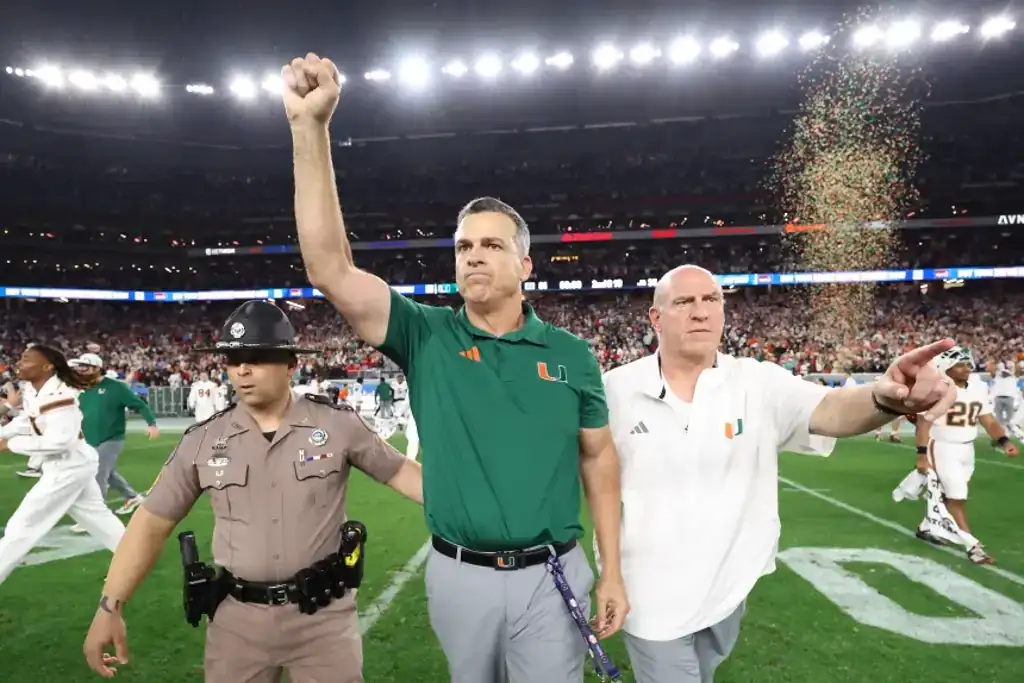
Miami Gardens, Florida — On Monday night, Mario Cristobal will lead the University of Miami onto the field at Hard Rock Stadium with a national championship at stake. For Cristobal, the moment is not simply the culmination of a football season, but the closing of a family circle that began decades earlier in rural Cuba and wound its way through exile, hard labor and quiet persistence in South Florida.
Cristobal is a second-generation Cuban American, the son and grandson of men who fled Fidel Castro’s revolution after imprisonment under the new regime. Their experiences shaped a household built on discipline, work and restraint — values that now underpin a coaching career that has brought Miami back to college football’s biggest stage.
His journey, like Miami’s resurgence, has been gradual and unspectacular by design. There were no shortcuts, no sudden turnarounds, only years of rebuilding — first himself, then programs others had written off — until the opportunity to lead his alma mater home arrived.

A family forged by exile
Cristobal’s grandfather, Mario Campos, grew up in the Cuban countryside and worked as a police officer under the Batista government. When Castro took power, Campos was imprisoned, spared execution only because his role was administrative rather than political. Released in 1961, he fled to Florida with no English and little money.
He found work as a dishwasher, taught himself the language and eventually bought a produce truck. With no formal training, Campos pivoted into construction, founding Campos Construction Company in 1970. He built homes well into his 70s, including houses along Southwest 25th Street in Miami where extended family members lived — among them the Cristobals.
Cristobal’s father, Luis Cristobal Sr., endured harsher treatment. One of the youngest officials in the Batista era, he spent two years in Cuban prisons, where he was tortured and twice faced firing squads. After his release, he emigrated to the United States alone, opening a small car battery business while his wife, Clara, worked processing titles at a car dealership. Both worked until late in life, saving steadily for their two sons.
The family’s expectations were clear. Nothing was given. Grades mattered. Respect mattered. Discipline was non-negotiable. Cristobal has often described his father as unyielding but formative — a man who believed preparation and effort were the only safeguards against instability.
Growing up Cuban, American, and uncompromising
Mario Cristobal and his older brother, Lou, grew up steeped in Cuban traditions while being shaped by American opportunity. Their parents maintained cultural ties but refused to return to Cuba, believing the country remained unfree. That tension — pride without nostalgia — would later mirror Mario’s own approach to Miami football.
The brothers followed parallel paths through school and sports, though their personalities differed. Lou pushed boundaries. Mario followed rules. Both learned judo, a sport deeply rooted in Cuban athletic culture, before gravitating toward football.
Mario’s discipline carried him to Christopher Columbus High School and then to the University of Miami in the late 1980s, at the height of the program’s swagger. The Hurricanes were college football’s most polarizing team, known as much for arrests and controversy as for championships. Cristobal, an offensive lineman, stayed largely removed from the spectacle, focusing on academics and graduating with a business degree.
Choosing coaching over certainty
After college, Cristobal played professionally in NFL Europe, then searched for direction. He considered marketing and law enforcement, even passing entrance exams for the U.S. Secret Service. The turning point came when Miami coach Butch Davis offered him a graduate assistant position.
Cristobal accepted, choosing uncertainty over security. The decision launched a long apprenticeship: assistant roles at Miami, Rutgers and back again, countless recruiting trips, and years spent learning the administrative machinery of college football.
His first head coaching opportunity came at Florida International University, a fledgling program burdened by NCAA sanctions, limited resources and academic issues. FIU had no weight room, minimal history and little margin for error. Cristobal embraced the scope of the challenge, handling everything from recruiting to compliance to academic oversight.
He rebuilt the program into a bowl team, only to be dismissed after a losing season. The setback sent him to Alabama, where three seasons under Nick Saban reshaped his approach and restored his credibility. In 2018, Oregon hired him, and Cristobal delivered two Pac-12 titles and a Rose Bowl victory.
The pull of home
Despite success in Eugene, Miami’s call proved decisive. Cristobal returned in 2021 to a program that had struggled for consistency and relevance, finishing ranked just four times in 16 years. The job carried competing mandates: repair the school’s image while restoring its football stature.
Cristobal approached both methodically. He prioritized recruiting, infrastructure and accountability, blending top high school classes with transfer portal additions. Early results were uneven — a 5–7 debut season followed by modest improvement — but the foundation held.
This season, Miami surged to an 11–2 record and a spot in the College Football Playoff. Even then, skepticism lingered, with critics questioning whether the Hurricanes belonged among the nation’s elite. Cristobal dismissed nostalgia-driven expectations, arguing that progress mattered more than recreating the past.
Completing the circle
Cristobal’s parents and grandfather did not live to see this moment. Campos died in 1992. Luis Cristobal passed away in 1996 while Mario was playing overseas. Clara Cristobal died shortly after her son accepted the Miami job, squeezing her sons’ hands from a hospital bed to signal her understanding.
On Monday night, Cristobal will coach for a national championship just miles from the house his grandfather built, leading the program that shaped him. His brother Lou will watch from the stands, carrying the family’s memory forward.
The path has been long, uneven and unspectacular — a steady accumulation rather than a leap. For Cristobal, and for Miami, that may be the point.
This article was rewritten by JournosNews.com based on verified reporting from trusted sources. The content has been independently reviewed, fact-checked, and edited for accuracy, neutrality, tone, and global readability in accordance with Google News and AdSense standards.
All opinions, quotes, or statements from contributors, experts, or sourced organizations do not necessarily reflect the views of JournosNews.com. JournosNews.com maintains full editorial independence from any external funders, sponsors, or organizations.
Stay informed with JournosNews.com — your trusted source for verified global reporting and in-depth analysis. Follow us on Google News, BlueSky, and X for real-time updates.