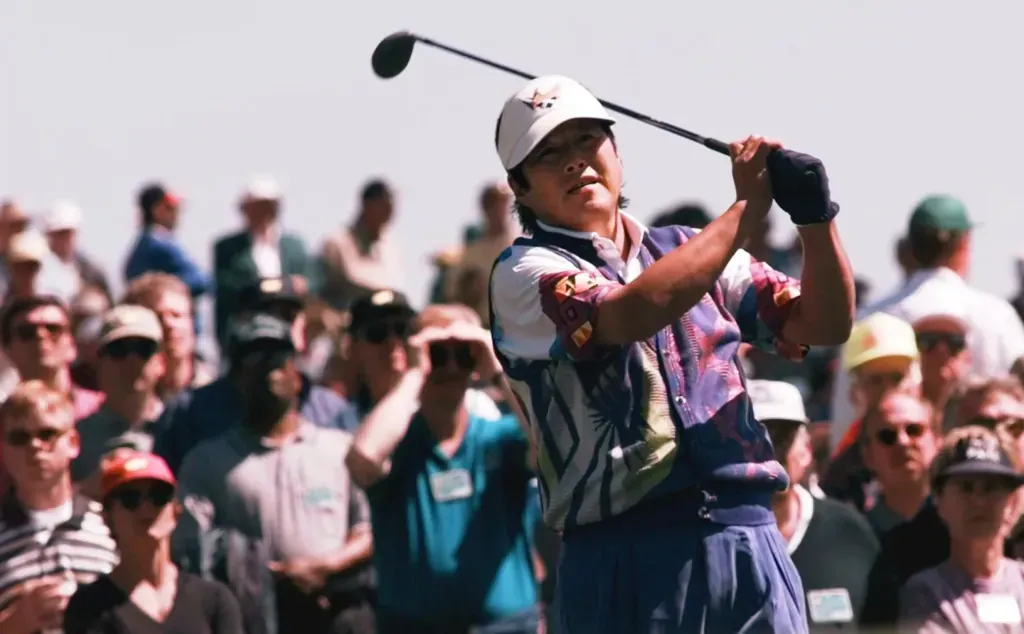
Masashi “Jumbo” Ozaki, the most decorated golfer in Japanese history and a towering figure in the country’s sporting culture, has died after a battle with colon cancer. He was 78, the Japan Golf Tour said on Wednesday.
Ozaki’s career spanned nearly three decades and produced a record number of victories, cementing his status as a pioneer who helped transform golf into a mainstream sport in Japan.
A record-setting career rooted in Japan
Ozaki recorded 113 professional victories worldwide, the most by any Japanese player, including 94 wins on the Japan Golf Tour across 29 seasons. His final tour victory came at the 2002 ANA Open, when he was 55, underlining an uncommon longevity at the elite level.

The Japan Golf Tour described him as “an indispensable, one-of-a-kind figure” in the history of men’s golf, reflecting the reverence with which he was regarded at home. Few athletes in Japan commanded the same combination of sporting respect, celebrity status, and cultural influence.
Despite his dominance domestically, Ozaki’s competitive focus remained largely within Japan. His lone professional victory outside the country came at the New Zealand PGA Championship, a fact that sometimes led to his achievements being underestimated internationally.
Global recognition and major championships
Ozaki’s standing within the sport was nonetheless recognized globally. He rose to No. 5 in the Official World Golf Ranking in 1996 at the age of 49, a rare feat for a player in the later stages of his career.
He competed in 49 major championships, with his best performance coming at the 1989 U.S. Open at Oak Hill, where he finished three shots behind winner Curtis Strange. Ozaki made his final appearance at the Masters in 2000, tying for 28th at age 53.
In 2011, he was inducted into the World Golf Hall of Fame via the International ballot, receiving 50 percent of the vote. At the time, Ozaki said his greatest regret was not playing more extensively outside Japan.
“But I dedicated my life to Japanese golf and am extremely grateful the voters thought I was worthy of this honor,” he said following his election.
Defining an era of Japanese golf
Ozaki’s influence extended well beyond his own results. He won the Japan Open five times and claimed six Japan PGA Championship titles. He also led the Japan Golf Tour money list a record 12 times, including five consecutive seasons from 1994 to 1998. His final money title came in 2002, again at age 55.
His career bridged generations. Isao Aoki became the first Japanese golfer inducted into the World Golf Hall of Fame, while Hideki Matsuyama later became the first Japanese player to win a major, capturing the Masters in 2021. Both men, in different ways, were shaped by the path Ozaki forged.
In a nation now deeply invested in golf, Ozaki is widely credited with helping popularize the sport during its formative professional era, combining sustained excellence with a larger-than-life presence.
Style, charisma, and life beyond golf
Often compared to Arnold Palmer for his impact at home, Ozaki was known for a powerful swing, bold fashion choices, and unmistakable charisma. He frequently wore silk shirts and loose-fitting trousers, projecting a distinctive image that resonated with fans and media alike.
His interests extended beyond the fairways. According to the World Golf Hall of Fame, Ozaki was an accomplished guitarist, and three of his songs reached Japan’s pop charts, adding to his profile as a crossover cultural figure.
Baseball, not golf, was his first sporting passion. Ozaki spent three years pitching professionally before switching sports, a background that later shaped his approach to golf instruction and swing mechanics.
Mentor to the next generation
Ozaki’s baseball roots influenced how he mentored younger players. Ryo Ishikawa, who won his first Japan Golf Tour title at age 15, has spoken of Ozaki’s lasting guidance. Ishikawa said he visited Ozaki around 10 times a year for advice during his formative seasons.
“Jumbo used to be a baseball player, so he always tried to teach me the link from pitching or hitting to golf,” Ishikawa said in a 2010 interview with The Associated Press. “Jumbo wanted me to hit the ball far.”
Ozaki’s presence was often accompanied by an entourage, particularly when competing overseas in major championships. He was known to rent a house and bring a sushi chef so his team could feel at home, reflecting both his stature and his attention to detail.
Family ties and team competition
Golf ran in the family. Ozaki’s two younger brothers, Naomichi, known as “Joe,” and Tateo, known as “Jet,” also competed professionally on tour, making the Ozaki name a familiar one across Japanese golf leaderboards.
In team competition, Ozaki represented the International side at the 1996 Presidents Cup, partnering with Vijay Singh to defeat Americans Fred Couples and Davis Love III. He qualified again for the 1998 event in Australia but chose not to travel, with his brother Joe taking his place.
A lasting legacy
Ozaki’s death marks the passing of a figure whose influence on Japanese golf was both foundational and enduring. His records remain unmatched, and his imprint is visible in the generations of players who followed, as well as in the sport’s popularity across the country.
For Japan’s golf community, Jumbo Ozaki was more than a champion. He was a symbol of what the sport could become—and, for decades, its most recognizable face.
This article was rewritten by JournosNews.com based on verified reporting from trusted sources. The content has been independently reviewed, fact-checked, and edited for accuracy, neutrality, tone, and global readability in accordance with Google News and AdSense standards.
All opinions, quotes, or statements from contributors, experts, or sourced organizations do not necessarily reflect the views of JournosNews.com. JournosNews.com maintains full editorial independence from any external funders, sponsors, or organizations.
Stay informed with JournosNews.com — your trusted source for verified global reporting and in-depth analysis. Follow us on Google News, BlueSky, and X for real-time updates.