DUBAI, United Arab Emirates (JN) – Iran’s Supreme Leader Ayatollah Ali Khamenei warned that any military action by the United States would ignite a “regional war,” escalating rhetoric at a time when U.S. naval forces are operating near the Strait of Hormuz and Iran faces the most extensive unrest seen in decades.
Speaking in Tehran during commemorations marking the anniversary of the 1979 Islamic Revolution, Khamenei framed the recent nationwide protests as a coordinated attempt to destabilize the state. His remarks came as U.S. President Donald Trump said Washington still hopes for a negotiated outcome but did not rule out the use of force if certain red lines are crossed.
The exchange of warnings underscores how domestic unrest in Iran has become intertwined with international tensions, particularly over Tehran’s nuclear program, maritime security in the Gulf, and the risk of wider conflict in a region critical to global energy flows.
Khamenei’s warning and regional implications
Addressing supporters at his compound, the 86-year-old leader accused the United States of seeking to exploit Iran’s natural resources and interfere in its sovereignty. He said Iran would not initiate hostilities but would respond forcefully to any aggression.
“The Americans must be aware that if they wage a war this time, it will be a regional war,” Khamenei said. He added that Iran does not plan to attack other countries but would “deal a heavy blow” to anyone who attempts to threaten it.
The warning comes as the aircraft carrier USS Abraham Lincoln and accompanying warships operate in the Arabian Sea. U.S. Central Command has cautioned against any interference with American forces or commercial shipping during planned Iranian military exercises near the Strait of Hormuz, a chokepoint through which roughly one-fifth of globally traded oil passes.
For energy markets and regional governments, the location of these maneuvers is as significant as the rhetoric. Any disruption to traffic in the narrow waterway would have immediate global economic consequences.
Trump signals pressure and possibility of talks
Asked about Khamenei’s warning, Trump said the U.S. maintains a powerful naval presence nearby and expressed hope that diplomacy could avert escalation.
“Hopefully we’ll make a deal. If we don’t make a deal, then we’ll find out whether or not he was right,” Trump told reporters.
The U.S. president has linked potential military action to what he described as two red lines: the killing of peaceful protesters and the possible mass execution of detainees. At the same time, he has increasingly referenced Iran’s nuclear program as a central concern, saying Tehran is “seriously talking” with Washington about a potential agreement to prevent it from acquiring nuclear weapons.
Trump declined to say whether he had made a final decision regarding military action, emphasizing uncertainty over whether backing away from strikes would embolden Tehran.
Protests reframed as “sedition”
Khamenei’s remarks also signaled a hardened stance toward the protests that began on Dec. 28 amid economic grievances tied to the collapse of Iran’s currency. What started as demonstrations over living conditions evolved into direct challenges to clerical rule.
“The recent sedition was similar to a coup. Of course, the coup was suppressed,” Khamenei said, accusing protesters of attacking state institutions, banks, security facilities and religious sites.
The language suggests a shift from earlier acknowledgments that some demonstrators had legitimate economic concerns. Labeling the unrest as sedition carries serious legal implications in Iran, where such charges can lead to the death penalty.
This framing has raised international concern that harsh punishments could follow for those detained in the crackdown.
Disputed toll and information blackout
Independent verification of events inside Iran remains difficult after authorities restricted internet access during the unrest.
The U.S.-based Human Rights Activists News Agency, which relies on sources inside Iran, has reported that more than 49,500 people were detained and that at least 6,713 people were killed, most of them demonstrators. The Associated Press and other outlets have been unable to independently confirm those figures.
Iran’s government has offered a much lower toll. As of Jan. 21, officials reported 3,117 deaths, including civilians and security personnel, describing others as “terrorists.” In past episodes of unrest, Iranian authorities have been accused by rights groups of underreporting casualties.
Even the official figures suggest a scale of violence not seen in Iran for decades, recalling the turbulence surrounding the 1979 revolution that brought the current system to power.
Parliament targets EU militaries after Guard designation
Separately, Iran’s parliament speaker Mohammad Bagher Qalibaf announced that Tehran now considers all European Union militaries to be terrorist groups. The move followed the EU’s decision to designate Iran’s Revolutionary Guard as a terrorist organization over its role in the crackdown.
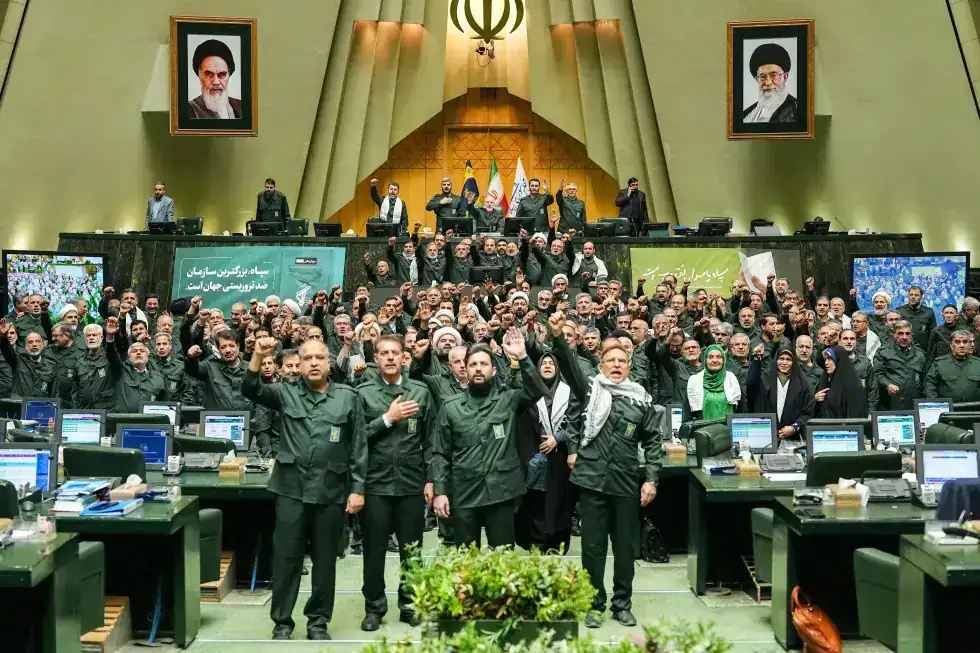
Qalibaf, himself a former Guard commander, made the announcement as lawmakers wore Guard uniforms in a show of support. The designation is likely to be symbolic, mirroring a 2019 Iranian law that allows reciprocal terror labels after the U.S. classified the Guard as a terrorist organization.
The Revolutionary Guard answers directly to Khamenei and controls Iran’s ballistic missile program as well as significant economic assets.
During the parliamentary session, lawmakers chanted anti-U.S. and anti-Israel slogans, underscoring how the domestic crisis has deepened political confrontation with Western governments.
Nuclear tensions resurface
The crisis also intersects with renewed scrutiny of Iran’s nuclear program. Trump referenced past negotiations and recent military action against Iranian nuclear facilities during a prior conflict, saying activity at some sites suggests Tehran may be attempting to shield them from satellite observation.
While details remain unclear, the issue has returned to the forefront of U.S.–Iran tensions, adding another layer to an already volatile situation.
For regional observers, the convergence of internal unrest, maritime military deployments, nuclear concerns and retaliatory political measures heightens the risk of miscalculation.
Iran’s warning of a “regional war” reflects the reality that any direct clash between Tehran and Washington would likely draw in neighboring states, disrupt global energy routes, and reverberate far beyond the immediate battlefield.
This article was rewritten by JournosNews.com based on verified reporting from trusted sources. The content has been independently reviewed, fact-checked, and edited for accuracy, neutrality, tone, and global readability in accordance with Google News and AdSense standards.
All opinions, quotes, or statements from contributors, experts, or sourced organizations do not necessarily reflect the views of JournosNews.com. JournosNews.com maintains full editorial independence from any external funders, sponsors, or organizations.
Stay informed with JournosNews.com — your trusted source for verified global reporting and in-depth analysis. Follow us on Google News, BlueSky, and X for real-time updates.