Iran has spent nearly five decades preparing for potential conflict with the United States. While it cannot match U.S. military power, Tehran has developed strategies aimed at imposing significant costs on its adversaries, both regionally and globally.
As a U.S. carrier strike group arrives in the Middle East and President Donald Trump signals the possibility of military action, analysts warn that Iran retains multiple avenues to respond. Despite suffering losses from last year’s Israeli and American operations and facing growing domestic unrest, Iran could strike U.S. and allied interests, mobilize regional proxies, or disrupt global trade and energy flows. The regime’s response is likely to be proportional to the perceived threat.
“The regime has a lot of capabilities to use if they see this as an existential war,” said Farzin Nadimi, senior fellow at the Washington Institute. “If they perceive a final war, they might deploy everything available.”
Missile and Drone Capabilities
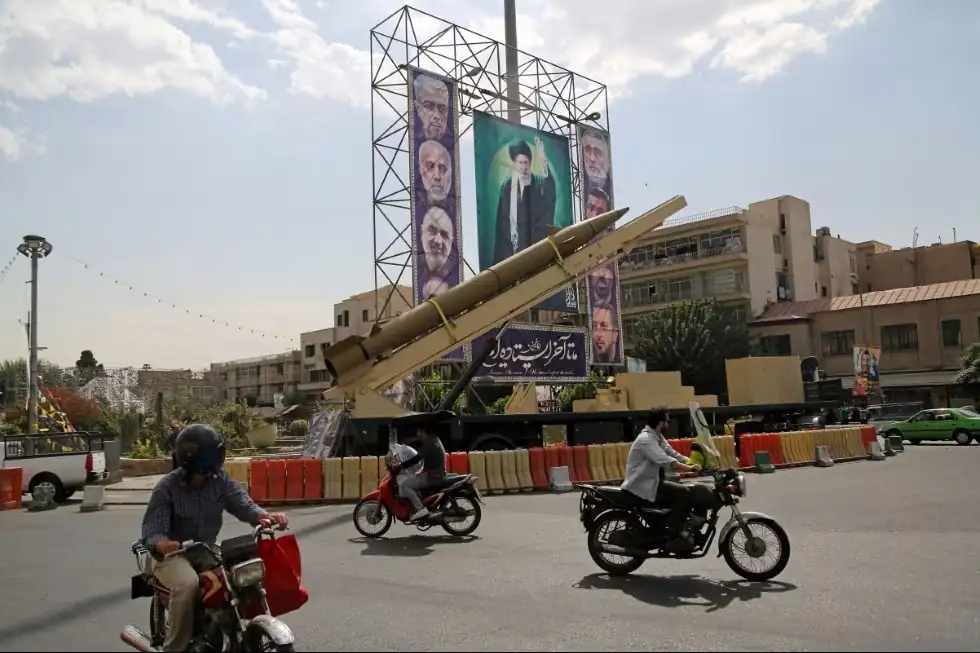
Iran reportedly possesses thousands of missiles and drones capable of reaching U.S. forces stationed across the Middle East, as well as Israel. In June, Iran retaliated against an Israeli strike with coordinated ballistic missile and drone attacks that bypassed advanced air defenses. Officials claim many of those stocks have been replenished.
Tehran has developed over 20 types of ballistic missiles, ranging from short- to long-range systems that could reach targets as far as southern Europe. The Shahed suicide drone, tested in conflicts including Ukraine, adds to Iran’s aerial threat.
“U.S. troops across eight or nine facilities in the region are within reach of thousands of Iranian UAVs and short-range ballistic missiles,” U.S. Secretary of State Marco Rubio said. Analysts note that, although older than U.S. systems, these weapons complicate any decisive strike against Iran.
Iran has repeatedly warned that U.S. allies in the region would also be targets if it were attacked. In response to U.S. strikes on nuclear facilities last year, Tehran launched a missile attack on al-Udeid Air Base in Qatar, the largest U.S. military installation in the Middle East.
Mobilizing Regional Proxies
Iran maintains networks of allied militias and political groups across the Middle East. Despite sustained Israeli campaigns against these proxies, militias in Iraq, Lebanon, and Yemen have pledged to support Iran if threatened.
Iraqi groups such as Kataeb Hezbollah and Harakat al-Nujaba, as well as Lebanon’s Hezbollah, have signaled readiness to defend Tehran. Abu Hussein al-Hamidawi, commander of Kataeb Hezbollah, called on supporters “across the globe … to prepare for all-out war.”
Constraints remain. Hezbollah is weakened after prolonged conflict with Israel and faces internal pressures, while Iraqi militias contend with government restrictions. The Houthis in Yemen, another Iranian-backed group, continue to strike Saudi Arabia, the UAE, Israel, and U.S. ships in the Red Sea, underscoring Tehran’s reach via proxies.
Economic Leverage and Global Trade
Iran’s strategic position along the Strait of Hormuz allows it to influence global energy flows. The waterway handles over 20% of the world’s oil exports and a significant share of liquefied natural gas. Tehran has repeatedly threatened to close the strait in retaliation to attacks, a move that could sharply increase fuel prices and disrupt international markets.
“Even partial disruptions could drive price spikes, disrupt supply chains, and amplify inflation worldwide,” said Umud Shokri, senior visiting fellow at George Mason University. “A global recession would be a realistic risk in such a scenario.”
Iran has built naval bases along its coastline and operates fast-attack boats and submarines designed to challenge shipping in the Persian Gulf. Retired Vice Adm. Robert Harward, former deputy commander of U.S. Central Command, noted that while Iranian capabilities can be countered, asymmetric tools like mines and drones present persistent challenges.
Historical precedent reinforces these concerns. During the 1980s Iran-Iraq war, Tehran laid sea mines near the strait, nearly sinking a U.S. warship. In 2019, oil tankers were attacked in the Gulf of Oman amid heightened U.S.-Iran tensions. More recently, the Houthis disrupted shipping at the Bab al-Mandab Strait, affecting roughly 10% of global seaborne trade.
“The next war might start not in downtown Tehran, but in the Strait of Hormuz and the Persian Gulf,” Nadimi said, highlighting the potential for Iran to leverage both military and economic pressure in any confrontation.
This article was rewritten by JournosNews.com based on verified reporting from trusted sources. The content has been independently reviewed, fact-checked, and edited for accuracy, neutrality, tone, and global readability in accordance with Google News and AdSense standards.
All opinions, quotes, or statements from contributors, experts, or sourced organizations do not necessarily reflect the views of JournosNews.com. JournosNews.com maintains full editorial independence from any external funders, sponsors, or organizations.
Stay informed with JournosNews.com — your trusted source for verified global reporting and in-depth analysis. Follow us on Google News, BlueSky, and X for real-time updates.