MINNEAPOLIS (AP) – President Donald Trump has threatened to invoke the Insurrection Act to deploy troops in Minneapolis, escalating a confrontation between his administration and Minnesota officials over an expanded federal immigration enforcement operation in the city. The warning follows days of protests, a fatal shooting involving an immigration officer earlier this month, and another shooting this week during a separate enforcement encounter.
The prospect of using the 1807 law—one of the most sweeping emergency powers available to a U.S. president—has raised legal and political stakes, with state leaders urging restraint and warning of court challenges. The situation has also disrupted daily life, prompting school districts and universities to adjust operations as tensions persist.
The Minneapolis unrest has become a focal point in a broader national debate over immigration enforcement, federal authority, and the limits of presidential power during domestic crises.
Federal threat and state pushback
Trump’s comments came Thursday after sustained demonstrations against federal officers sent to Minneapolis as part of what the Department of Homeland Security describes as a large-scale immigration operation. In a social media post, the president said he would “institute the INSURRECTION ACT” if Minnesota leaders failed to stop what he called attacks on Immigration and Customs Enforcement personnel.
The Insurrection Act allows a president to deploy the U.S. military or federalize state National Guard units to restore order, even without a governor’s consent. While it has been invoked more than two dozen times in U.S. history, its use is rare in modern times. The most recent instance was in 1992, when President George H.W. Bush sent federal troops to Los Angeles at the request of California officials during unrest following the Rodney King verdict.
Trump has repeatedly raised the possibility of invoking the law, including during protests in 2020 after George Floyd was killed by Minneapolis police. In recent months, he has also pointed to the act as a potential response to demonstrations tied to immigration enforcement.
Minnesota Governor Tim Walz, a Democrat, appealed for de-escalation, urging the White House to “turn the temperature down.” Minnesota Attorney General Keith Ellison said the state would challenge any deployment in court, arguing that federal intervention without state consent would exceed presidential authority.
Immigration operation and rising tensions
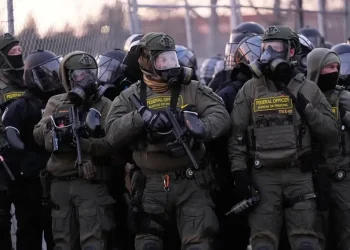
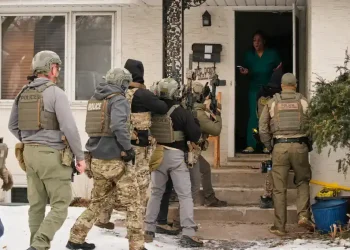
The current standoff centers on a Department of Homeland Security initiative known as “Metro Surge,” which expanded in early January when ICE sent about 2,000 officers and agents to the Twin Cities area. DHS says more than 2,500 people have been arrested since late November as part of the operation.
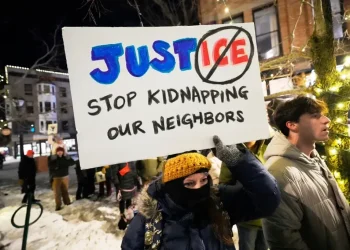
Protests intensified after Jan. 7, when an ICE agent fatally shot Renee Good during an encounter that authorities say escalated rapidly. Demonstrations have since become a near-daily presence around federal facilities associated with the operation.
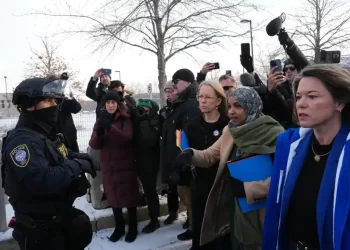
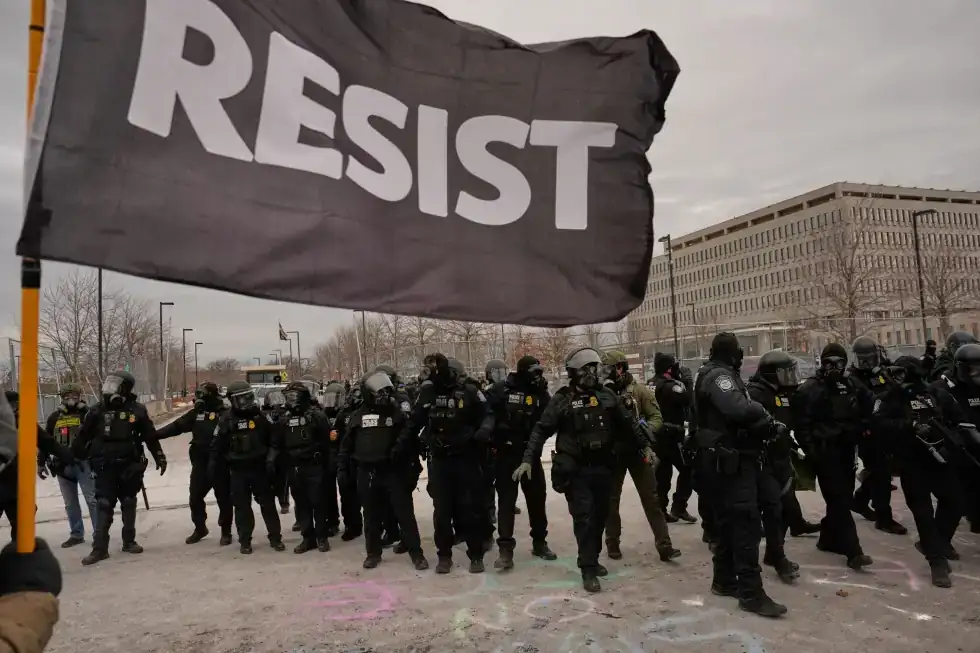
On Thursday night, protesters gathered outside a federal building used as a base for enforcement activities, shouting at officers guarding the site. The demonstration was described by local officials as more subdued than earlier protests, following public appeals from city and state leaders for calm.
Minneapolis Mayor Jacob Frey said city officials were working to balance public safety with the right to protest. “This is an impossible situation that our city is presently being put in,” he said, adding that leaders were seeking ways to move forward while keeping residents safe.
Another shooting deepens concerns
Tensions escalated further Wednesday after an immigration officer shot and wounded a man during a separate incident several miles from where Good was killed. According to DHS, officers stopped a driver from Venezuela who was in the United States illegally. The driver fled, crashed into a parked vehicle, and ran on foot.
DHS said two other people arrived during the pursuit and attacked the officer with objects including a shovel and a broom handle. “Fearing for his life and safety as he was being ambushed by three individuals, the officer fired a defensive shot,” the agency said.
Minneapolis Police Chief Brian O’Hara said the wounded man did not suffer life-threatening injuries. DHS later said the two additional men involved were also in the U.S. illegally and from Venezuela. Local and federal accounts of the incident largely aligned.
The FBI reported that several government vehicles were damaged and property was stolen when agents responded to the shooting. Images released by authorities showed broken windows and graffiti. The FBI has offered a reward of up to $100,000 for information related to the damage and theft.
Legal challenges and civil rights claims
Civil rights groups have moved quickly to challenge the federal operation. The American Civil Liberties Union of Minnesota filed a class-action lawsuit on behalf of three U.S. citizens who say they were questioned or detained during recent enforcement actions. The plaintiffs—two Somali Americans and one Hispanic American—allege racial profiling and warrantless arrests.
The lawsuit seeks to halt practices the ACLU says violate constitutional protections. Federal officials did not immediately comment on the claims.
Similar legal challenges have been filed in other cities, including Los Angeles and Chicago, where large-scale federal immigration operations have drawn protests. While some cases have produced short-term court orders, several have been narrowed or halted on appeal, limiting their broader impact.
Minnesota Attorney General Ellison has also filed suit seeking to block aspects of the DHS surge, arguing that the scale and methods of enforcement exceed federal authority and infringe on civil liberties.
Community impact and school disruptions
The unrest has prompted significant changes for local institutions. St. Paul Public Schools, which serves more than 30,000 students, announced it will offer online learning options for families who do not feel safe attending in person. Schools will close until Thursday next week to prepare for the shift.
Minneapolis Public Schools, with a similar enrollment, is also offering temporary remote learning. The University of Minnesota said it would begin its upcoming term with a mix of in-person and alternative options, depending on the class.
Local officials say the measures are intended to reduce anxiety and maintain continuity as protests and enforcement actions continue. Community leaders have warned that prolonged disruption could deepen divisions and strain trust between residents and authorities.
National implications
The confrontation in Minneapolis underscores the broader national debate over immigration enforcement and the use of federal power in domestic law enforcement. The Insurrection Act, while legal, remains politically contentious, particularly when invoked without state support.
Legal scholars note that any attempt to deploy troops would likely face immediate court challenges, potentially setting precedents for future presidential authority. For now, Minnesota leaders are urging dialogue and restraint, while the White House maintains that federal officers must be protected as they carry out enforcement duties.
As protests continue, Minneapolis finds itself once again at the center of a national reckoning over policing, federal authority, and civil rights—issues with implications that extend well beyond the city’s borders.
This article was rewritten by JournosNews.com based on verified reporting from trusted sources. The content has been independently reviewed, fact-checked, and edited for accuracy, neutrality, tone, and global readability in accordance with Google News and AdSense standards.
All opinions, quotes, or statements from contributors, experts, or sourced organizations do not necessarily reflect the views of JournosNews.com. JournosNews.com maintains full editorial independence from any external funders, sponsors, or organizations.
Stay informed with JournosNews.com — your trusted source for verified global reporting and in-depth analysis. Follow us on Google News, BlueSky, and X for real-time updates.