Valentine’s Day has long favored sit-down restaurants, where atmosphere and occasion drive higher spending. This year, fast-food chains are testing whether novelty, social media ritual, and limited-time theatrics can redirect some of that traffic. The result is a wave of promotions that pair heart shapes with high-low indulgence — from caviar-topped nuggets to heart-cut pizzas.
For U.S. restaurants, Valentine’s Day is typically the second-busiest dining occasion after Mother’s Day, according to the National Restaurant Association. Historically, casual and full-service venues see the clearest lift, particularly when the holiday falls on a weekday. Quick-service restaurants (QSRs) have benefited less, often positioned as convenience rather than destination.
This year’s promotional slate suggests several chains are trying to challenge that pattern. By leaning into visual novelty, social media culture, and limited availability, fast-food brands are attempting to convert a holiday built on ambiance into one driven by shareability and ritual.
Reframing the occasion: from ambience to novelty
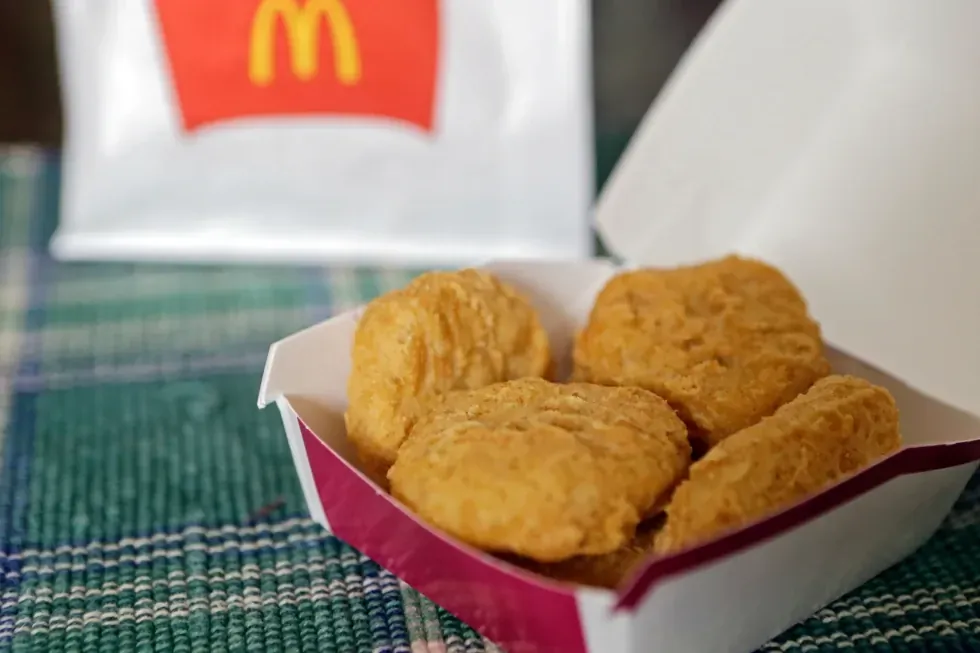
McDonald’s limited-time “McNugget Caviar” kit is the most conspicuous example. The free promotion, available online on Feb. 10 while supplies last, pairs a one-ounce tin of Paramount’s Siberian sturgeon caviar with a $25 McDonald’s gift card intended for purchasing Chicken McNuggets. The kit also includes crème fraîche and a caviar spoon, packaging the experience as a curated pairing rather than a novelty garnish.
The concept draws on a social media trend in which consumers and chefs have celebrated the contrast between luxury ingredients and everyday fast food. Celebrity chef David Chang has frequently posted about pairing caviar with fried chicken and biscuits, while pop culture moments — including a viral video of Rihanna eating caviar with nuggets — have helped normalize the combination as playful indulgence rather than culinary irony.
The idea suggests a shift in how QSR brands think about Valentine’s Day participation. Instead of competing on décor or service, McDonald’s is competing on meme-worthiness, scarcity, and cultural relevance.
Heart shapes as ritual, not product innovation
Other chains are leaning into a different strategy: visual symbolism that turns ordinary menu items into holiday artifacts. Chick-fil-A offers nuggets in heart-shaped trays. Papa Johns and Pizza Hut produce heart-shaped pizzas. Auntie Anne’s shapes pretzels into hearts. Jack in the Box distributes heart-shaped straws. Hardee’s makes heart-shaped biscuits. Even 7-Eleven has joined with heart-shaped donuts and discounted delivery offers.
These changes do not alter the underlying food but change its presentation. The transformation is symbolic rather than culinary, allowing customers to perform the holiday without leaving the familiarity of fast food.
This approach reflects a broader retail insight: on emotionally charged holidays, presentation often carries more weight than product differentiation. The heart shape becomes a low-cost signal that repositions convenience food as occasion-appropriate.
White Castle’s long-running counterexample
White Castle provides a useful comparison. For 35 years, the chain has converted participating locations into “Love Castles,” complete with hostess seating, tableside service, and themed décor. Some of its 300 participating restaurants report full bookings for the evening.
Unlike other QSR tactics, White Castle’s approach mimics the sit-down dining experience rather than reframing the food. It acknowledges that Valentine’s demand is driven by environment and ritual, not menu innovation. The chain effectively turns its restaurants into temporary casual-dining venues.
This contrast highlights two distinct interpretations of how fast food can compete for the holiday: either recreate the restaurant experience or repackage the food as culturally expressive.
Scarcity and price contrast as storytelling tools
The McNugget Caviar kit introduces an additional layer: price contrast. A one-ounce tin of Siberian sturgeon caviar retails for roughly $85 on Paramount’s website, a figure that dwarfs the cost of the nuggets it is meant to accompany. McDonald’s declined to specify how many kits it will distribute, emphasizing limited availability.
This framing turns the promotion into a story about access and contrast rather than consumption. The juxtaposition of a luxury ingredient with a mass-market staple invites sharing and discussion, regardless of whether most consumers ever obtain the kit.
Scarcity also serves a marketing function. By limiting supply and offering the kits online rather than in stores, McDonald’s creates an event that extends beyond its restaurants and into social feeds.
Why fast food is chasing a sit-down holiday
Market researchers such as Circana have noted that quick-service restaurants historically see less of a Valentine’s bump than casual dining chains. When the holiday lands midweek, the lift for full-service restaurants becomes even more pronounced, as couples seek a distinct night out rather than routine meals.
These promotions suggest QSR brands are trying to capture a different segment of Valentine’s demand: customers who want to mark the occasion but avoid reservations, crowds, or higher prices. Fast food becomes a canvas for celebration at home or in informal settings.
The strategy also aligns with broader post-pandemic dining patterns, where at-home occasions and delivery have become normalized for events once associated with restaurants.
Social media as the new dining room
Many of these tactics appear designed with platforms like TikTok and Instagram in mind. Heart-shaped food and caviar-topped nuggets photograph easily. They are recognizable, ironic, and instantly legible as Valentine’s content.
In this sense, the target audience may not be couples seeking a romantic dinner but younger consumers seeking shareable moments. The performance of the holiday — what is posted, liked, and commented on — becomes as important as the meal itself.
This dynamic explains why presentation changes can carry marketing weight disproportionate to their culinary impact.
The limits of novelty
Whether these efforts materially shift Valentine’s sales toward fast food remains uncertain. The promotions are highly visible but limited in scale. Many rely on symbolic packaging rather than menu changes that would alter spending per visit.
White Castle’s reservations suggest that immersive experience can drive measurable demand, but such transformations require operational changes not easily replicated across thousands of locations.
For chains like McDonald’s, the likely benefit is brand visibility rather than immediate revenue. The caviar promotion may generate discussion far beyond the number of kits distributed.
What this signals about QSR strategy
Taken together, these promotions indicate how fast-food brands are adapting to a holiday traditionally dominated by ambience and table service. Instead of competing directly on those terms, they are redefining what participation looks like: novelty over décor, symbolism over service, and shareability over seating.
The effort reflects an understanding that modern holiday rituals are increasingly shaped by digital culture as much as physical settings.
It also suggests that for quick-service brands, the goal is not to replace the romantic dinner but to create an alternative ritual — one that fits contemporary habits, budgets, and social behaviors.
This article was rewritten by JournosNews.com based on verified reporting from trusted sources. The content has been independently reviewed, fact-checked, and edited for accuracy, neutrality, tone, and global readability in accordance with Google News and AdSense standards.
All opinions, quotes, or statements from contributors, experts, or sourced organizations do not necessarily reflect the views of JournosNews.com. JournosNews.com maintains full editorial independence from any external funders, sponsors, or organizations.
Stay informed with JournosNews.com — your trusted source for verified global reporting and in-depth analysis. Follow us on Google News, BlueSky, and X for real-time updates.