
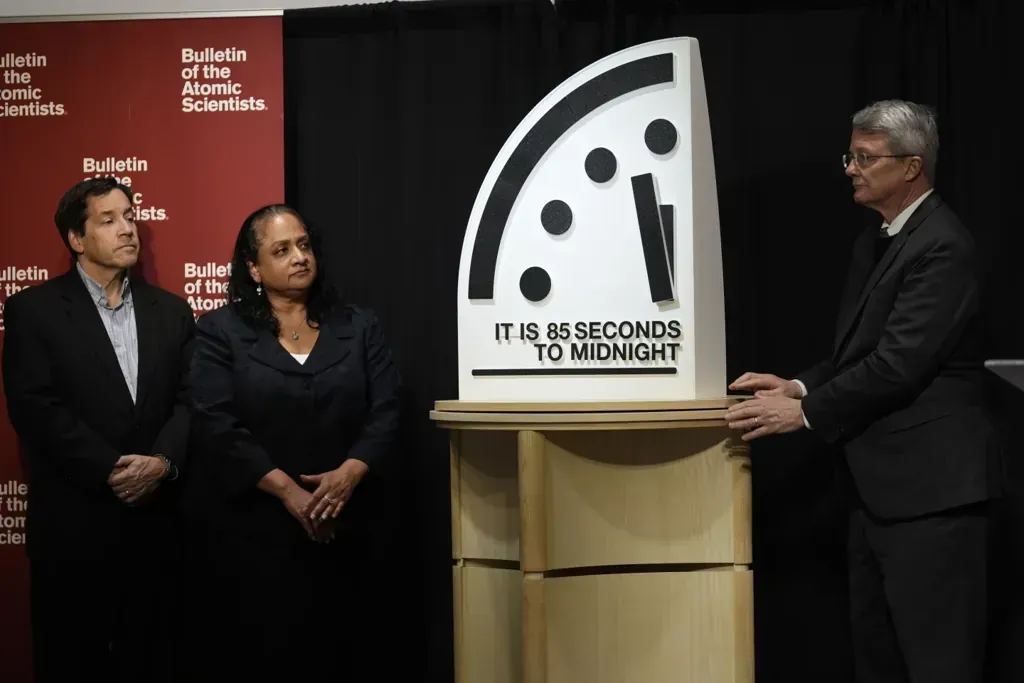
Humanity is closer to self-destruction than at any point since the Cold War, according to the Bulletin of the Atomic Scientists, which on Tuesday moved its symbolic Doomsday Clock to 85 seconds before midnight. The adjustment reflects what the group describes as a convergence of escalating nuclear threats, accelerating climate change and the unchecked use of emerging technologies.
The clock’s movement is not a prediction but a warning, intended to reflect how global conditions compare with past moments of extreme risk. Scientists behind the decision say international cooperation is eroding at the very moment when collective action is most urgently needed.
The Bulletin argues that growing geopolitical hostility, weakening arms control frameworks and inadequate responses to climate and technological dangers are collectively pushing the world closer to irreversible harm.
Why the clock moved closer
The Bulletin cited heightened risks of nuclear conflict as a central factor in advancing the clock. Ongoing and recent confrontations involving nuclear-armed states have increased the likelihood of miscalculation, escalation or accidental use of catastrophic weapons, the group said.
Among the conflicts referenced were Russia’s war in Ukraine, renewed military tensions between India and Pakistan earlier this year, and concerns surrounding Iran’s nuclear capabilities following strikes last year by the United States and Israel. While none of these situations has led to nuclear weapons use, scientists warn that the cumulative risk has risen as diplomatic safeguards weaken.
The group said last year’s setting of 89 seconds to midnight already reflected an unstable global environment, but developments since then have further undermined security. According to the Bulletin, long-standing international agreements and informal norms that once helped manage existential threats are increasingly breaking down.
A fractured global order
Daniel Holz, chair of the Bulletin’s science and security board, said rising nationalism and adversarial politics are eroding trust between countries at a critical moment.
“If the world splinters into an us-versus-them, zero-sum approach, it increases the likelihood that we all lose,” Holz said. He emphasized that existential threats, by definition, cannot be managed by individual nations acting alone.
The Bulletin warned that competition among major powers is displacing cooperation on arms control, climate mitigation and technology governance. In this environment, even established crisis-management mechanisms are becoming less reliable, increasing the danger of rapid escalation during periods of tension.
Climate change remains a core threat
Climate change was again identified as a major driver of global risk, with scientists pointing to intensifying droughts, heat waves and floods as evidence of a warming planet already affecting millions of people.
The group said governments continue to fall short of implementing policies capable of limiting long-term damage, despite decades of scientific warnings. It highlighted the gap between climate commitments and real-world emissions reductions, noting that delays now increase the likelihood of severe and irreversible impacts.
The Bulletin also criticized political decisions that favor expanded fossil fuel production while weakening support for renewable energy, arguing that such moves deepen long-term instability rather than delivering durable economic or security benefits.
Technology risks beyond climate and weapons
In addition to nuclear and climate dangers, the scientists underscored concerns about biotechnology and artificial intelligence. Rapid advances in both fields, they said, are outpacing governance structures designed to prevent misuse.
Artificial intelligence, in particular, is being deployed across military, political and information systems with limited oversight. The Bulletin warned that AI-driven decision-making could amplify misinformation, accelerate conflict dynamics or reduce human control over critical systems if safeguards are not strengthened.
Biotechnology poses parallel risks, especially as tools capable of manipulating biological systems become cheaper and more widely accessible. Without global standards and transparency, the group said, these technologies could be exploited in ways that threaten public health and security.
A symbol shaped by history
The Doomsday Clock was created in 1947 by scientists involved in the Manhattan Project, who sought a simple way to communicate the dangers posed by nuclear weapons. Midnight represents a theoretical point of global catastrophe.
At the height of the Cold War, the clock moved perilously close to midnight, while the end of the Cold War saw it pushed back as far as 17 minutes before midnight. In recent years, however, the Bulletin shifted from measuring minutes to seconds, reflecting the pace and complexity of modern global risks.
The clock’s current setting of 85 seconds marks the closest it has ever been to midnight in its nearly eight-decade history.
Can the clock be turned back?
Despite its stark warning, the Bulletin stressed that the clock is not fixed. Scientists said it could be moved away from midnight if world leaders take coordinated steps to reduce existential risks.
That would require renewed arms control efforts, meaningful climate action and international frameworks to govern emerging technologies, the group said. Rebuilding trust and cooperation among major powers remains central to that effort.
The Bulletin’s message, repeated in various forms since 1947, remains consistent: humanity retains the capacity to change course, but delay and division make that task increasingly difficult.
This article was rewritten by JournosNews.com based on verified reporting from trusted sources. The content has been independently reviewed, fact-checked, and edited for accuracy, neutrality, tone, and global readability in accordance with Google News and AdSense standards.
All opinions, quotes, or statements from contributors, experts, or sourced organizations do not necessarily reflect the views of JournosNews.com. JournosNews.com maintains full editorial independence from any external funders, sponsors, or organizations.
Stay informed with JournosNews.com — your trusted source for verified global reporting and in-depth analysis. Follow us on Google News, BlueSky, and X for real-time updates.


