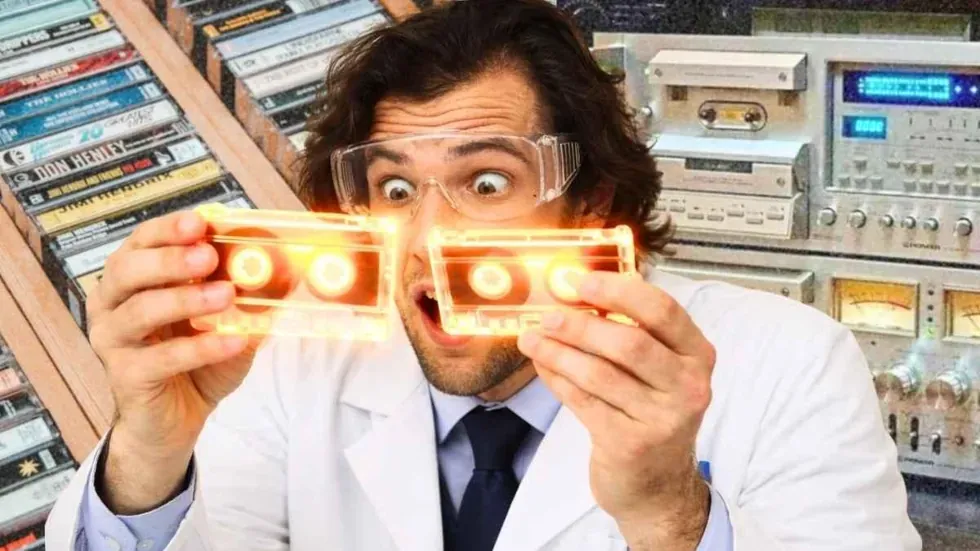
A research team at Southern University of Science and Technology has engineered a DNA-based “cassette tape” capable of storing 36 petabytes of data—enough for roughly three billion songs. While the breakthrough highlights DNA’s potential for ultra-dense archival storage, read/write speed and cost constraints underscore the gap between laboratory feasibility and practical deployment.
The exponential growth of digital data is creating an urgent need for storage technologies that combine density with durability. Current data centers consume an estimated 4.4% of U.S. electricity, and conventional storage media, including SSDs and magnetic tape, require periodic maintenance and replacement. Against this backdrop, DNA has emerged as a theoretically ideal medium: it can survive for centuries without power, offers unparalleled data density, and resists obsolescence.
However, the Southern University experiment illustrates a fundamental tension between potential and practicality. Writing just 156 kilobytes of data required 2.5 hours, equating to roughly one kilobyte per minute. Economically, the cost of storing one terabyte using DNA exceeds $100 million—millions of times higher than conventional tape or flash solutions. These limitations suggest that while DNA may offer long-term archival reliability, its use will remain constrained to niche, high-value applications rather than mainstream storage.
The Storage Density and Durability Argument
DNA’s capacity stems from its molecular structure: sequences of nucleotides—adenine (A), thymine (T), guanine (G), and cytosine (C)—encode information at a scale far beyond silicon-based media. Southern University’s cassette design physically compartmentalizes DNA with a Code-128 barcode system. Hydrophilic “white spaces” absorb DNA, while hydrophobic black bars prevent cross-contamination, enabling 545,000 addressable partitions per kilometer of tape.
Durability further distinguishes DNA from conventional media. Scientists have successfully recovered readable DNA from sediments dating back two million years. For context, high-end consumer SSDs typically last five to seven years, and magnetic tape requires climate control and periodic migration. DNA, by contrast, can remain stable at room temperature for centuries when coated and protected—making it a potential medium for institutions needing records to outlast both technological cycles and human lifespans.
The Speed Bottleneck
Despite its theoretical advantages, DNA storage remains constrained by chemistry. Nucleotide synthesis is inherently sequential, limiting write speeds regardless of automation or investment. To match a modern archival tape drive, researchers would need to synthesize roughly two billion DNA bases per second; global annual production is closer to ten terabases—a disparity of six orders of magnitude.
Comparisons to early computing illustrate the challenge. Southern University’s demonstration is slower than a 1995 dial-up modem, while Microsoft and the University of Washington previously wrote five bytes spelling “HELLO” over 21 hours. Even with automated workflows, these rates remain far below the throughput of contemporary SSDs, which can write several gigabytes per second. As Jeff Nivala of the University of Washington notes, the bottleneck lies less in engineering ingenuity than in fundamental chemical reaction speeds.
Cost Implications
Economic barriers compound speed limitations. DNA storage currently costs around $100 per megabyte, translating to $100 million per terabyte. By comparison, an LTO-10 magnetic tape system stores a terabyte for roughly $300, while SSDs are orders of magnitude cheaper. Viable deployment would require write costs to fall below $1 per megabyte—a threshold that does not account for the remaining speed constraints.
Investment patterns reflect this risk. Since 2012, global investment in DNA storage totals roughly $1.4 billion, concentrated largely in two companies. Yet funding continues, exemplified by Atlas Data Storage’s $155 million seed round in 2025, backed by high-profile investors including Bezos Expeditions and In-Q-Tel. The rationale is not to compete with everyday storage but to address extreme archival needs where longevity outweighs speed and cost.
Niche Applications and Strategic Implications
The DNA cassette tape concept targets ultra-long-term, “cold” storage rather than active data access. Potential beneficiaries include national archives, film studios preserving master recordings, aerospace corporations, and intelligence agencies requiring records that survive centuries without maintenance. By eliminating dependence on electrical power and electronics cycles, DNA storage offers a resilience unmatched by contemporary media.
However, practical adoption faces clear trade-offs. While the cassette demonstrates the feasibility of physical indexing and compartmentalization, speed and cost limitations preclude large-scale commercial use. Unlike flash memory, which benefited from large-scale projects like the Human Genome Project to reduce costs, DNA synthesis has no equivalent driver for exponential cost reduction. Chemistry and physics inherently limit parallelization and speed.
In this context, the Southern University experiment can be understood as a proof of principle rather than a commercially viable product. It underscores both the promise of molecular data storage and the magnitude of obstacles facing its broader adoption.
Looking Forward: Potential and Constraints
DNA storage remains an area of experimental promise, but bridging the gap to practical utility will require breakthroughs in synthesis speed, cost reduction, and automation. Historical parallels, such as the early cost prohibitions of flash memory, offer cautious optimism; transformative reductions are possible but contingent on coordinated investment, technological scaling, and perhaps new chemical approaches.
For now, DNA cassettes are most relevant for archival applications where density, durability, and power independence outweigh cost and speed considerations. The technology invites strategic investment and exploration, but widespread replacement of conventional storage media remains a distant prospect.
This article was rewritten by JournosNews.com based on verified reporting from trusted sources. The content has been independently reviewed, fact-checked, and edited for accuracy, neutrality, tone, and global readability in accordance with Google News and AdSense standards.
All opinions, quotes, or statements from contributors, experts, or sourced organizations do not necessarily reflect the views of JournosNews.com. JournosNews.com maintains full editorial independence from any external funders, sponsors, or organizations.
Stay informed with JournosNews.com — your trusted source for verified global reporting and in-depth analysis. Follow us on Google News, BlueSky, and X for real-time updates.