WASHINGTON (JN) – A federal judge in Washington has declined to temporarily block a new Department of Homeland Security policy requiring members of Congress to provide seven days’ notice before visiting immigration detention facilities, leaving the rule in effect for now.
The ruling does not determine whether the policy itself is lawful. Instead, the court found that Democratic lawmakers challenging the measure used the wrong procedural approach and must bring a separate case if they want to contest the new policy on its merits.
The decision comes amid heightened scrutiny of Immigration and Customs Enforcement detention facilities and as Congress negotiates funding for DHS ahead of an imminent budget deadline, underscoring the tension between executive branch enforcement priorities and congressional oversight authority.

U.S. District Judge Jia Cobb ruled Monday that the Department of Homeland Security did not violate a prior court order when it reinstated the notice requirement through a new memorandum issued on January 8. Cobb emphasized that the policy represents a new agency action, distinct from an earlier version she had temporarily blocked in December.
“The Court emphasizes that it denies Plaintiffs’ motion only because it is not the proper avenue to challenge Defendants’ January 8, 2026 memorandum and the policy stated therein,” Cobb wrote, adding that the denial should not be read as a determination that the policy is lawful.
The plaintiffs were seeking to enforce a December ruling in which Cobb found it was likely illegal for ICE to require members of Congress to give advance notice before conducting oversight visits of detention facilities. That earlier decision temporarily halted an oversight policy announced by the administration in 2025.
Background to the dispute
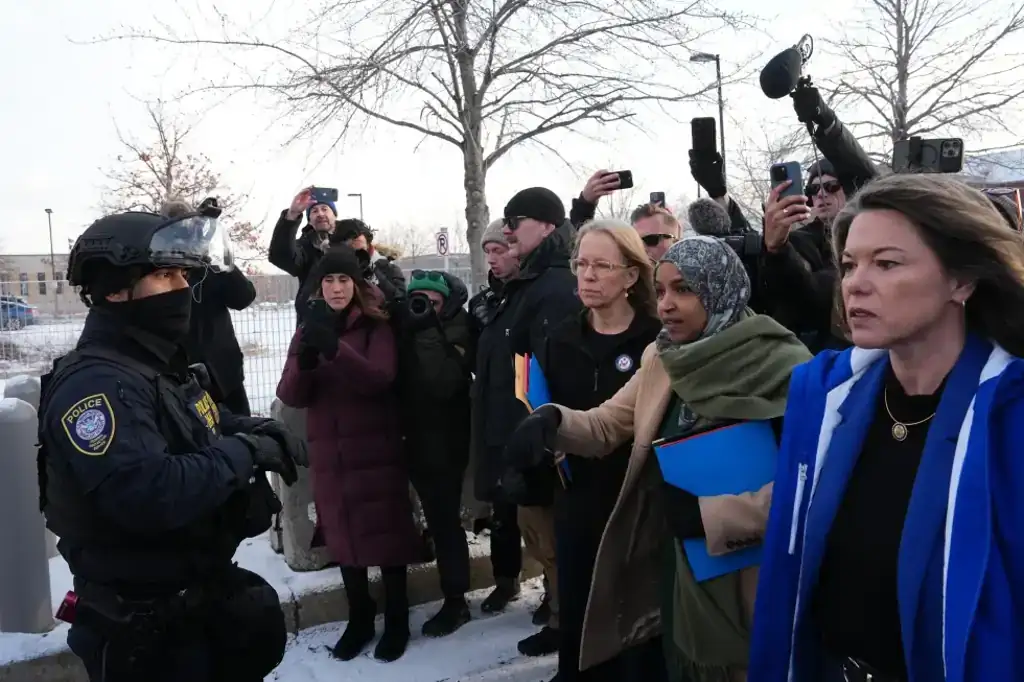
The latest legal challenge arose after three Democratic members of Congress from Minnesota — Reps. Ilhan Omar, Kelly Morrison, and Angie Craig — were denied access earlier this month to an ICE facility in the Minneapolis federal building.
The attempted visit took place three days after an ICE officer shot and killed Renee Good, a U.S. citizen, in Minneapolis, an incident that intensified local and national attention on ICE operations. According to plaintiffs’ attorneys, DHS did not disclose the existence of the new notice policy until after the lawmakers were turned away.
Court records show that DHS Secretary Kristi Noem signed the January 8 memorandum reinstating a seven-day notice requirement one day after Good’s death. The policy was issued without public announcement, according to lawyers representing the lawmakers.
Judge Cobb noted that while the new policy resembles the earlier rule, it is not legally identical. As a result, she said, it cannot be challenged through a motion to enforce her prior order.
Oversight authority and legal arguments
The lawsuit is being brought by Democratic members of Congress with representation from the Democracy Forward Foundation, a legal advocacy group. They argue that federal law explicitly bars DHS from using appropriated funds to prevent members of Congress from entering DHS facilities for oversight purposes.
During a recent hearing, plaintiffs’ attorney Christine Coogle said the administration had not demonstrated that no appropriated funds were being used to implement the notice requirement.
“Appropriations are not a game. They are a law,” Coogle told the court.
Justice Department attorney Amber Richer countered that the January 8 memorandum constitutes a new policy decision that must be challenged independently.
“This is really a challenge to a new policy,” Richer said, arguing that the court’s December injunction does not apply.
Cobb agreed with that procedural assessment, even as she reiterated concerns expressed in her earlier ruling about the practical impact of delayed access on congressional oversight.
In December, the judge rejected government arguments that concerns about changing conditions inside detention facilities over a seven-day period were speculative. She wrote then that fluctuating conditions make it “likely impossible” for lawmakers to reconstruct what a facility was like on the day access was initially sought.
Political and timing pressures
The ruling lands at a critical moment for both DHS and Congress. Lawmakers are in the midst of negotiating funding for DHS and ICE for the next fiscal year, with the agency’s current appropriations set to expire on January 30.
Plaintiffs’ attorneys told the court that unannounced visits are essential for lawmakers to gather accurate, time-sensitive information relevant to those funding decisions.
“This is a critical moment for oversight,” the lawyers wrote in court filings, arguing that advance notice undermines Congress’s ability to assess conditions independently.
Government attorneys have maintained that the notice requirement does not meaningfully obstruct oversight and is designed to ensure safety and operational readiness. Those arguments were not directly resolved in Monday’s ruling.
Next steps in the legal fight
In a statement issued after the decision, Democracy Forward spokeswoman Melissa Schwartz said the organization was reviewing the court’s order.
“We will continue to use every legal tool available to stop the administration’s efforts to hide from congressional oversight,” she said.
Separately, a broader lawsuit brought by a dozen Democratic members of Congress remains pending in Washington. That case challenges ICE’s amended visitor policies more broadly and accuses the Trump administration of obstructing congressional oversight during an intensified nationwide immigration enforcement push.
Judge Cobb, who was appointed by former President Joe Biden, made clear that lawmakers retain the option to challenge the January 8 policy directly through a new legal action. Until then, the seven-day notice requirement remains in force, shaping how and when Congress can access ICE detention facilities during a politically sensitive period for immigration policy and federal funding.
This article was rewritten by JournosNews.com based on verified reporting from trusted sources. The content has been independently reviewed, fact-checked, and edited for accuracy, neutrality, tone, and global readability in accordance with Google News and AdSense standards.
All opinions, quotes, or statements from contributors, experts, or sourced organizations do not necessarily reflect the views of JournosNews.com. JournosNews.com maintains full editorial independence from any external funders, sponsors, or organizations.
Stay informed with JournosNews.com — your trusted source for verified global reporting and in-depth analysis. Follow us on Google News, BlueSky, and X for real-time updates.