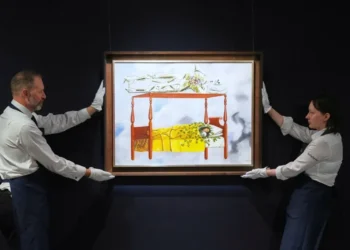
As a child in Colombia, Fernando Dávila once failed a drawing class for painting donkeys red — a moment that revealed he was colorblind. More than six decades later, Dávila is a widely exhibited artist whose vivid paintings hang in galleries across the Americas and Europe, shaped by both limitation and resolve.
Early discovery and artistic beginnings
Dávila was eight years old when a classroom reprimand exposed a congenital condition that would quietly define his life. Unable to distinguish between certain colors, particularly reds and greens, he struggled in formal art education during childhood. For years, he compensated by working almost exclusively in black and white, building his craft through form, texture, and composition rather than hue.
Colorblindness, also known as color vision deficiency, affects the ability to perceive differences between specific colors and shades. There is no cure. For Dávila, the condition also blurs distinctions among pink, violet, turquoise, and yellow-green, narrowing the palette available to him without assistance.

Despite these constraints, he persisted. Painting, he has said, was never optional. It was instinctive.
Learning to work with color
Dávila began painting in color in his early thirties after moving to New York, where an ophthalmologist introduced him to a pair of specially designed glasses. One lens is transparent, the other tinted red. Together, they allow him to separate contrasting shades that would otherwise appear indistinguishable.
With the glasses, Dávila estimates he can perceive close to two-thirds of the color spectrum. Without them, that figure drops to about 40%. The difference, he says, is profound.
He has likened the experience to being offered a box of chocolates but only being able to taste a few. The desire to see every color, he explains, has never faded. When someone points out a brightly colored flower, he wants not just to observe it, but to understand it — to feel what he describes as the “vibration” of color.
A family trait, a personal journey
Colorblindness runs through Dávila’s family. His grandfather and several great-uncles saw only in black and white. His mother and her three sisters were also colorblind, a rarity given that the condition is far less common among women. His two brothers experience similar difficulties distinguishing colors.
Yet Dávila’s path within that shared inheritance has been singular. Rather than withdrawing from color, he spent decades finding ways to approach it indirectly — through tools, memory, intuition, and repetition.
Career across continents
Over a career spanning more than five decades, Dávila has lived and worked in Colombia, New York, and Florida. His paintings have been exhibited in South America, Europe, and the United States, establishing him as a recognized figure in contemporary Latin American art.
In 1999, the Colombian Congress awarded him the Order of Democracy in recognition of his contribution to the arts. His work has appeared in major international auctions, including Christie’s and Sotheby’s, and he has published two hardcover books along with numerous exhibition catalogues documenting his artistic evolution.
Themes, technique, and color choices
Dávila’s paintings often depict romantic figures — men and women embracing — alongside expansive landscapes. Blue frequently anchors his compositions, serving as both a visual foundation and an emotional constant. The choice is partly aesthetic, partly practical: blue remains one of the colors he perceives most reliably.
Rather than attempting hyper-realism, Dávila focuses on mood and movement. Viewers familiar with his story often note that his work does not feel restrained by his condition. Instead, it reflects a deliberate, measured engagement with color — one shaped by patience rather than impulse.
Painting as daily practice
Now 72, Dávila works from a studio in Doral, a suburb of Miami. He paints each morning, a routine he describes as both discipline and privilege. Mixing colors, he says, remains an act of discovery.
For him, painting is not about overcoming colorblindness, but living alongside it. Color, he insists, is essential — not only to art, but to life itself. And for someone who has spent a lifetime reaching toward shades he cannot fully see, that belief carries particular weight.
This article was rewritten by JournosNews.com based on verified reporting from trusted sources. The content has been independently reviewed, fact-checked, and edited for accuracy, neutrality, tone, and global readability in accordance with Google News and AdSense standards.
All opinions, quotes, or statements from contributors, experts, or sourced organizations do not necessarily reflect the views of JournosNews.com. JournosNews.com maintains full editorial independence from any external funders, sponsors, or organizations.
Stay informed with JournosNews.com — your trusted source for verified global reporting and in-depth analysis. Follow us on Google News, BlueSky, and X for real-time updates.