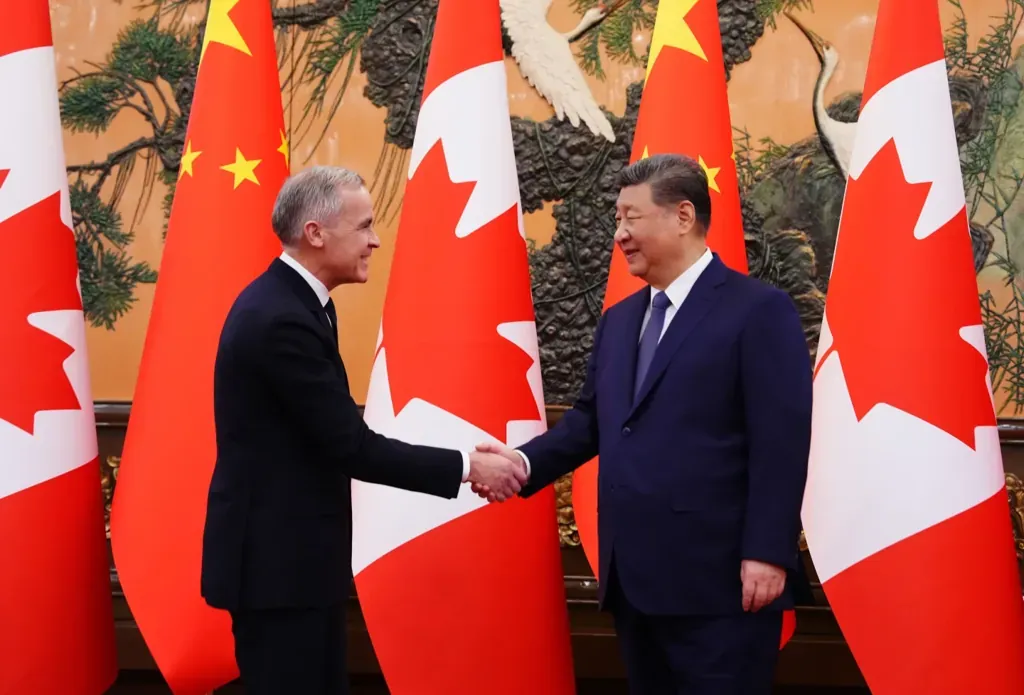
BEIJING, China (Journos News) – Canada has agreed to sharply reduce tariffs on electric vehicles imported from China in exchange for lower Chinese duties on Canadian agricultural exports, marking a significant reset in trade relations between the two countries. The deal, announced by Prime Minister Mark Carney in Beijing, represents a clear departure from Ottawa’s previous alignment with U.S. trade policy toward China.
The agreement comes after two days of high-level meetings with Chinese leaders and reflects Canada’s broader effort to diversify its trade relationships amid rising global protectionism and uncertainty in the international trading system.
The move is likely to be closely watched in Washington and other capitals, as it signals Canada’s willingness to pursue a more independent economic strategy while seeking to restore access to one of its most important overseas markets.

Tariff cuts tied to limits on Chinese EV imports
Speaking to reporters on Friday in Beijing, Carney said Canada would roll back its 100% tariff on Chinese electric vehicles under a managed import framework. The agreement allows an initial cap of 49,000 Chinese-made EVs entering the Canadian market, rising gradually to 70,000 vehicles over a five-year period.
In return, China will significantly reduce tariffs on Canadian canola seeds, one of Canada’s most valuable agricultural exports. According to Carney, Beijing will lower its tariff on canola seeds from roughly 84% to about 15%, restoring partial access to a market that had effectively been closed to Canadian producers.
“It has been a historic and productive two days,” Carney said, adding that Canada must focus on areas of cooperation where interests align, despite differences between the two countries.
The agreement does not alter Canada’s tariffs on Chinese steel and aluminum, according to officials familiar with the discussions, but it establishes a framework for further trade talks.
Leaders signal thaw after years of strained relations
The tariff announcement followed meetings between Carney and Chinese President Xi Jinping, during which both leaders pledged to stabilize and improve bilateral relations after several years of diplomatic tension.
Xi told Carney that talks on restoring cooperation had been underway since the two leaders first met in October on the sidelines of a regional economic conference in South Korea. That meeting, Xi said, marked the beginning of a gradual effort to move relations in a more constructive direction.
“It can be said that our meeting last year opened a new chapter in turning China–Canada relations toward improvement,” Xi said during their discussions at Beijing’s Great Hall of the People.
Carney’s visit is the first by a Canadian prime minister to China in eight years, underscoring the symbolic importance Beijing has attached to the talks.
Agriculture at the center of Canada’s push
Canadian officials have long warned that tariffs imposed by China had severely damaged the country’s agricultural sector, particularly canola producers in Western Canada. Industry groups have said Chinese import duties made Canadian canola uncompetitive, forcing exporters to seek alternative markets.
Under previous retaliatory measures, China imposed tariffs of 100% on Canadian canola oil and meal, 25% on pork and seafood, and an additional 75.8% duty on canola seeds last August. Chinese customs data showed imports from Canada fell 10.4% last year to $41.7 billion.
The tariff reduction is expected to bring immediate relief to farmers, though trade groups cautioned that rebuilding market share in China will take time after years of disruption.
Breaking with Washington on China trade
Canada’s decision marks a notable break from its earlier coordination with the United States. Under former Prime Minister Justin Trudeau, Ottawa mirrored U.S. policy by imposing 100% tariffs on Chinese electric vehicles and 25% tariffs on Chinese steel and aluminum.
Those measures were part of a broader effort by Western governments to counter what they describe as unfair Chinese industrial subsidies, particularly in the EV sector.
China has publicly expressed hope that U.S. pressure on allies will encourage countries like Canada to adopt a more independent foreign policy. U.S. President Donald Trump has recently renewed hardline trade rhetoric and has suggested Canada should consider becoming America’s 51st state, comments that have drawn sharp criticism in Ottawa.
Carney has said his government is seeking to reduce Canada’s economic reliance on the United States during what he described as a period of “global trade disruption.”
Broader diplomatic and economic agenda
Beyond trade, Carney framed improved relations with China as part of a wider effort to strengthen global governance at a time of increasing geopolitical strain. He said cooperation between major economies is essential as international institutions face mounting pressure.
The prime minister highlighted potential areas for deeper collaboration, including agriculture, energy, and finance, while stressing that Canada would continue to protect its national interests.
Canadian business leaders welcomed the visit as a turning point. Jacob Cooke, chief executive of WPIC Marketing + Technologies, a firm that helps foreign companies operate in China, described the trip as “game-changing.”
“For years, the parties were not talking,” Cooke said. “This re-establishes dialogue, respect, and a framework that simply didn’t exist.”
Carney is scheduled to leave China on Saturday before traveling to Qatar, where he will meet business leaders and investors to promote trade and investment. He will then attend the World Economic Forum’s annual meeting in Switzerland next week, where global trade and economic fragmentation are expected to dominate discussions.
This article was rewritten by JournosNews.com based on verified reporting from trusted sources. The content has been independently reviewed, fact-checked, and edited for accuracy, neutrality, tone, and global readability in accordance with Google News and AdSense standards.
All opinions, quotes, or statements from contributors, experts, or sourced organizations do not necessarily reflect the views of JournosNews.com. JournosNews.com maintains full editorial independence from any external funders, sponsors, or organizations.
Stay informed with JournosNews.com — your trusted source for verified global reporting and in-depth analysis. Follow us on Google News, BlueSky, and X for real-time updates.