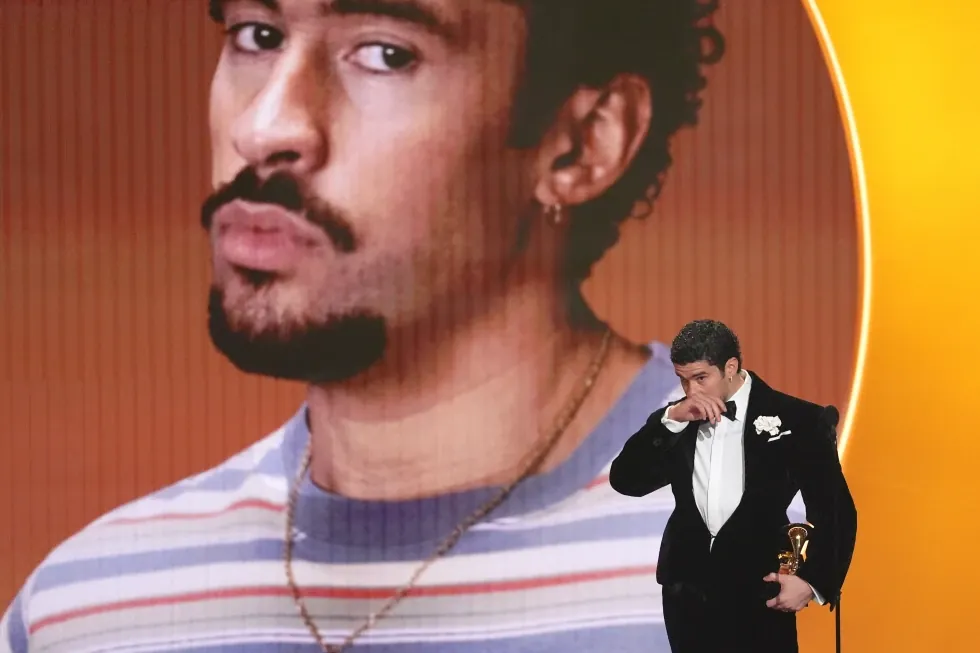
LOS ANGELES (JN) – The 2026 Grammy Awards unfolded as a ceremony defined as much by history as by harmony. In a result that reshaped the awards’ narrative arc, Bad Bunny’s “Debí Tirar Más Fotos” became the first Spanish-language album to win album of the year, marking a milestone for global music recognition at the industry’s most prominent stage.
The Puerto Rican artist closed the night with an emotional acceptance speech that moved between Spanish and English, reflecting both his roots and his reach. “Puerto Rico, believe me when I tell you that we are much bigger than 100 by 35,” he said, invoking a well-known reference to the island’s size. He thanked his collaborators, his mother, and the Academy before dedicating the award “to all the people who had to leave their homeland to follow their dreams.”
Presented by Harry Styles — himself a past winner in the category — the award represented a reversal of fortunes from 2023, when Styles won over Bad Bunny’s “Un Verano Sin Ti,” the first Spanish-language album previously nominated for the prize. This time, the outcome reflected a broader shift in how the Recording Academy recognizes music that transcends linguistic and geographic boundaries.
Immigration emerges as a recurring theme from the stage
While the music took center stage, the evening’s speeches revealed a shared undercurrent: immigration and identity. Several artists used their time at the microphone to speak directly about immigration enforcement policies in the United States.
Earlier in the broadcast, after winning the award for música urbana album, Bad Bunny delivered a pointed message in English: “Before I say thanks to God, I’m going to say ICE out. We’re not savage, we’re not animals, we’re not aliens. We are humans and we are Americans.”
Billie Eilish, who won song of the year for “Wildflower,” echoed the sentiment. “No one is illegal on stolen land,” she said during her acceptance speech, adding an expletive directed at U.S. Immigration and Customs Enforcement.
Best new artist winner Olivia Dean also reflected on her background. “I’m up here as a granddaughter of an immigrant,” she said. “I am a product of bravery, and I think those people deserve to be celebrated.”
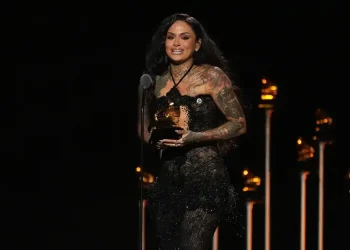
Similar remarks were heard during the earlier Premiere Ceremony, where dozens of awards are presented before the main broadcast. Shaboozey, accepting the award for country duo/group performance, dedicated his win to his mother, an immigrant nurse. Kehlani ended her speech with a similar message, while Gloria Estefan, speaking backstage, said she felt unsettled by the current political climate.
These statements aired live during the CBS telecast, underscoring how artists used the platform to connect personal narratives with broader social debates.
Major category wins and record-breaking moments
Beyond the speeches, the awards delivered several notable firsts and records.
Kendrick Lamar and SZA won record of the year for “Luther,” with presenter Cher briefly misstating the winner as “Luther Vandross,” prompting smiles and a nod during the acceptance speech to the late singer. Lamar also won rap album for “GNX,” bringing his career total to 27 Grammys — surpassing Jay-Z’s record for the most awards won by a rapper.
Lady Gaga won pop vocal album for “Mayhem,” while Lola Young took pop solo performance for “Messy,” joking about her lack of a prepared speech. The newly renamed contemporary country album category went to Jelly Roll for “Beautifully Broken,” part of a restructuring of country categories announced this year.
Pharrell Williams received the Dr. Dre Global Impact Award, thanking “everyone in this room who believes in the power of Black music.”
A ceremony shaped by performance and remembrance
The live performances gave the ceremony much of its texture. The in memoriam segment paid tribute to D’Angelo and Roberta Flack, with Ms. Lauryn Hill returning to the Grammy stage for the first time since her landmark appearance in 1999. Joined by artists including Jon Batiste, John Legend, Chaka Khan, and Wyclef Jean, Hill led a series of performances that blended reverence with reinvention.
Tyler, the Creator delivered one of the night’s most theatrical medleys, joined by Regina King, in a set that unfolded like performance art. Elsewhere, nominees for best new artist performed across multiple parts of the venue, creating a moving, multi-stage presentation that highlighted diverse musical styles.
Opening performances from Rosé and Bruno Mars, Sabrina Carpenter, Justin Bieber, and Lady Gaga ensured the first hour moved briskly between genres and moods.
Early winners and unexpected milestones
Before the main telecast, the Premiere Ceremony produced its own headlines. The Dalai Lama won his first Grammy for audiobook narration, while the song “Golden” from “KPop Demon Hunters” became the first Grammy-winning work associated with a K-pop act in the song written for visual media category.
The music film “Music for John Williams” earned Steven Spielberg his first Grammy, making him an EGOT winner — a rare achievement across Emmy, Grammy, Tony, and Oscar awards.
A Grammy night that reflected a changing industry
The 68th Grammy Awards blended musical achievement with cultural reflection. Bad Bunny’s historic win did more than recognize a single album; it highlighted the Recording Academy’s evolving understanding of what constitutes global mainstream music.
Across speeches, performances, and award presentations, artists repeatedly linked their art to questions of identity, migration, and belonging. For many viewers, the evening became a portrait not just of the year in music, but of the social and cultural currents shaping it.
As the ceremony closed with a Spanish-language album holding the industry’s top honor, the moment stood as a signal of how far the Grammys — and popular music — have traveled.
This article was rewritten by JournosNews.com based on verified reporting from trusted sources. The content has been independently reviewed, fact-checked, and edited for accuracy, neutrality, tone, and global readability in accordance with Google News and AdSense standards.
All opinions, quotes, or statements from contributors, experts, or sourced organizations do not necessarily reflect the views of JournosNews.com. JournosNews.com maintains full editorial independence from any external funders, sponsors, or organizations.
Stay informed with JournosNews.com — your trusted source for verified global reporting and in-depth analysis. Follow us on Google News, BlueSky, and X for real-time updates.