Journos News - Breaking News, World News, Top Stories, Todays Headlines and Flash Reports
Tuesday, July 14, 2026
  • Login
  • Home
  • World
    • Africa
    • Americas
    • Asia
    • Europe
    • Middle East
    • Oceania
  • Politics
  • Business
  • Technology
  • Health
  • Science
  • Sports
  • Entertainment
  • Culture
No Result
View All Result
  • Home
  • World
    • Africa
    • Americas
    • Asia
    • Europe
    • Middle East
    • Oceania
  • Politics
  • Business
  • Technology
  • Health
  • Science
  • Sports
  • Entertainment
  • Culture
No Result
View All Result
Journos News - Breaking News, World News, Top Stories, Todays Headlines and Flash Reports
No Result
View All Result
Home Science Archaeology & Ancient History

The Mystery of Stonehenge’s Missing Megaliths

Uncovering the Lost Stones of Stonehenge

The Daily Desk by The Daily Desk
June 23, 2026
in Archaeology & Ancient History, Science
0
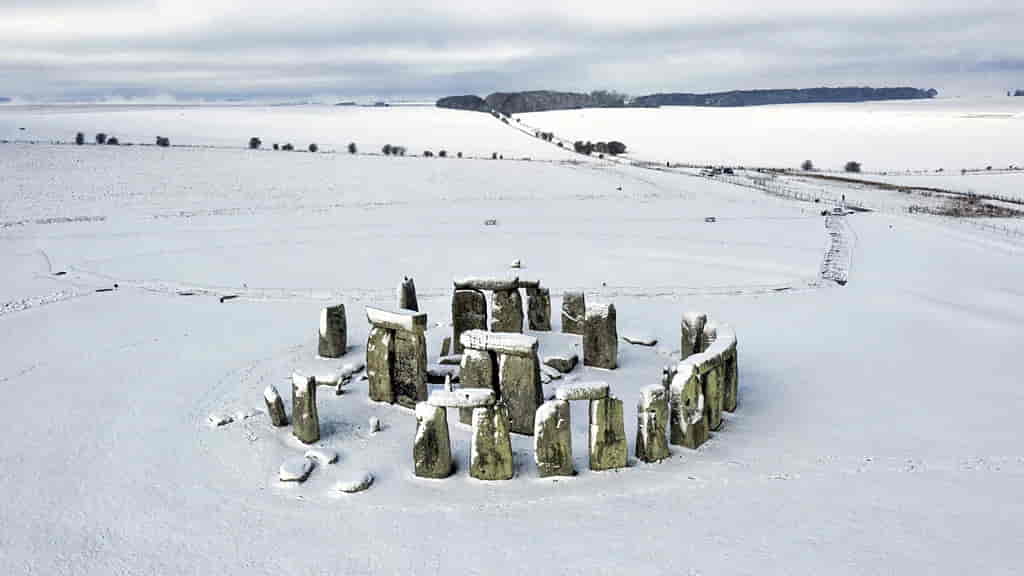
Stonehenge’s Hidden History: The Search for Lost Stones - Getty Images

What We Know About Stonehenge’s Disappearing Stones - Getty Images

The Mystery of Stonehenge’s Lost Megaliths: Unraveling the Ancient Puzzle

Stonehenge, one of the most iconic and enigmatic landmarks in the world, has always fascinated historians, archaeologists, and visitors alike. However, the Stonehenge we see today is vastly different from the structure that existed over 4,500 years ago. The missing stones of this ancient monument raise compelling questions about its original form and purpose. Writer and archaeologist Mike Pitts delves into the mystery of Stonehenge’s long-lost megaliths.

A Midwinter Solstice at Stonehenge: A Glimpse of the Past

If you’re fortunate enough to be at Stonehenge on December 21st, with clear skies and the Sun setting just right, you’ll witness a remarkable phenomenon. Stand between the towering Heel Stone and the stone circle, and as the Sun disappears, the sight is awe-inspiring. The megaliths form a dramatic backdrop, with orange light filtering through gaps between the stones. It feels as though the monument itself swallows the Sun.

This alignment wasn’t a coincidence. Archaeologists, including myself, believe it was meticulously designed by the builders of Stonehenge. However, imagine experiencing this same sight 4,500 years ago. Back then, the spectacle would have been even grander, with up to six additional upright pairs of stones. Of the tallest and most intricately carved stones that once stood here, only one remains—Stone 56, its tenon exposed and useless. And that’s just one of many lost stones.

The Missing Stones: What Happened to Them?

The questions about the missing stones of Stonehenge are numerous and perplexing. Where did they go? Who took them down? Were they ever replaced? More importantly, can we reconstruct the original appearance of Stonehenge? Was the monument ever truly completed?

These are questions that have haunted archaeologists for centuries. While we may never have definitive answers, a series of excavations and discoveries over the years have brought us closer to solving the puzzle.

RELATED POSTS

Vera C. Rubin Observatory Launches Decade-Long Sky Survey With World’s Largest Digital Camera

Scientific Imaging Reveals Hidden Layers in Raphael Portrait’s Restoration History

Artemis II Splashdown Validates NASA’s Deep-Space Systems for Future Lunar Research

Artemis II Lunar Flyby Will Test Deep-Space Systems Ahead of Future Moon Landings

NASA resumes Artemis II preparations after repairs on Space Launch System rocket

Total Lunar Eclipse Colors the Moon Reddish-Orange Across Multiple Continents

Stonehenge Through the Ages: A Complex History

What we see today at Stonehenge is largely unchanged since the 18th century when architect John Wood made the first accurate plan of the site. However, that doesn’t mean the monument has remained untouched. Between 1901 and 1964, many of the standing stones were moved to prevent them from falling. Some stones were straightened and secured with concrete, while others, having fallen in past centuries, were restored. This work, although necessary for preservation, revealed something unexpected: many stones were missing.

In 1666, antiquary John Aubrey noticed five “cavities in the ground” inside the circular bank and ditch surrounding the stone circle. He suggested these were the result of removed megaliths, hinting that an outer stone circle had once stood here, now entirely gone. Excavations in the 1920s uncovered 56 pits, known as the Aubrey Holes, which may have once held stones. More recently, some archaeologists believe that these holes are all that remains of a vast stone circle.

Excavations Reveal Clues About the Missing Stones

In the 1950s and 60s, further excavations near the standing stones uncovered more buried pits. These were likely once occupied by smaller megaliths. Other pits suggest that stones had been rearranged, creating a concentric oval and circle. Over time, these arrangements were altered, and many stones disappeared.


In 1979, I made a discovery that would deepen my understanding of Stonehenge. While excavating near the Heel Stone, I uncovered a pit where a large stone had once stood. The crushed chalk at the bottom of the pit indicated that this stone had once been part of a pair that framed the solstice alignment. This was a turning point for me as an archaeologist, as it demonstrated the monument’s complex history and the many changes it had undergone.

The Case of the Missing Stones: Why Were They Taken?

As archaeologists, we know that Stonehenge evolved over more than a thousand years. During this time, many stones were lost, broken, or removed. But why? One key factor is the composition of the stones themselves.

The large stones—sarsens—are made of hard, local sandstone and form the iconic structure of Stonehenge. The smaller stones, known as bluestones, are made from softer rock, with many brought from South Wales. Excavations have shown that the Aubrey Holes, for example, likely contained bluestones, as did another nearby circle, the stones of which may have been moved to Stonehenge.

Interestingly, reports from earlier centuries speak of visitors removing pieces of the stones as souvenirs. These stories were once dismissed as exaggerations, but in 2012, a laser survey of the megaliths revealed widespread damage, much of it caused by hammering. One particularly striking example is a sarsen lintel, which had been chiselled away to such an extent that it resembled a sausage roll compared to its sharp-edged counterparts.
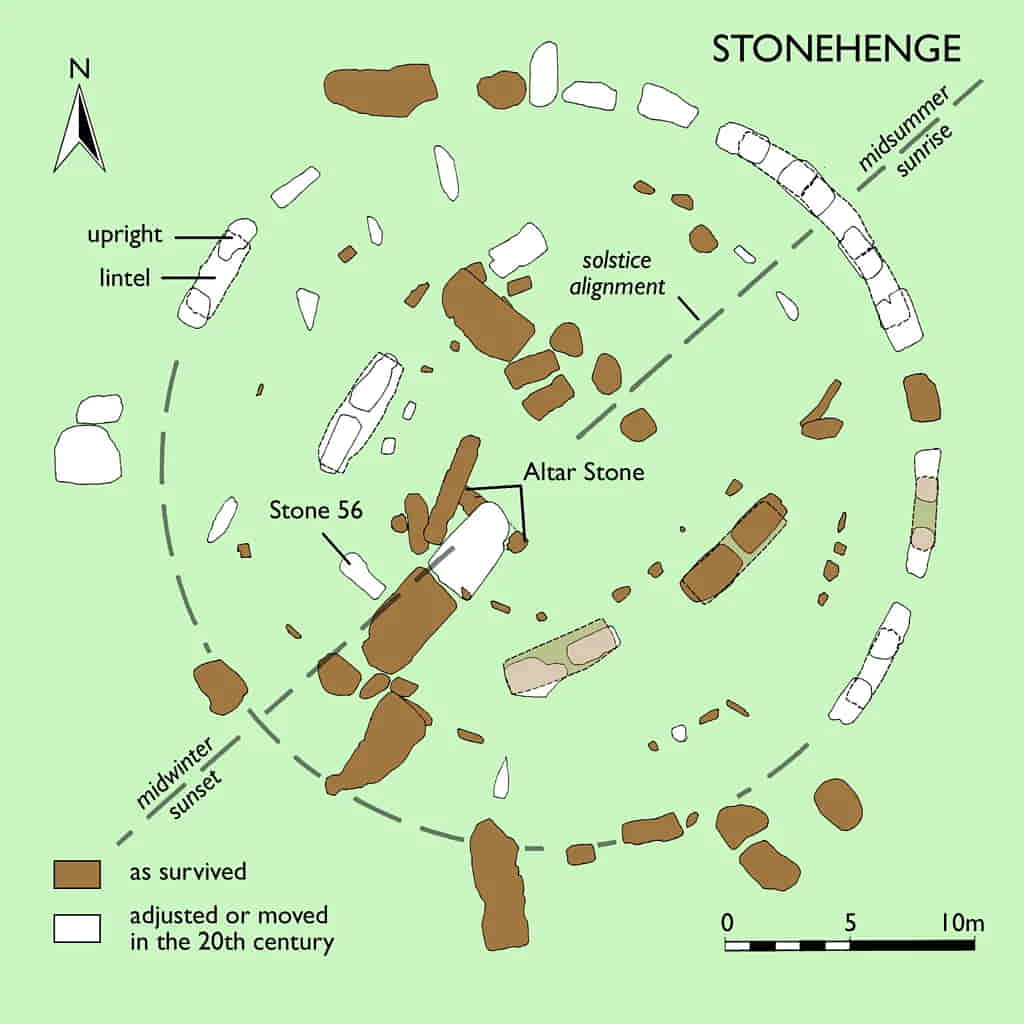
Stonehenge’s Hidden History: The Search for Lost Stones - Mike Pitts
What We Know About Stonehenge’s Disappearing Stones – Mike Pitts

The Slaughter Stone: A Clue to the Past?

One of the most mysterious pieces of Stonehenge is the Slaughter Stone, a large sarsen that lies on the ground between the Heel Stone and the stone circle. This stone shows signs of hammer and chisel marks, suggesting it may have been vandalized or repurposed in some way. Excavation near the Slaughter Stone revealed a pit that may have been used to remove or relocate the stone. Could this be evidence of further stone theft or destruction?

The Bluestones: A Story of Destruction and Healing

Unlike the sarsens, the bluestones are much more fragile and were often broken or damaged. Excavations suggest that some of this destruction occurred during Roman times or even in the Bronze Age, not long after the stones had been erected. One theory is that the stones were believed to have healing properties, and pieces may have been taken for their supposed magical or medicinal qualities.

In one remarkable case, the Altar Stone at the center of Stonehenge was found to have come from northern England or Scotland, not from South Wales as originally thought. Thanks to advanced geological techniques, researchers were able to track the Altar Stone’s origins, revealing the far-reaching history of this monument.

Conclusion: The Enduring Enigma of Stonehenge

Despite centuries of study, Stonehenge remains a monument of mystery. While we may never know exactly what happened to all the missing stones, ongoing archaeological research continues to shed new light on the monument’s complex history. The story of Stonehenge is one of creation, destruction, and reconstruction, with each new discovery adding another layer to the puzzle. And as we continue to explore, one thing is clear: Stonehenge’s mystery is far from over.

Source

Tags: #AncientCivilizations#AncientHistory#AncientMonuments#AncientSites#ArchaeologicalDig#Bluestones
The Daily Desk

The Daily Desk

The Daily Desk is a contributor at JournosNews.com covering politics, media, governance, and the evolving dynamics of public discourse. Stories published under this byline are produced in accordance with JournosNews' editorial standards, with an emphasis on verified reporting, accuracy, context, and impartiality.

Related Posts

Vera C. Rubin Observatory Launches Decade-Long Sky Survey With World’s Largest Digital Camera

by The Daily Desk
July 2, 2026
0
Vera C. Rubin Observatory telescope beginning its decade-long southern sky survey - NSF–DOE Vera C. Rubin Observatory/NOIRLab/SLAC/AURA via AP

NEW YORK — The Vera C. Rubin Observatory has officially launched a decade-long astronomical survey using the world's largest digital...

Read moreDetails

Scientific Imaging Reveals Hidden Layers in Raphael Portrait’s Restoration History

by The Daily Desk
June 23, 2026
0
X-ray analysis reveals hidden layers in Raphael unicorn portrait - Alamy/ Galleria Borghese

Advanced imaging and conservation research are reshaping scholarly understanding of Raphael’s Portrait of a Young Woman with a Unicorn, with...

Read moreDetails

Artemis II Splashdown Validates NASA’s Deep-Space Systems for Future Lunar Research

by The Daily Desk
June 23, 2026
0
Artemis II Orion capsule splashes down after lunar return mission - Bill Ingalls/NASA via AP

NASA’s Artemis II mission concluded with a Pacific splashdown after nearly 10 days in deep space, delivering the first crewed...

Read moreDetails

Artemis II Lunar Flyby Will Test Deep-Space Systems Ahead of Future Moon Landings

by The Daily Desk
June 23, 2026
0
Artemis II crew aboard Orion during lunar flyby systems test - AP Photo/Chris O’Meara

NASA’s Artemis II mission is set to deliver the most significant deep-space systems test since the Apollo era, as four...

Read moreDetails

NASA resumes Artemis II preparations after repairs on Space Launch System rocket

by The Daily Desk
June 23, 2026
0
NASA rocket moved back to launch pad for Artemis II mission - AP Photo/Terry Renna

NASA has returned its massive Space Launch System (SLS) rocket to the launch pad at Kennedy Space Center, marking a...

Read moreDetails

Total Lunar Eclipse Colors the Moon Reddish-Orange Across Multiple Continents

by The Daily Desk
June 23, 2026
0
Red lunar eclipse visible across Asia and Americas sky - Petros Giannakouris/AP

A total lunar eclipse on Tuesday is giving the moon a reddish-orange hue, visible across Asia, Australia, the Pacific Islands,...

Read moreDetails

Chile Telescope Discovery Reveals Striking New Image of Cosmic ‘Butterfly’

by The Daily Desk
June 24, 2026
0
Gemini South telescope captures glowing Butterfly Nebula image - NSF NOIRLab via AP

A Chile-based telescope has captured a sweeping new image of the Butterfly Nebula, offering one of the clearest looks yet...

Read moreDetails

1,700-Year-Old Roman Sarcophagus Unearthed in Budapest

by The Daily Desk
June 23, 2026
0
1,700-Year-Old Roman Sarcophagus Unearthed in Budapest’s Óbuda District - Gabor Lakos, Budapest History Museum via AP

Roman Sarcophagus Found in Budapest Reveals Pristine 4th-Century Burial A remarkably preserved Roman sarcophagus, dating back approximately 1,700 years, has...

Read moreDetails

Researchers Analyze DNA Believed to Belong to Hitler, Reveal Possible Genetic Condition

by The Daily Desk
June 23, 2026
0
Researchers analyze Hitler’s DNA, suggesting a rare hormonal disorder and debunking ancestry rumors in new documentary. - Blink Films via CNN

Analysis of Hitler’s DNA Suggests Rare Hormonal Condition, Genetic Study Sparks Debate A team of researchers led by Turi King...

Read moreDetails
Load More
Next Post
How Advanced Scanning Rebuilt Notre Dame Cathedral After the Fire - Thomas Hubert/Sipa/AP

How Lasers and Drones Helped Rebuild Notre Dame Cathedral

Honda and Nissan’s Merger: A New Era for the Auto Industry - Kyodo News Via AP, File

Honda and Nissan Plan Merger to Become World’s Third-Largest Automaker

Burt, the 16-Foot Crocodile Who Made Movie History, Dies at 90 - (AP Photo/Steve Holland, File)

Burt, the Famous Crocodile Dundee Crocodile, Passes Away at 90

JournosNews logo

Journos News delivers globally neutral, fact-based journalism that meets international media standards — clear, credible, and made for a connected world.

  • Categories
  • World News
  • Politics
  • Business & Markets
  • Technology
  • Health
  • Science
  • Sports
  • Arts & Culture
  • Resources
  • Editorial Standards
  • Submit a Story
  • Advertise with Us
  • Syndication & Partnerships
  • Site Map
  • Press & Media Kit
  • Editorial Team
  • Careers

Join thousands of readers receiving the latest updates, tips, and exclusive insights straight to their inbox. Never miss an important story again.

  • About Us
  • Editorial & Trust Center
  • Contact Us
  • Privacy Policy
  • Terms of Use & Copyright Notice

© JournosNews.com All rights reserved.

Welcome Back!

Login to your account below

Forgotten Password?

Retrieve your password

Please enter your username or email address to reset your password.

Log In
JournosNews

Independent Journalism.
Verified Facts.

You're about to read a professionally edited article from JournosNews.com.

Every article is produced in accordance with our editorial standards, emphasizing factual accuracy, transparent attribution, fairness, editorial independence, and meaningful context.

Editorial Standards
No Result
View All Result
  • Home
  • World
    • Africa
    • Americas
    • Asia
    • Europe
    • Middle East
    • Oceania
  • Politics
  • Business
  • Technology
  • Health
  • Science
  • Sports
  • Entertainment
  • Culture

© JournosNews.com All rights reserved.

This website uses cookies. By continuing to use this website you are giving consent to cookies being used. Visit our Privacy and Cookie Policy.