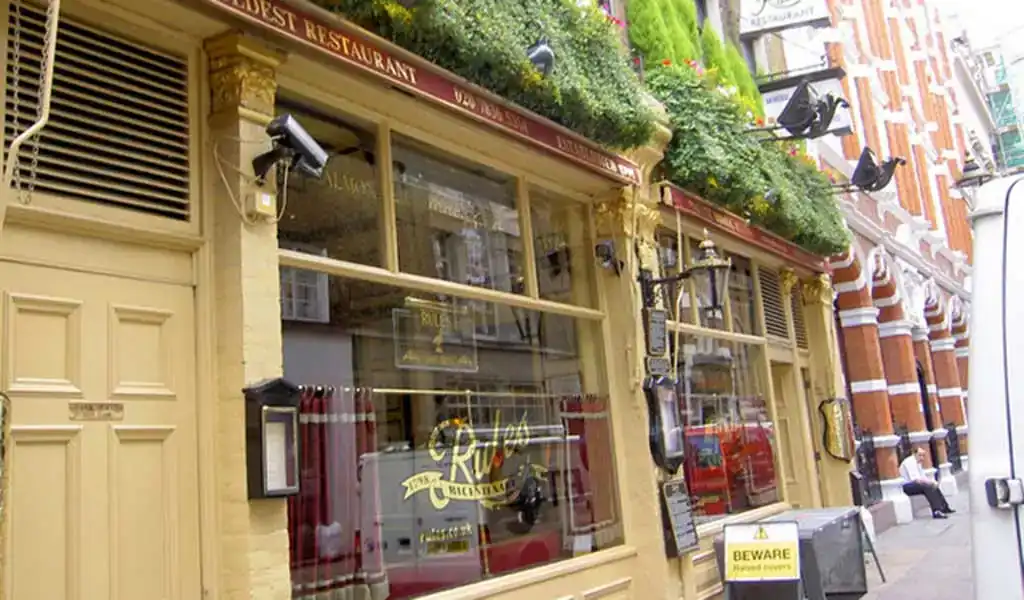
LONDON, United Kingdom – The historic building housing Rules, widely recognised as London’s oldest restaurant, has been donated to the National Trust in a move intended to protect its interiors, collections and continued use as a working restaurant.
The gift from J-P Mayhew, who owned the property for about 40 years, covers the freehold building at 34–35 Maiden Lane in Covent Garden and a collection of objects documenting the restaurant’s history. The National Trust announced the donation on October 14, 2026.
The restaurant business itself was not part of the transfer. Ricky McMenemy, who acquired the business in 2022 after working at Rules for decades, will continue to operate it as a commercial tenant. The National Trust says the annual rent will provide income for its conservation work.

The arrangement separates ownership of the historic premises from the running of the restaurant. That distinction is central to how the gift is intended to preserve the site while allowing it to continue serving customers.
Building and collection pass to the National Trust
Rules occupies 34–35 Maiden Lane, close to Covent Garden’s theatres and cultural venues. Thomas Rule opened the restaurant as an oyster house in 1798. It has continued operating at the site for more than two centuries.
The National Trust’s announcement says the donation includes historic visitor books, menus, photographs, caricatures, stained glass and signs. Together with the building’s interiors, the objects document the restaurant’s changing clientele, traditions and place in London’s social history.
The Trust describes the site as an example of “living heritage”: a historic place that remains in its original broad use rather than becoming solely a museum or exhibition space.
That continuing use is a defining feature of the transfer. The property will be held by a conservation charity, but the restaurant will remain a commercial operation rather than becoming a National Trust-run dining business.




The Trust says it will care for the building and collection and make their history available to future generations. The precise arrangements for public access to individual objects, however, have not been fully set out in the material reviewed for this report.
Restaurant business remains separate
The ownership change follows an earlier separation between the premises and the restaurant business.
Mayhew sold the business to McMenemy in 2022 but retained the property. The donation transfers the building to the National Trust, which now identifies the restaurant operator as a third-party commercial tenant.
That structure means the Trust owns the premises while McMenemy remains responsible for operating the restaurant business. The public announcements do not provide the full tenancy agreement, including its duration, renewal provisions or detailed obligations for maintenance and conservation.
The Trust says the restaurant will continue operating and that the tenancy will support the preservation of the property. McMenemy welcomed the transfer, saying that the Trust’s ownership provides security and peace of mind for the business.
The announcement does not indicate that the Trust will run the restaurant’s daily operations. Nor does the available documentation establish that the charity will determine its menu, staffing or other commercial decisions.
Those responsibilities are distinct from the Trust’s role in caring for the historic building and collection.
Rental income will help fund conservation
The National Trust says the annual rent from the restaurant will contribute to its conservation work. This gives the property an ongoing income stream connected to its continued commercial use.
The arrangement does not, however, disclose the rent amount, the expected annual conservation budget or how income will be allocated between routine maintenance, restoration and care of the collection.
The Trust has also not published a detailed programme of immediate conservation projects in the announcement reviewed for this report. Without the tenancy agreement, financial schedule or conservation plan, it is not possible to calculate how much work the rental income will fund or whether additional charitable resources will be required.
The reported value of the donation is approximately £11 million. The National Trust’s public announcement confirms the gift but does not set out an independent valuation report or explain the methodology behind that figure. The valuation should therefore be treated as a reported estimate rather than a verified independent appraisal.
Legal protection and the limits of the announcement
The National Trust’s ownership provides a long-term conservation framework, but the precise legal protection attached to this particular property requires documentary confirmation.
The Financial Times reported that the gift was made on an inalienable basis. In general, land held inalienably by the National Trust cannot be voluntarily sold by the Trust, and compulsory acquisition is subject to special statutory procedures. The Trust’s own guidance explains the wider significance of inalienability for properties it holds under the relevant legislation.
However, the specific deed or formal declaration establishing the status of 34–35 Maiden Lane was not available in the material reviewed for this article. The legal status should therefore be confirmed against the transfer documentation before publication describes the property as definitively inalienable.
The building’s interiors are Grade II-listed, according to the National Trust’s property information. That listing provides a separate heritage-protection framework for the listed interiors. It should not be confused with the legal status of the freehold or the terms of the donation.
The gift is intended to secure the site’s future, but the public announcement alone does not establish every restriction on future disposal, development or alteration. Those questions depend on the formal property and heritage records.
A restaurant with more than two centuries of history
Rules opened in 1798 as an oyster house and grew into a long-standing part of London’s restaurant and theatre culture. Its history is reflected in its interiors, accumulated memorabilia and association with writers, actors and public figures.
The National Trust identifies the site as the last survivor of a group of historic London restaurants that once included the Trocadero Restaurant, the Mirabelle and Le Gavroche. Its survival as a working restaurant distinguishes it from historic dining rooms preserved only as displays.
The building also survived redevelopment pressure in the 1970s. Poet John Betjeman spoke in its defence when plans threatened the area, an episode that became part of the restaurant’s preservation story.
The National Trust’s acquisition now adds a new layer of protection, combining ownership of the property with responsibility for the historic collection. Its practical effect will depend on the ongoing tenancy, the resources available for conservation and the legal conditions attached to the gift.
For customers, the immediate change is in the ownership of the premises, not the identity of the business operating there. For conservation, the key test will be how the National Trust maintains the historic fabric and collection while the restaurant continues to trade.
Reporting Credit: National Trust for its official announcement of the donation, property ownership information and conservation details; and the National Trust’s published history of 34–35 Maiden Lane for the restaurant’s origins and historical context. The Financial Times was consulted for reporting on the transfer’s reported valuation and inalienability, but the underlying transfer deed and independent valuation have not been examined.
Rules Restaurant, National Trust, London Heritage, Covent Garden, Historic Buildings, Restaurant History, J-P Mayhew, Ricky McMenemy, Heritage Conservation, British Culture