Political campaigns are increasingly using social media creators to reach voters through personalities they already follow and trust. California is now considering stronger penalties for influencers who fail to disclose campaign payments, exposing a broader problem for modern elections: political advertising can look increasingly like ordinary online conversation.
Political campaigning has always depended on people who can persuade others.
For decades, campaigns relied on television personalities, newspaper columnists, celebrities, union leaders, community organizers and political surrogates to carry messages beyond the candidate’s own advertisements. Social media has changed the scale and the appearance of that relationship.

A political message can now arrive in a short video from a creator a voter already follows for fashion, fitness, entertainment, local news or lifestyle content. The message may feel personal rather than institutional. The creator may speak directly to the camera, use their familiar style and address an audience that has developed a relationship with them over months or years.
That creates a problem that traditional campaign-disclosure rules were not designed to solve easily.
When is a political message an advertisement, and when does it look like an individual’s personal opinion?
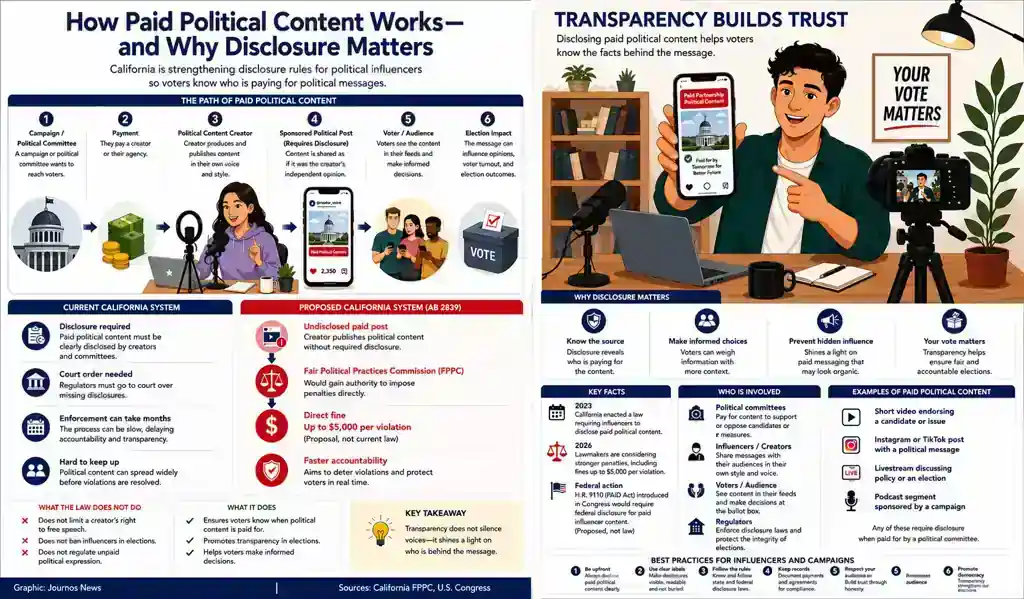
California has become one of the main testing grounds for that question. The state passed a law in 2023 requiring content creators to disclose when they have been paid to promote or oppose candidates or ballot measures. But the state’s enforcement mechanism has been difficult to use quickly. Now California is considering allowing its campaign-finance regulator to impose fines directly on influencers and political committees when required disclosures are missing.
The debate is about more than influencers.
■ Related News


It is about whether voters can reliably distinguish between political speech that comes from a person’s own views and political messaging that has been purchased by a campaign.
The Rise of the Political Creator
Political campaigns have increasingly recognized that social-media creators can reach audiences that traditional campaign advertisements do not.
A television advertisement interrupts a program. A social-media post appears inside a person’s existing feed.
That difference matters.
A creator can speak to an audience that already knows their personality, communication style and interests. The campaign is not simply buying an advertisement; it is gaining access to a relationship between the creator and the audience.
The approach is also not limited to celebrities with millions of followers.
The Associated Press reported that campaigns are increasingly working with smaller creators, sometimes with fewer than 100,000 followers, because those accounts can reach more targeted audiences. That can make creator campaigns useful for reaching specific communities rather than the general electorate.
The result is a political advertising environment in which influence is increasingly distributed across thousands of individual accounts.
A candidate does not necessarily need a famous actor or nationally recognized television personality.
A creator with a highly engaged local, professional, cultural or demographic audience can provide something potentially more valuable: access to a community that already pays attention.
When Political Advertising Looks Like Ordinary Content
The central regulatory difficulty is the appearance of the message.
A conventional political advertisement usually looks like an advertisement.
It has campaign branding. It may contain a disclaimer. It may clearly identify the organization that paid for it. Its production style signals to viewers that they are receiving campaign communication.
Creator content can look different.
A political influencer may record a video in a bedroom, kitchen, gym or car. They may speak without formal campaign graphics. They may present their reasoning in the same format used for their nonpolitical posts.
The communication can therefore resemble a recommendation from a familiar personality rather than a conventional campaign advertisement.
California’s existing rules recognize this distinction. The Fair Political Practices Commission’s regulations specifically address advertisements by paid third-party influencers when a committee pays someone to post content supporting or opposing a candidate or ballot measure and the content appears to express the influencer’s own thoughts, opinion or message.
That regulatory definition gets to the heart of the issue.
The problem is not simply that an influencer is discussing politics.
People have a right to express political opinions.
The problem is whether the audience knows when that opinion has been financially supported by a political committee.
California Already Has a Disclosure Requirement
California’s approach did not begin with the latest proposed penalties.
The state adopted legislation in 2023 requiring influencers to disclose when they are paid for political promotional content. The rule was part of a broader effort to apply campaign-transparency principles to social-media communications.
The state’s current framework requires political advertisements to identify who paid for or authorized them, while specific rules apply to online and social-media communications. The Fair Political Practices Commission publishes disclosure requirements and guidance for campaign communications.
The state also has specific regulations for paid third-party influencers.
That means the basic principle is already established:
If a political committee pays a creator to communicate political messaging, the audience should be told.
The difficulty is enforcement.
According to the Associated Press, California’s existing law can require the state’s Fair Political Practices Commission to seek a court order when an influencer violates the disclosure requirement. That process can take months.
That creates an unusual problem for election regulation.
Political content spreads quickly.
A video can reach hundreds of thousands of people within hours. By the time an enforcement process moves through the legal system, the relevant election may already be over.
The Push for Direct Penalties
That gap has prompted California Assemblymember Marc Berman to pursue legislation that would give the Fair Political Practices Commission greater enforcement authority.
Under the proposal described by the Associated Press, the commission would be able to impose fines on influencers and political committees when a creator fails to disclose compensation. The maximum penalty could reach $5,000 per violation.
The proposal changes the nature of enforcement.
Instead of relying on a court proceeding to force compliance, the state’s campaign regulator would have a direct administrative penalty mechanism.
Supporters argue that this is necessary because disclosure rules have little deterrent value if enforcement is too slow.
Critics and creators have raised a different concern: whether penalties could fall disproportionately on smaller creators who may not have the legal resources of campaigns or major political organizations. The Associated Press reported that some creators support transparency while warning that compliance costs and penalties could create difficulties for small-scale influencers.
That tension will likely remain central to the debate.
The goal is transparency.
The question is how to enforce it without creating an unreasonable regulatory burden.
The 2026 California Primary Put the Issue in the Spotlight
The debate intensified during California’s 2026 gubernatorial primary.
One of the most visible examples involved Los Angeles influencer Shaka Smith, who had more than 700,000 followers and posted paid videos supporting Tom Steyer’s campaign.
Smith disclosed that the content was an advertisement and that he had been paid. The disclosure itself became part of the discussion about how political creator content should work.
But other creator posts raised questions about whether compensation was adequately disclosed.
The Los Angeles Times reported in May that California political influencers had raised concerns about posts supporting Steyer that appeared to use similar language and talking points. The newspaper reported that California’s disclosure law did not impose criminal, civil or administrative penalties at that time, leaving the FPPC to seek a court order to compel compliance.
The controversy demonstrated the central challenge.
Political campaigns can move quickly.
Regulation often moves more slowly.
Why Campaigns Like Influencers
The appeal for campaigns is straightforward.
Influencers already possess something campaigns spend enormous amounts of money trying to create: audience attention.
A candidate can purchase a television advertisement, but that does not guarantee that viewers will trust the person delivering it.
A creator begins with an existing audience relationship.
That relationship can be particularly valuable when the creator is talking about an issue that naturally fits the audience.
A fitness creator might discuss health policy.
A housing creator might discuss housing affordability.
A business creator might discuss taxes.
A local creator might discuss transportation or education.
The political message can therefore be integrated into an existing content environment.
This does not mean audiences automatically believe influencers.
Nor does it mean every creator is simply a paid political spokesperson.
The important point is that campaigns increasingly have an incentive to use creators because their influence is tied to communities and identities rather than traditional mass-media reach.
Trust Is the Valuable Asset
The economics of political influencer marketing are ultimately about trust.
A campaign can buy exposure.
It cannot directly purchase the audience’s belief.
The creator’s value comes from the possibility that followers will listen because the message comes from someone they have chosen to follow.
That creates an ethical distinction between persuasion with disclosure and persuasion without disclosure.
If a creator says:
“This is a paid political advertisement.”
the audience has additional information with which to evaluate the message.
The audience can still agree with the creator.
It can still reject the candidate.
It can still believe the creator’s argument.
But the financial relationship is visible.
Without that information, the audience may evaluate the communication under a different assumption.
That is why disclosure is not simply an administrative requirement.
It changes the information available to the voter.
The Problem Is Bigger Than California
California’s debate is part of a broader national question.
The federal government does not currently have a comparable general disclosure requirement specifically addressing paid political influencers in the way California does. The Associated Press reported that outside groups have urged the Federal Election Commission to establish federal rules.
Congress is also beginning to address the issue directly.
Representative Mark Takano introduced the Promoting Authenticity with Influencer Disclaimers Act, H.R. 9110, on June 2, 2026. According to the official congressional record, the bill would amend federal campaign law to require disclaimers for certain communications paid for by political committees. It was referred to the House Committee on House Administration and had not advanced to a vote at the time of the record’s latest listed action.
The proposal would create a federal framework for paid influencer political content.
That is significant because federal elections operate across state boundaries.
A presidential campaign, congressional campaign or national political committee can work with creators whose audiences are spread across the country. A state-by-state system can therefore create different obligations depending on where a campaign operates and what election is involved.
The federal proposal reflects a recognition that the creator economy is no longer separate from political campaigning.
The Regulation Is Expanding From Television to the Feed
Traditional campaign-finance law was built around identifiable communications.
Television advertisements had sponsors.
Radio advertisements had sponsors.
Printed campaign materials had sponsors.
Social media complicates that model because the individual distributing the message can also be the person whose identity gives the message its persuasive value.
The advertisement and the messenger become intertwined.
California’s current rules already reflect this evolution. The FPPC’s regulations specifically recognize paid third-party influencer advertising as a category of political communication.
The next question is whether other jurisdictions will follow.
Texas has already adopted a rule requiring disclosure when content creators are paid for political advertisements, while New York is considering a similar approach, according to the Associated Press.
The regulatory landscape could therefore become increasingly fragmented.
Small Creators Could Become More Important
One of the most consequential developments may be the movement away from celebrity endorsements toward smaller creators.
A campaign does not necessarily need one person with 10 million followers.
It can work with dozens or hundreds of creators, each speaking to a different audience.
That creates a decentralized political communication network.
One creator might reach young voters in Los Angeles.
Another might reach parents in suburban communities.
Another might focus on Latino voters.
Another might specialize in housing.
Another might reach technology workers.
The campaign’s message can then move through multiple trusted communities without appearing as one centrally coordinated advertising operation.
That model can be highly targeted.
It can also make transparency more difficult.
The more creators participate, the more individual posts regulators and journalists may need to examine.
Enforcement Becomes a Scale Problem
This is where the proposed California penalties become especially important.
A rule is only effective if regulators can identify violations and act within a meaningful timeframe.
The traditional enforcement model was designed for a slower media environment.
Social media operates differently.
A creator can post a video in the morning, accumulate hundreds of thousands of views during the day and delete or modify the content later.
The original audience may have already seen it.
A regulatory process that takes months may therefore have limited preventive value.
Direct penalties could change the incentives.
But enforcement also requires clear definitions.
Regulators must determine what constitutes payment.
They must distinguish paid political promotion from independent commentary.
They must determine whether a disclosure is sufficiently clear.
They must account for different formats, including video, audio, captions and graphics.
And they must avoid turning ordinary political speech into regulated advertising merely because an influencer has political views.
Those boundaries will be crucial.
The Difference Between Political Speech and Paid Promotion
The regulatory objective is not to silence political creators.
That distinction is essential.
A person can support a candidate without being paid.
A creator can criticize a politician without receiving money.
A journalist can discuss a campaign.
A commentator can endorse a candidate.
A creator can change their mind.
None of those activities necessarily becomes a campaign advertisement simply because they influence voters.
The regulatory trigger is the financial relationship and the nature of the communication.
California’s influencer regulation specifically concerns situations in which a committee pays a third party to post content supporting or opposing a candidate or ballot measure and the content appears to express the third party’s own thoughts or message.
That distinction protects an important democratic principle.
Political speech should remain broad.
Paid political communication should remain transparent.
AI Adds Another Layer
The influencer debate is now developing alongside another problem: artificial intelligence.
Political campaigns can increasingly produce realistic synthetic video, audio and images that resemble real people.
California’s 2026 primary has already become part of that debate. Senator Adam Schiff has introduced legislation addressing paid influencers and AI-generated political content, following controversies involving both creator campaigns and AI-generated videos.
These issues are related but not identical.
Influencer disclosure asks:
Who paid the person communicating this political message?
AI regulation asks:
Is the person or event depicted in this communication authentic?
Both questions concern the information environment surrounding voters.
A political message can be misleading because its financial sponsor is hidden.
It can also be misleading because the content itself is fabricated.
As political campaigns become more dependent on digital media, regulators are increasingly confronting both problems simultaneously.
What Disclosure Can and Cannot Solve
Disclosure is not a cure for political misinformation.
A creator can disclose that a campaign paid for a video and still make false claims.
A viewer can know who paid for a message and still believe it.
A campaign can comply with disclosure requirements while producing highly persuasive content.
Transparency therefore addresses one specific problem: hidden financial relationships.
That is still important.
Knowing who financed a political message gives voters additional context.
But it does not tell them whether the candidate’s claims are true, whether the creator’s analysis is accurate or whether the campaign’s policies are effective.
Those remain matters for journalism, public debate and individual judgment.
The Larger Question Is Who Gets to Shape Political Attention
The rise of political influencers points toward a larger change in election campaigning.
Candidates are no longer competing only for advertising space.
They are competing for attention inside social networks.
The most valuable political communicator may increasingly be the person who can make an issue feel relevant to a particular community.
That changes the relationship between campaigns and audiences.
Traditional advertising tells voters that a campaign wants their attention.
Creator marketing can make the campaign appear inside a relationship that already exists.
The distinction may be subtle to viewers.
That is precisely why disclosure matters.
What Remains Unresolved
California’s current debate leaves several questions unanswered.
First, it remains uncertain how far the proposed enforcement changes will go and whether they will become law.
Second, policymakers must determine how large penalties should be and whether the same standards should apply to major creators and small accounts.
Third, regulators must decide how to enforce disclosure rules across rapidly changing formats and platforms.
Fourth, the United States still lacks a single comprehensive federal framework governing paid political influencer communications comparable to California’s approach.
The federal PAID Act has been introduced, but its introduction does not mean that it has become law. H.R. 9110 remains a proposal before Congress.
Finally, the political industry itself is still developing its creator strategies.
Campaigns are learning how to work with influencers.
Influencers are learning how political sponsorship can affect their relationship with audiences.
Regulators are learning how existing campaign-finance principles translate into a media environment that did not exist when many of those rules were written.
The Election Advertisement Is Changing Shape
The political advertisement of the future may not look like an advertisement.
It may look like a livestream.
A short video.
A podcast segment.
A TikTok-style explanation.
An Instagram story.
A YouTube conversation.
A creator answering questions from followers.
The format will continue to evolve.
The underlying democratic question, however, is much older.
Who is speaking, and who is paying for that speech?
California’s effort to strengthen enforcement is an attempt to make that answer easier for voters to see.
Whether the approach succeeds will depend not only on the size of the penalties but on whether the rules can keep pace with the speed, scale and intimacy of modern social-media campaigning.
Political influencers are unlikely to disappear from elections.
If anything, their role is likely to expand.
The challenge for regulators is therefore not to prevent creators from participating in politics.
It is to ensure that when campaigns purchase their influence, voters can tell the difference between an independent voice and paid political persuasion.