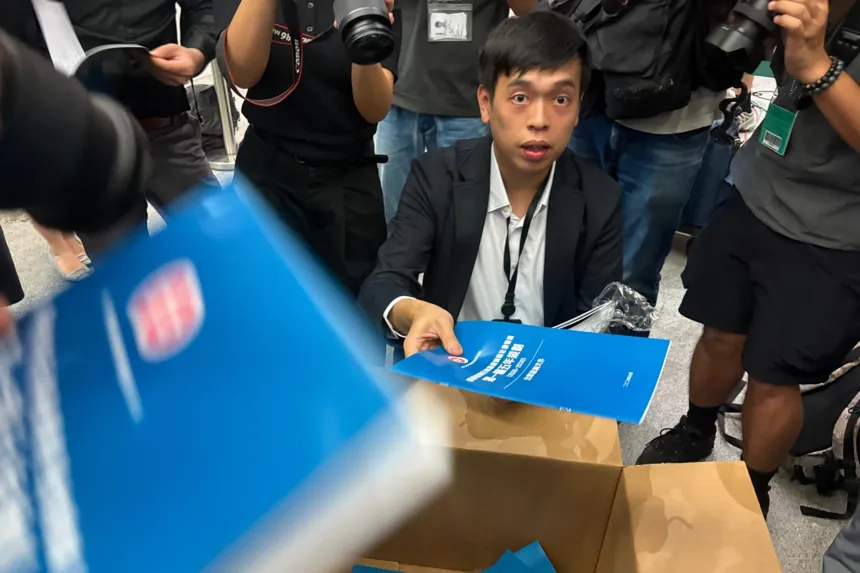
Hong Kong – Has begun a public consultation process for its first formal five-year development plan, marking a significant step toward aligning the city’s policy framework with mainland China’s long-term planning model while maintaining its market-oriented economic system.
Officials announced Monday that residents, businesses and organizations will have two months to submit feedback on the proposed blueprint, which is intended to complement China’s national 15th five-year plan covering the period from 2026 to 2030.
Speaking at a news conference, Secretary for Constitutional and Mainland Affairs Janice Tse said the initiative would help Hong Kong better synchronize with national development priorities while preserving the city’s role as a free-market economy.

“Aligning with the national 15th five-year plan does not replace the free market,” Tse said. “Rather, it channels a clear vision and strategic planning through major policies, and that allows the market to develop more stably and clearly.”
Closer Coordination With National Priorities
The consultation reflects Hong Kong’s growing integration with mainland China’s economic planning framework. While Beijing has long relied on five-year plans to guide national development, Hong Kong traditionally emphasized limited government intervention and market-led growth.
Under the proposed framework, officials aim to strengthen Hong Kong’s role as an international financial, maritime and trade center while supporting major regional development projects.
Among the priorities is the continued expansion of the Northern Metropolis, a large-scale initiative near the border with the mainland city of Shenzhen that includes plans for technology industries, innovation facilities and higher education institutions.
Authorities also seek to deepen participation in the Greater Bay Area, Beijing’s initiative to create a more integrated economic region linking Hong Kong, Macao and nine mainland Chinese cities.
■ Related News




Government Sees Benefits for Residents and Businesses
Hong Kong Chief Executive John Lee said earlier this month that the plan would promote closer coordination between government policy and market activity, describing the approach as combining a capable government with an efficient market.
Officials argue that clearer long-term planning could provide businesses with greater certainty and help residents identify future economic and career opportunities.
The government intends to finalize and publish the completed plan during the third quarter of the year following the consultation process.
A senior Beijing official responsible for Hong Kong and Macao affairs is expected to visit the city this week to review efforts related to the national 2026–2030 development strategy and the progress of the Northern Metropolis project.
Political and Economic Context
Since Hong Kong’s return to Chinese sovereignty in 1997, economic and infrastructure links with mainland China have steadily expanded. The city continues to operate under the “one country, two systems” framework, maintaining separate legal and administrative institutions while remaining under Chinese sovereignty.
China’s influence over the territory has increased in recent years, particularly following the 2019 anti-government protests. Beijing subsequently imposed a national security law, and political reforms reshaped the city’s electoral system.
These developments have transformed Hong Kong’s political environment and strengthened the role of Beijing-backed institutions in policymaking.
Debate Over Government’s Expanding Role
Economists and academics say the proposed plan could signal a more active role for government in guiding economic development.
Gary Ng, a senior economist at Natixis Corporate and Investment Banking, said many governments worldwide have adopted industrial policies to support competitiveness, making strategic planning increasingly common. He said the initiative could provide greater policy consistency but would also test the government’s ability to identify the right priorities for Hong Kong’s future.
While he does not expect the city to abandon its market-driven model, Ng said authorities may become more influential in directing economic development.
“A lot of things that we’re seeing may not be fully as market-driven as before,” he said.
John Burns, a professor of politics and public administration at the University of Hong Kong, said the city may benefit from more strategic planning but questioned the effectiveness of the consultation process.
Burns argued that public consultations have often been viewed skeptically because governments are not obligated to alter policies based on public feedback. He also noted that the consultation document contains relatively few detailed targets or timelines.
“This is the government selling its notion of a local five-year plan to the community that dovetails with central government priorities,” he said.
Tags: Hong Kong, China, Greater Bay Area, Northern Metropolis, John Lee