Apple reported quarterly earnings that exceeded Wall Street expectations, supported by sustained momentum in iPhone sales, according to reporting from the Associated Press. The results highlight continued strength in the company’s core hardware segment, even as markets closely monitor its artificial intelligence roadmap and upcoming leadership transition.
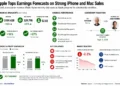
For the January–March quarter, Apple posted revenue of $111.18 billion, up 17% year-over-year, while net income rose to $29.58 billion, or $2.01 per share, according to the AP report. The figures surpassed analyst forecasts of $109.46 billion in revenue and $1.95 per share in earnings, as compiled by FactSet.
The results underscore the central role of the iPhone in Apple’s financial performance, with continued demand driving overall growth across its product ecosystem.

iPhone Sales Remain Core Growth Driver
iPhone revenue reached $56.99 billion in the quarter, representing the bulk of Apple’s total sales, according to company disclosures cited by the Associated Press. CEO Tim Cook said it was Apple’s “best March quarter ever,” attributing performance to “double-digit growth across every geographic segment.”
The iPhone 17 lineup was a key contributor to results, with Cook noting “extraordinary demand” during the period. Analysts highlighted that sustained upgrade cycles and strong global demand helped offset broader macroeconomic uncertainty in parts of the consumer electronics sector.
Broader Product Segments Show Mixed but Stable Growth
Beyond the iPhone, Apple reported gains across its Mac, iPad, and services businesses. Mac and iPad revenue increased year-over-year, supported by new product introductions, while services continued to expand as a recurring revenue stream.
According to the AP report, services—encompassing subscriptions such as iCloud, Apple Music, and App Store transactions—remained a stabilizing force in Apple’s overall revenue mix. The segment continues to be closely watched by investors due to its higher margins compared with hardware sales.
Investor Focus Shifts to AI Strategy and Leadership Change
Despite strong financial results, investor attention is increasingly centered on Apple’s artificial intelligence strategy and corporate leadership transition.
■ Related News


The company has faced scrutiny over its pace in deploying advanced AI features compared with competitors, a factor that analysts say could influence future device upgrade cycles. Apple has indicated ongoing development of AI-driven features across its ecosystem, though full implementation timelines remain a key market focus.
At the same time, Apple is preparing for a leadership change. Tim Cook announced earlier this month that he will step down as CEO later this year, with hardware chief John Ternus set to succeed him, according to AP reporting. The transition marks a significant shift for the company after more than a decade under Cook’s leadership.
Outlook Hinges on Product Cycle and AI Integration
Analysts cited in market coverage suggest Apple’s near-term performance will depend on continued iPhone demand and the company’s ability to integrate AI features into its hardware ecosystem. Services growth and global market expansion remain additional supporting factors.
While the earnings beat reinforces Apple’s scale and resilience, investors are watching closely for signals on how the company plans to compete in an increasingly AI-driven technology landscape.