The final whistle of the Super Bowl is followed by a ritual as familiar as the trophy lift itself: a blizzard of color pouring onto the field as champions celebrate. For three decades, that moment has been orchestrated not by the league or the teams, but by a small California company whose specialty is engineered celebration.
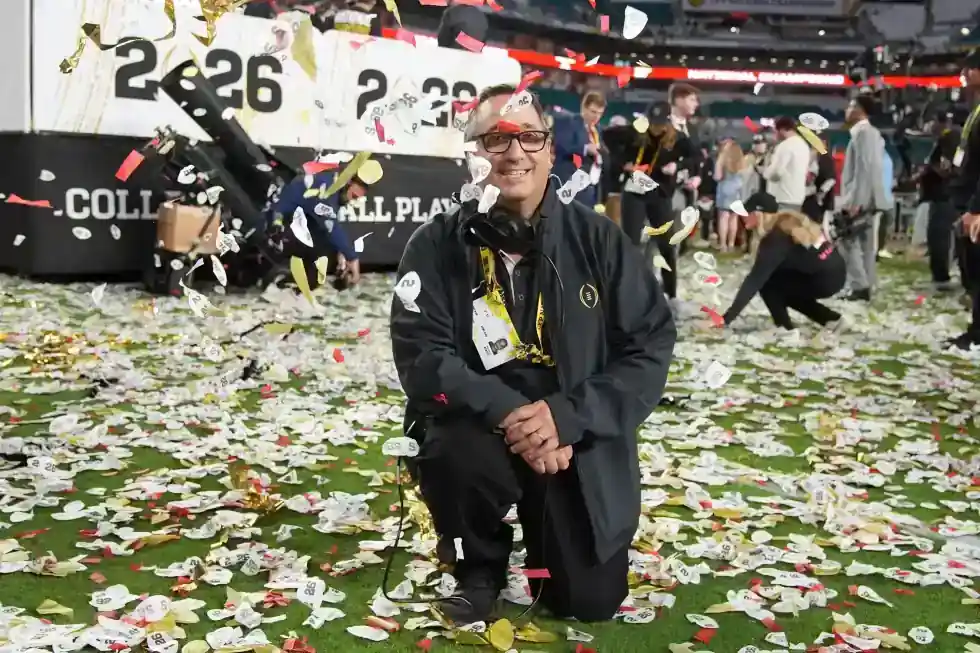
Noah Winter, founder of Artistry in Motion in Northridge, California, has overseen the confetti drop at the Super Bowl for 30 consecutive years. While players and coaches come and go, Winter’s team has become a constant presence behind one of the event’s most enduring visuals.
From rock concerts and political conventions to the Olympics, Artistry in Motion designs confetti effects for major global events. Yet Winter says it is the Super Bowl’s end-of-game spectacle that people most often associate with his work — and the one he is most frequently asked about.
Timing, precision and two sets of colors
Each year, Artistry in Motion transports about 300 pounds (135 kilograms) of two-color confetti for each of the competing teams to the stadium. Confetti cannons are positioned around the field with several minutes left on the clock, ready for the moment the game is officially over.
Even if players spill onto the field early, the confetti does not launch until the scoreboard shows triple zero.
“It’s always better to be late than early,” Winter said. “Over 30 years, we’ve never launched the wrong color or launched too soon.”
Both teams’ confetti is prepared in advance. Only the winners’ colors are released, while the losing team’s stock is packed up and recycled.
The precise color blend is not simply a 50–50 split. Some hues dominate on television screens, so Winter’s team tests combinations to ensure the right visual balance for broadcast viewers as well as those in the stadium.
The tissue paper used to create the confetti is supplied by Seaman Paper, a Massachusetts manufacturer that has worked with Artistry in Motion for 25 years. While the Super Bowl order is small compared to the company’s daily production of gift-wrap and food-service paper, Seaman’s owners describe it as a point of pride for their workforce.
Designed to flutter, not fall
The confetti’s rectangular shape is intentional. According to Winter, the small flags rotate on their axis as they descend, creating a slower, floating effect that keeps them visible in the air for longer.
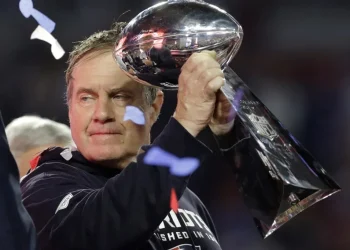
Television viewers may not realize that there are typically two confetti moments during the Super Bowl. The first follows the final whistle. The second occurs during the presentation of the Vince Lombardi Trophy, when specially cut pieces shaped like the trophy itself are released.
At times, event sponsors have asked for messages to be printed on the confetti. For several years, small social media prompts were printed on the pieces at the request of a sponsor.
Recycled material and stadium cleanup
The confetti is made from U.S.-sourced tissue paper composed of 98% postconsumer recycled material, Winter said. The paper is biodegradable, and any unused stock prepared for the four NFL playoff finalists is recycled after the event.
Once the celebration ends, however, cleanup falls to stadium crews, not Artistry in Motion. Methods vary depending on whether the venue uses natural grass or artificial turf. Some crews rake the paper into piles, while others use leaf blowers carefully to avoid damaging the playing surface.
Photographer Jane Gershovich, who covered the Seattle Seahawks’ Super Bowl win in 2014, recalled that once the confetti falls, players, families and staff often treat it as part of the celebration itself — tossing it into the air and posing for photos.
“Seeing players and their kids engage with it brings a lot of joy to the field,” she said.
From Disney parades to global events
Winter’s path into the confetti business began in the mid-1980s. After studying lighting design in college and working in pyrotechnics at venues including the Hollywood Bowl, he was asked by Disney to recreate falling leaves for a live “Pocahontas” show. That project led to designing confetti effects for Disneyland’s daily parade.
In 1986, Mick Jagger saw the Disney confetti display and asked Winter’s company to create a similar effect for a Rolling Stones concert at Dodger Stadium. The band later took Artistry in Motion on tour. Other performers, including U2’s Bono, followed.
Large-scale stadium concerts opened the door to sporting events. Winter’s first Super Bowl assignment came in 1997 at the Louisiana Superdome in New Orleans, when the Green Bay Packers defeated the New England Patriots. He had worked the year before as a pyrotechnician at the game, making this season his 30th consecutive year involved in some capacity.
In 2025, an estimated 127.7 million viewers watched the Super Bowl across television and streaming platforms, making the confetti moment one of the most widely seen visual traditions in sport.
Winter does not name a favorite team, though he notes that two of his brothers support the New York Jets. He has promised to bring them to work a confetti cannon if the Jets ever return to the Super Bowl — a feat the team has not achieved since its 1969 victory led by quarterback Joe Namath.
This article was rewritten by JournosNews.com based on verified reporting from trusted sources. The content has been independently reviewed, fact-checked, and edited for accuracy, neutrality, tone, and global readability in accordance with Google News and AdSense standards.
All opinions, quotes, or statements from contributors, experts, or sourced organizations do not necessarily reflect the views of JournosNews.com. JournosNews.com maintains full editorial independence from any external funders, sponsors, or organizations.
Stay informed with JournosNews.com — your trusted source for verified global reporting and in-depth analysis. Follow us on Google News, BlueSky, and X for real-time updates.