MILAN (JN) – Italy enters the opening day of the Milan Cortina Winter Olympics under an unusually dense security umbrella, as authorities deploy thousands of personnel across venues stretching from the financial capital to alpine valleys hundreds of kilometers away. The government’s preparations combine traditional counter-terrorism planning with cyber monitoring and new legal powers aimed at preventing violent protest.
The Milan Cortina Olympics security operation is being tested not only by geography but by politics. A cabinet decree approved on the eve of the ceremony grants police expanded authority to detain suspected agitators for up to 12 hours. Opposition lawmakers say the measure risks curbing freedom of expression, while the government argues it is a proportionate response to recent unrest and the scale of the event.
Preliminary hockey and curling matches began earlier in the week, but the Games formally open Friday evening at Milan’s San Siro Stadium, where world leaders, athletes and entertainers will gather under tight protection.
Coordinating security across a vast Olympic map
Authorities say around 6,000 security personnel — including bomb disposal teams, snipers and counter-terrorism units — will be deployed across Olympic locations throughout the competition. The challenge is not the size of any single venue, but the unprecedented dispersion of sites across northern Italy.
Events are spread between Milan and three mountainous clusters in the Dolomites, requiring police to operate through a network of interconnected operations centers rather than a single command hub. These centers are located in Milan as well as Bolzano, Trento, Venice, Verona, Belluno, Sondrio and Varese.
From the main operations room in Milan, officers monitor live feeds and data streams from across the territory. Sabrina Pane, Milan’s deputy prefect, said the system is designed to ensure “a very fast, constant flow of information” so incidents can be addressed in real time.
The structure reflects lessons learned from previous multi-site events in Europe, where decentralized but synchronized control rooms have been used to shorten response times and reduce the risk of communication bottlenecks.
International cooperation and cyber vigilance
Security planning also extends beyond Italy’s borders. Foreign police officers are working alongside Italian counterparts, while Interpol and Europol personnel are supporting coordination on intelligence and cross-border risks.
Earlier this week, Foreign Affairs Minister Antonio Tajani said Italian police had already thwarted a series of cyberattacks linked to Russian actors targeting foreign ministry offices, Olympic-related websites and hotels in Cortina. Authorities say specialized interforce teams are monitoring both physical spaces and digital infrastructure around the clock.
Luisa Massaro, a chief police commissioner, described a “dual approach” focused on protecting critical computer systems while tracking online activity for early warning signs of disruption.
The emphasis on cyber defense reflects the increasing vulnerability of major sporting events to digital interference, from ticketing systems to accommodation networks and communications platforms.
Protests over presence of U.S. security unit
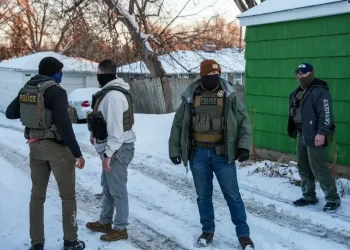
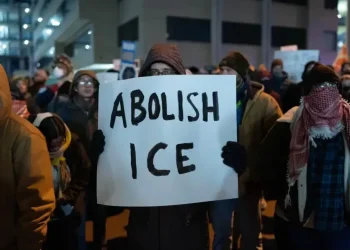
Security planning has also sparked public debate. News that officers from Homeland Security Investigations (HSI), a unit within U.S. Immigration and Customs Enforcement (ICE), would be present during the Games prompted protests in Milan over the past week.
HSI routinely assists at international events in an advisory capacity focused on cross-border crime, and is separate from ICE’s Enforcement and Removal Operations branch associated with immigration enforcement in the United States. Italian Interior Minister Matteo Piantedosi told parliament that the U.S. officers would have no operational role on Italian soil and would remain within diplomatic missions.
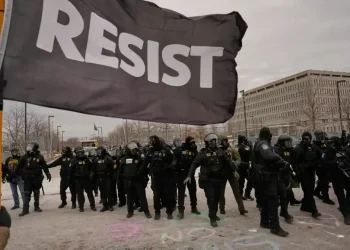
Despite these assurances, at least three rallies were planned in Milan on Friday ahead of the opening ceremony, including demonstrations specifically targeting the ICE presence. On Friday morning, students gathered at Leonardo da Vinci plaza, blowing whistles and chanting as pink smoke drifted above the crowd.
“It’s not only that I don’t like what they are doing to immigrants, I also don’t like what they are doing to protesters,” said 18-year-old Andrea Cucuzza.
Milan Cortina Olympics security decree draws political criticism
The government’s new decree allows police to detain individuals for up to 12 hours if there are reasonable grounds to believe they may incite disorder during otherwise peaceful protests. The measure takes effect immediately upon publication in the official gazette but must be ratified by parliament within 60 days.
Center-left lawmakers argue the decree imposes disproportionate limits on civil liberties and uses Olympic security as a pretext for expanding state control. The government, which holds a parliamentary majority, maintains the law is necessary to prevent a repeat of recent violence.
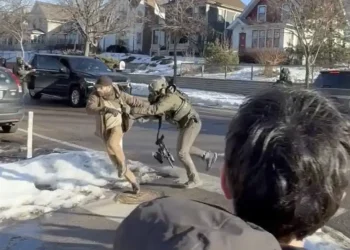
The decision follows clashes in Turin last weekend, where a large demonstration over the eviction of a long-occupied community center turned violent after a smaller group of masked protesters attacked police. The incident accelerated approval of a security package that had been under discussion for months.
Officials insist the new powers are targeted at preventing similar flare-ups during the Olympics, when large crowds and global attention heighten the risks associated with disorder.
Balancing celebration and caution
Italy has hosted major global events before, but the Winter Olympics present a distinctive test of logistics and public order management. The country is seeking to present an image of openness and celebration while ensuring that risks — from cyber threats to protest violence — are contained.
For residents and visitors, much of the security effort will be invisible, unfolding in control rooms, data centers and coordinated patrols rather than at checkpoints. For lawmakers and activists, however, the Games have become a focal point for broader questions about security, sovereignty and civil rights.
As the Olympic flame is lit in Milan, authorities will be hoping that months of preparation, and a newly expanded legal toolkit, allow the competition to proceed without incident across one of the most geographically ambitious Olympic maps in history.
This article was rewritten by JournosNews.com based on verified reporting from trusted sources. The content has been independently reviewed, fact-checked, and edited for accuracy, neutrality, tone, and global readability in accordance with Google News and AdSense standards.
All opinions, quotes, or statements from contributors, experts, or sourced organizations do not necessarily reflect the views of JournosNews.com. JournosNews.com maintains full editorial independence from any external funders, sponsors, or organizations.
Stay informed with JournosNews.com — your trusted source for verified global reporting and in-depth analysis. Follow us on Google News, BlueSky, and X for real-time updates.