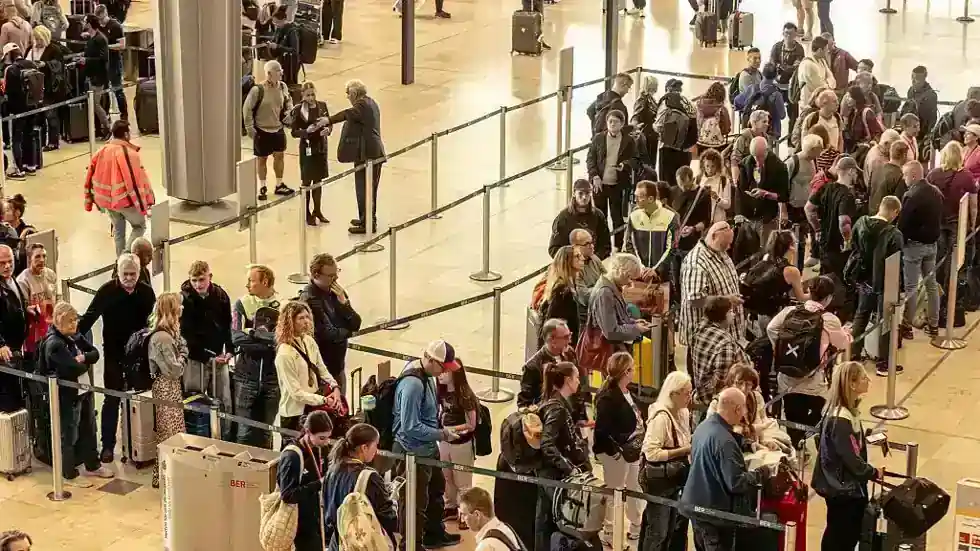
Passengers travelling through European airports during peak holiday periods are being warned to prepare for extended waits at passport control as the European Union’s new biometric border system continues its phased rollout.
Reports of delays stretching into hours have emerged from multiple destinations during busy arrival periods, prompting airport representatives and travel associations to caution that the situation could intensify during the Easter and summer travel peaks.
While the European Commission says the system has largely functioned as intended and allows for temporary suspension at peak times, airport officials argue that staffing pressures and equipment challenges are already creating bottlenecks that were not present under the old passport stamping process.
Border queues reported at key holiday gateways
Videos shared on social media in recent days show passengers standing in long queues at Geneva Airport’s passport control, with some travellers describing waits of up to three hours.
Geneva is typically busy during the winter ski season as visitors, including many from the UK, travel onward to Alpine resorts. Airport authorities say, however, that the new Entry-Exit System (EES) has contributed to congestion, particularly on Saturdays when multiple flights arrive within a short window.
RELATED POSTS
A spokesperson for Geneva Airport described the introduction of the system as a “major challenge” for both Swiss customs and the airport itself. Additional staff have been deployed to ease pressure, but delays have persisted at peak times.
Similar reports have come from Tenerife in Spain’s Canary Islands, a popular winter sun destination for British travellers. Andrew Knight, who runs Sanasty Car Hire at Tenerife Airport, said passenger experiences varied widely depending on arrival time.
Those arriving during quieter periods were passing through passport control within around 20 minutes, he said. But when several aircraft landed close together, queues grew quickly, with some passengers waiting up to two hours to complete the process at border kiosks.
He added that occasional technical issues had further disrupted the flow. “A few times the systems have gone down, so it’s really hit and miss,” he said.
What the Entry-Exit System requires from travellers
The digital Entry-Exit System is designed to replace traditional ink passport stamps for non-EU citizens entering and leaving the Schengen free-movement zone.
Under the system, eligible travellers must register fingerprints and a facial image alongside a passport scan the first time they cross a Schengen border. This biometric registration remains valid for three years and is then used to verify subsequent entries and exits.
At airports, this is typically done using automated kiosks or machines upon arrival before travellers proceed to border officers for verification.
The EES began its gradual rollout in October and is currently operating at around half of border crossing points. At least one third of non-EU passengers are now using the system as part of this transition phase.
Processing times “four to five times” longer, airports say
Olivier Jankovec, director general of Airports Council International (ACI) Europe, which represents more than 600 airports, said the new procedures had significantly increased the time needed to process passengers at border control.
He told the BBC that processing times had risen by “four to five times” compared with the previous system, with passengers in some cases waiting up to two hours.
Jankovec cited a combination of factors, including insufficient border staff and equipment malfunctions, as contributing to the delays. He warned that the situation could deteriorate as more travellers are required to register under EES during major holiday periods.
“If these issues are not addressed and passenger volumes increase over Easter and summer, waiting times of five to six hours are a real risk,” he said.
ACI Europe has called for close coordination between airports and border authorities to ensure contingency measures can be implemented quickly if queues become unmanageable.
European Commission: system “largely without issues”
The European Commission maintains that the EES has so far functioned largely as intended.
Markus Lammert, spokesperson for internal affairs, said that 23 million entries and exits had already been recorded under the system, alongside 12,000 refusals of entry.
From 10 April, the system is scheduled to be in use at every border point for all eligible travellers. However, the Commission has confirmed that member states may partially suspend EES operations during peak periods until September if necessary.
Lammert said countries would continue working on improvements to smooth the process as the rollout continues.
Travel industry urges better use of contingency measures
Travel industry groups say the ability to scale back checks temporarily is not always being used effectively.
ABTA, the UK travel association, said some border authorities were under-using their powers to reduce checks during busy periods, leaving passengers caught in lengthy delays.
The group called for better planning between destinations and border agencies ahead of major travel peaks to prevent unnecessary congestion.
Julia Lo Bue-Said, chief executive of The Advantage Travel Partnership, said the new system had added pressure to border points that were already struggling to handle high passenger volumes.
“Without question, the new system has created even more bottlenecks and pinch points in places that were already challenged,” she said.
She advised travellers to plan for possible delays over school holidays and peak travel periods. “Plan for the worst,” she said, suggesting passengers carry refreshments and items to keep children occupied in case of long waits.
A system still in transition
The EES forms part of the EU’s broader effort to modernise border management, improve security, and create a centralised digital record of non-EU travellers entering and leaving the Schengen area.
While the long-term aim is to speed up repeat crossings through biometric verification, the initial registration requirement is proving time-consuming at busy airports where passenger flows were designed around faster manual checks.
For now, airports, border authorities, and travellers are navigating a transition period in which new technology, staffing levels, and peak seasonal traffic are combining to create unexpected delays at Europe’s gateways.
This article was rewritten by JournosNews.com based on verified reporting from trusted sources. The content has been independently reviewed, fact-checked, and edited for accuracy, neutrality, tone, and global readability in accordance with Google News and AdSense standards.
All opinions, quotes, or statements from contributors, experts, or sourced organizations do not necessarily reflect the views of JournosNews.com. JournosNews.com maintains full editorial independence from any external funders, sponsors, or organizations.
Stay informed with JournosNews.com — your trusted source for verified global reporting and in-depth analysis. Follow us on Google News, BlueSky, and X for real-time updates.