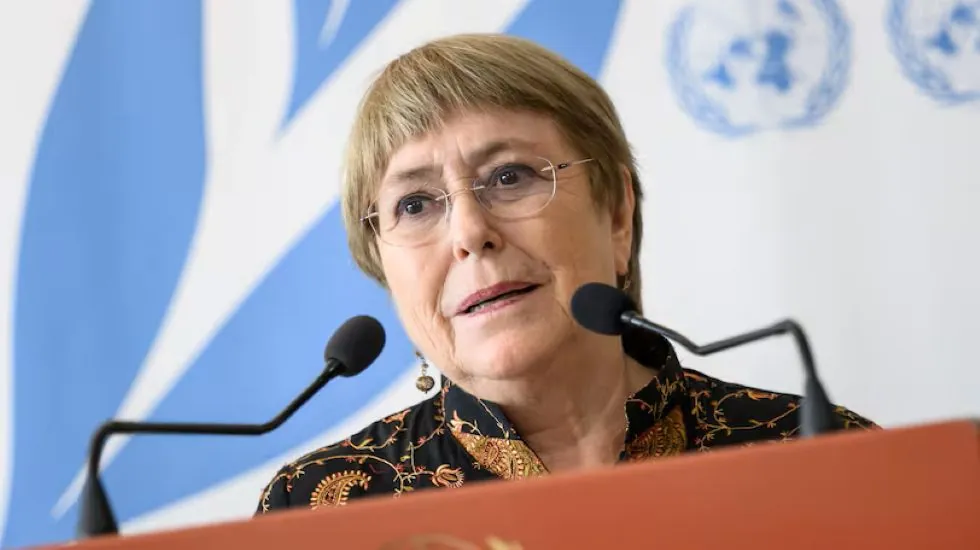
SANTIAGO (JN) – Michelle Bachelet’s candidacy for United Nations Secretary-General has gained formal backing from Chile, Mexico and Brazil, positioning the former Chilean president as a leading regional contender to become the first woman to head the global body. The endorsement signals a coordinated effort by key Latin American governments to present a unified candidate as the term of current Secretary-General António Guterres approaches its end.
Chilean President Gabriel Boric announced the decision on Monday, describing Bachelet as a figure who “faithfully embodies the values of the United Nations” and linking her nomination to broader regional aspirations for a stronger Latin American and Caribbean role in global governance. The move comes amid political transition in Chile, with president-elect José Antonio Kast set to take office next month.
The Michelle Bachelet UN chief bid is emerging as a focal point for Latin American diplomacy at a time when the UN’s leadership rotation tradition places the region in line for the next term.
Regional unity behind Bachelet’s nomination
In a social media statement, Boric framed the nomination as part of a shared commitment to democracy, multilateralism and human rights. He said Latin America continues to believe in “an international system capable of responding with greater effectiveness, legitimacy and humanity to the world’s great challenges.”
Chile’s formal endorsement follows months of quiet diplomatic coordination. Mexico and Brazil have publicly supported Bachelet’s candidacy, giving her backing from three of the region’s most influential governments. This alignment is seen as an attempt to avoid divided regional support, which in past UN selection cycles has weakened candidates.
Boric first nominated Bachelet for the role last year. She later met with Kast to seek cross-party political backing for her international bid, underscoring the effort to present her candidacy as a national rather than partisan initiative.
A career spanning national leadership and UN human rights work
Bachelet, 74, has held a series of historic roles in Chilean politics. She was the country’s first female defence minister and later became Chile’s first woman president, serving two non-consecutive terms from 2006 to 2010 and from 2014 to 2018.
Her international profile expanded significantly after her presidency when she served as the United Nations High Commissioner for Human Rights. In that role, she frequently addressed sensitive global issues, including migration, racial justice and state accountability, positioning her as one of the UN system’s most visible advocates for human rights.
Her tenure as rights chief also placed her at the centre of diplomatic tensions. She criticised policies of former US President Donald Trump during his first term, particularly on immigration and racial justice, prompting sharp responses from Washington. The period coincided with the Trump administration’s decision to withdraw from the UN Human Rights Council.
Those episodes elevated Bachelet’s global recognition but also demonstrated the political complexities surrounding UN leadership roles.
Latin America’s turn in UN leadership rotation
The United Nations, now marking its 81st year, has historically rotated the Secretary-General position among global regions. Only one Latin American has previously held the role: Peruvian diplomat Javier Pérez de Cuéllar, who served from 1982 to 1991.
With Guterres’ term nearing completion, Latin America is widely viewed as next in line under this informal rotation practice. That context is central to the region’s effort to rally behind a candidate with both political leadership experience and a strong UN background.
Bachelet’s profile, combining presidential experience with senior UN leadership, fits criteria that many member states have historically favoured: diplomatic credibility, executive experience, and familiarity with multilateral institutions.
Competing candidacies and diplomatic dynamics
Bachelet is not the only declared contender from the region. Argentine diplomat Rafael Grossi, who currently heads the International Atomic Energy Agency (IAEA), has also entered the race. Grossi brings a strong technical and diplomatic résumé rooted in nuclear oversight and international security, adding another dimension to Latin America’s representation in the field.
The eventual selection will depend not only on regional unity but also on broader geopolitical negotiations among permanent members of the UN Security Council, whose approval is decisive in the appointment process.
In this context, early endorsements from influential Latin American governments are viewed as a strategic step to consolidate support before the campaign moves into more formal diplomatic stages within the UN system.
Gender representation at the UN’s highest level
If selected, Bachelet would become the first woman to serve as Secretary-General in the UN’s history. The absence of a female leader in the organisation’s top post has been the subject of increasing scrutiny in recent years, particularly as the UN promotes gender equality across its programs and agencies.
Her candidacy therefore intersects not only with regional rotation but also with broader calls for gender representation in global leadership.
Bachelet’s career trajectory, from defence minister to president to UN human rights chief, has often been cited as evidence of her ability to operate in traditionally male-dominated political and diplomatic arenas.
Political transition in Chile and continuity of support
The timing of Chile’s endorsement is notable, coming just weeks before Kast assumes office. Observers have noted concerns that a change in government could complicate Chile’s support for Bachelet, given political differences between the outgoing and incoming administrations.
By publicly reaffirming the nomination before the transition, Boric’s government appears to be seeking to lock in institutional backing and signal continuity in Chile’s diplomatic position.
Bachelet’s outreach to Kast suggests an effort to maintain bipartisan support for a candidacy framed as serving Chile’s international standing rather than domestic political interests.
A test of regional coordination
Latin America’s success in securing the Secretary-General post will depend heavily on maintaining unity behind a single candidate. In previous UN selection processes, fragmented regional endorsements have diluted influence.
The joint support from Chile, Mexico and Brazil is therefore seen as an early test of whether the region can sustain a coordinated diplomatic strategy through what is typically a long and politically sensitive selection process.
As the campaign progresses, additional endorsements from other Latin American and Caribbean states are likely to be closely watched for signs of consolidation or division.
This article was rewritten by JournosNews.com based on verified reporting from trusted sources. The content has been independently reviewed, fact-checked, and edited for accuracy, neutrality, tone, and global readability in accordance with Google News and AdSense standards.
All opinions, quotes, or statements from contributors, experts, or sourced organizations do not necessarily reflect the views of JournosNews.com. JournosNews.com maintains full editorial independence from any external funders, sponsors, or organizations.
Stay informed with JournosNews.com — your trusted source for verified global reporting and in-depth analysis. Follow us on Google News, BlueSky, and X for real-time updates.