NEW YORK (JN) – The Westminster Kennel Club Dog Show is widely regarded as the pinnacle of competitive dog showing in the United States. Yet behind the grooming tables, travel crates, and meticulously trained breeds lies a less visible but equally powerful force: the personal relationships that sustain the sport.
For many of the handlers, breeders, and exhibitors who converge on New York each year, Westminster is not simply a test of canine excellence. It is also the culmination of shared lives built around dogs — marriages, partnerships, family traditions, and friendships shaped by decades in the show ring. The event offers a rare lens into how a highly specialized pursuit influences human bonds as profoundly as it celebrates animal ones.
The 150th anniversary edition of the show made this dynamic especially visible, as veteran couples, newcomers, and even Hollywood-connected participants reflected a common theme: dog showing is rarely a solo pursuit. It is often a shared calling that demands logistical coordination, emotional alignment, and mutual commitment on a scale few hobbies or professions require.
A marriage built in the show ring
Few stories illustrate this better than that of Bill and Taffe McFadden, two of the most recognized professional handlers in American dog showing. The couple met at a dog show in the late 1970s and married in 1985, eventually building a career that has taken them to between 150 and 200 shows annually.
Their relationship has unfolded in parallel with their professional rivalry. Both have handled top dogs, sometimes competing directly against each other at major events, including Westminster.
Bill McFadden, a two-time Westminster winner, describes the arrangement without any hint of tension. If one of them wins Best in Show, he says, the victory belongs to both. Some of his strongest memories, he notes, are watching his wife win.
The practical demands of their life underscore why such alignment matters. The couple lives on five acres in California with a rotating population of dogs that require feeding, grooming, training, and transport across the country. The schedule leaves little room for conventional domestic routines, let alone maintaining relationships with partners unfamiliar with the sport’s intensity.
For professional handlers at this level, partnership is less about convenience and more about necessity.
The structure of competition, the continuity of tradition
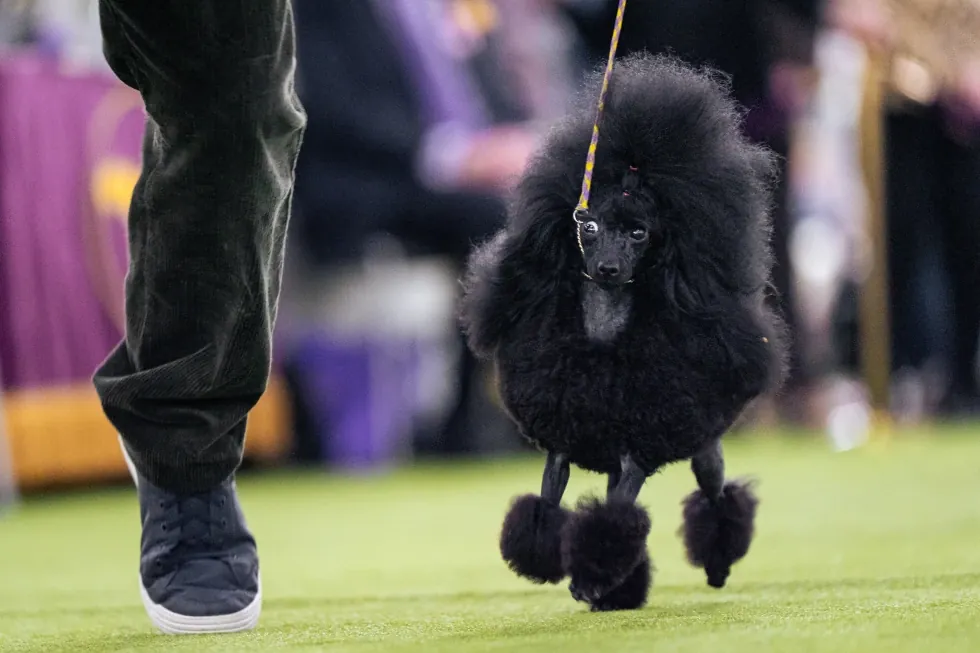
As breed judging began Monday following agility and sport competitions over the weekend, the familiar Westminster rhythm resumed. Dogs from Chihuahuas to Irish wolfhounds entered multi-round breed competitions leading to Tuesday night’s Best in Show award.
Among the early finalists was Zaida, an Afghan hound with two World Dog Show titles who had never previously advanced this far at Westminster. Her handler, Willy Santiago, described the moment as a lifelong aspiration, reflecting how the show often represents the peak of years — sometimes decades — of preparation.
Other advancing dogs carried their own histories. Graham, an Old English sheepdog, is the grandson of Swagger, who finished runner-up at Westminster in 2013. JJ, a Lhasa apso who won the AKC National Championship in December, reflects decades of breed stewardship by his handler and co-owner Susan Giles, who has lived with the breed for over half a century.
These narratives reveal how Westminster is not simply an annual event but a repository of lineage, both canine and human. Success in the ring often represents the continuation of multigenerational effort by breeders, handlers, and families who have invested lifetimes into maintaining breed standards.
When dog showing is not a profession but a shared life
Not all participants are professionals. Randy and Andrea Huelsemann of Wisconsin represent another dimension of Westminster: couples who balance full-time careers with breeding and showing dogs.
He works as a 911 dispatcher; she is a dental hygienist. Together, they breed and show French bulldogs as a shared pursuit rather than a career. Waiting to enter the ring with their dog Ollie, they describe the activity as something they do “for the love of it” and as a hobby that keeps them connected.
This dual-track life — ordinary employment alongside a highly specialized competitive pursuit — is common in the sport. It requires coordination of time, finances, and travel that would be difficult without shared enthusiasm. For such couples, dog showing becomes less an extracurricular activity and more a central axis of their personal lives.
Show dogs with show-business connections
Westminster also attracts participants whose lives extend into other public arenas. Actress Lydia Hearst and her husband, television host Chris Hardwick, attended to support their otterhound, Zoltar. While he did not win his breed, the enthusiasm they brought to ringside reflected a background familiarity with dogs — pets in Hardwick’s case, and show dogs in Hearst’s family.
Hearst’s mother, Patricia Hearst Shaw, also had a dog competing Monday, adding a generational element that mirrors many long-standing dog-show families.
Elsewhere, Wilbur the beagle brought a different form of recognition. The dog appears in the upcoming Netflix drama “The Rip,” starring Matt Damon and Ben Affleck, and competed Monday with a junior handler. His owner, Mary Cummings, has long trained dogs for both show rings and film sets, underscoring the overlap between performance and presentation that dog showing requires.
In these cases, Westminster becomes a convergence point for different worlds, where professional entertainment and canine competition briefly intersect.
The emotional architecture of the sport
Across these stories runs a consistent theme: dog showing demands emotional resilience and long-term commitment. Travel schedules are grueling, financial investment is significant, and outcomes are uncertain. Even elite dogs may never win at Westminster, a reality handlers openly acknowledge.
This uncertainty appears to deepen rather than diminish participants’ attachment to the sport. Success is framed not as an expectation but as the culmination of effort shared across years, sometimes across generations.
Handlers frequently describe their dogs as partners rather than possessions. The language used — “he loves showing,” “she makes me feel anything can happen” — reflects an emotional reciprocity that extends beyond competitive objectives.
For couples and families, this shared emotional vocabulary reinforces bonds. The sport provides not only a common goal but also a common set of experiences: early mornings, cross-country travel, meticulous preparation, and the tension of competition.
Why Westminster highlights more than dogs
Westminster’s global reputation rests on breed standards, judging rigor, and its role as a showcase of canine excellence. Yet the event also functions as a social institution within the dog-show community.
It is a meeting place for people who have spent their lives in a niche world few outsiders fully understand. Marriages form, careers develop, mentorships unfold, and traditions pass from one generation to the next.
In this sense, the show reveals how specialized communities sustain themselves over time. Dogs may be the focal point, but the continuity of the sport depends equally on the people who devote their lives to it — and often to each other.
As Westminster marked its 150th year, the stories behind the leashes offered a reminder that competitive traditions endure not only through rules and trophies, but through relationships built around them.
This article was rewritten by JournosNews.com based on verified reporting from trusted sources. The content has been independently reviewed, fact-checked, and edited for accuracy, neutrality, tone, and global readability in accordance with Google News and AdSense standards.
All opinions, quotes, or statements from contributors, experts, or sourced organizations do not necessarily reflect the views of JournosNews.com. JournosNews.com maintains full editorial independence from any external funders, sponsors, or organizations.
Stay informed with JournosNews.com — your trusted source for verified global reporting and in-depth analysis. Follow us on Google News, BlueSky, and X for real-time updates.