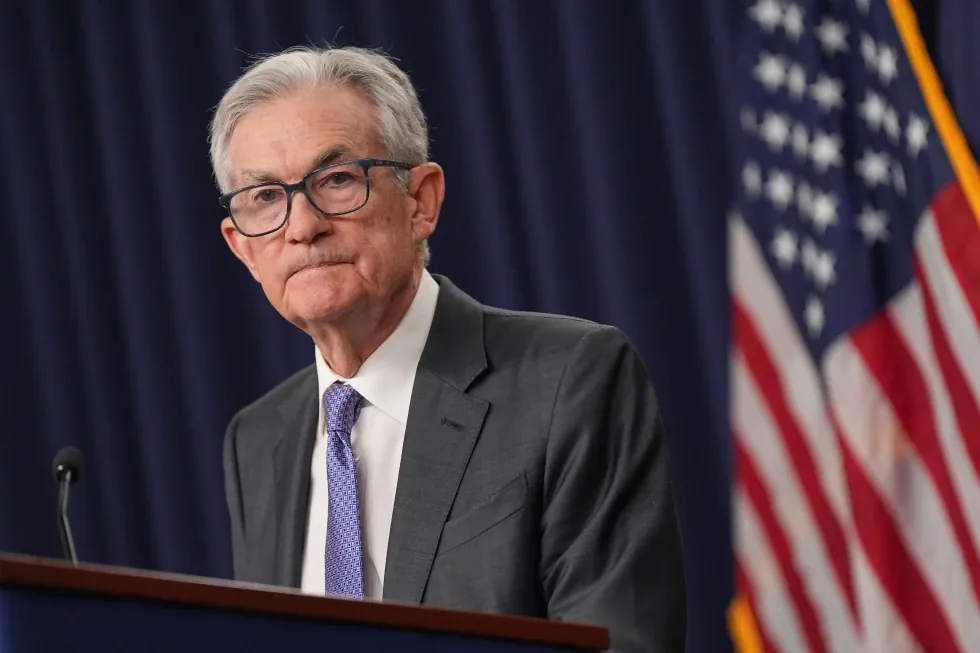
WASHINGTON (AP) – The U.S. Federal Reserve on Wednesday left its benchmark interest rate unchanged, signaling caution about further easing even as President Donald Trump continues to publicly urge sharper cuts. Policymakers said the economy has shown resilience in recent months, reducing the urgency to move quickly on borrowing costs.
The decision highlights the delicate balance the Fed faces as it navigates moderating inflation, steady economic growth, and an unusually intense political backdrop. While most officials still anticipate rate reductions later this year, they are seeking clearer evidence that price pressures are easing toward the central bank’s 2% goal.
The move also underscores the Fed’s emphasis on institutional independence, as Chair Jerome Powell addressed questions ranging from trade policy to legal challenges involving the central bank and the White House.
Rates remain on hold as outlook improves
The Federal Open Market Committee voted to keep its key short-term interest rate at roughly 3.6%, following three reductions last year. In its post-meeting statement, the Fed said the economic outlook has improved since December and noted signs that the labor market is stabilizing.
Powell said at a news conference that growth remains solid and should support hiring over time. Recent data show the U.S. economy expanded at an annual rate of 4.4% in the July-to-September quarter, the most recent figures available, suggesting that current interest rates are not significantly restraining activity.
With unemployment appearing to level off, many policymakers see little immediate need to provide additional stimulus. Powell indicated that the Fed can afford to wait, describing the economy as having “once again surprised us with its strength.”
Inflation remains the central concern
Despite progress from the highs seen in 2022, inflation remains above the Fed’s target. According to the central bank’s preferred measure, prices rose 2.8% in November from a year earlier, a level officials say warrants caution.
Most policymakers expect inflation to continue easing, but several want firmer evidence before backing further rate cuts. Michael Gapen, chief U.S. economist at Morgan Stanley, said Powell “kept the door open” to additional reductions once inflation shows clearer signs of deceleration.
Powell also addressed the impact of tariffs imposed by the Trump administration, which have raised prices on some imported goods such as furniture and appliances. He said the Fed views tariffs largely as a one-time price increase and expects their effect on inflation to peak around midyear, assuming no major new trade measures are introduced.
Divisions within the Fed
The decision to hold rates was not unanimous. Governors Stephen Miran and Christopher Waller dissented, preferring a quarter-point cut. Miran, appointed by Trump in September, has consistently pushed for more aggressive easing, while Waller is among those reportedly under consideration to succeed Powell when his term as chair ends in May.
The split reflects a broader debate within the Fed over how long to remain on pause. Some officials argue that premature cuts could reignite inflation, while others believe lower rates would provide additional support to hiring as job growth shows signs of cooling.
In December, only 12 of the 19 policymakers participating in the Fed’s meetings supported at least one rate cut this year. Most private-sector economists expect two reductions in 2026, likely beginning in June or later.
Political pressure and institutional independence
The Fed’s latest decision comes amid sustained criticism from Trump, who has repeatedly faulted Powell for not cutting rates more sharply. Lower policy rates can ease borrowing costs for mortgages, auto loans, and businesses, though longer-term rates are also influenced by financial markets.
Powell faced questions on issues extending beyond monetary policy, reflecting what many economists describe as an unprecedented period of political scrutiny for the central bank. Earlier this month, Powell disclosed that the Justice Department issued subpoenas related to his congressional testimony on a $2.5 billion Fed building renovation. Powell has said the investigation is a pretext aimed at pressuring the Fed over interest rates.
On Wednesday, he declined to elaborate further on the matter.
Separately, the U.S. Supreme Court last week heard arguments in a case stemming from Trump’s attempt to remove Fed Governor Lisa Cook over allegations of mortgage fraud, which she denies. No Fed governor has been fired in the institution’s 112-year history, and justices appeared inclined to allow Cook to remain in her post while the case proceeds.
Powell said he attended the Supreme Court hearing because of its significance to the Fed’s independence, calling it “perhaps the most important legal case” in the central bank’s history.
Looking ahead to leadership changes
Trump has suggested he may soon name a successor to Powell, whose term as chair expires in May, though previous timelines have slipped. Powell said he has not yet decided whether he would remain on the Fed’s board as a governor after stepping down as chair.
Asked if he had advice for his eventual successor, Powell offered a brief response: avoid politics. “Don’t get involved in elected politics,” he said. “Don’t do it.”
Despite the pressure, Powell said he is confident the Fed can maintain its independence, noting support from colleagues and lawmakers. Several Republican senators have publicly backed Powell and warned they could oppose a replacement seen as politically driven.
Consumers cautious, spending holds up
While the broader economy remains resilient, consumer sentiment has weakened. The Conference Board said this week that its measure of consumer confidence fell to an 11-year low in January, reflecting persistent concerns about inflation and household finances.
Powell acknowledged the disconnect, noting that while surveys show pessimism, actual spending remains solid. Consumer demand continues to be a key driver of U.S. growth, even as gains are uneven across income groups.
“The overall numbers are good,” Powell said, pointing to steady consumption as a pillar of economic strength.
For now, Wall Street expects the Fed to keep rates unchanged at least until midyear, as policymakers weigh incoming data on inflation, employment, and the broader impact of trade policy.
This article was rewritten by JournosNews.com based on verified reporting from trusted sources. The content has been independently reviewed, fact-checked, and edited for accuracy, neutrality, tone, and global readability in accordance with Google News and AdSense standards.
All opinions, quotes, or statements from contributors, experts, or sourced organizations do not necessarily reflect the views of JournosNews.com. JournosNews.com maintains full editorial independence from any external funders, sponsors, or organizations.
Stay informed with JournosNews.com — your trusted source for verified global reporting and in-depth analysis. Follow us on Google News, BlueSky, and X for real-time updates.