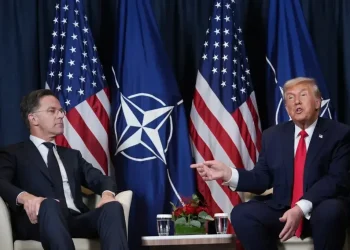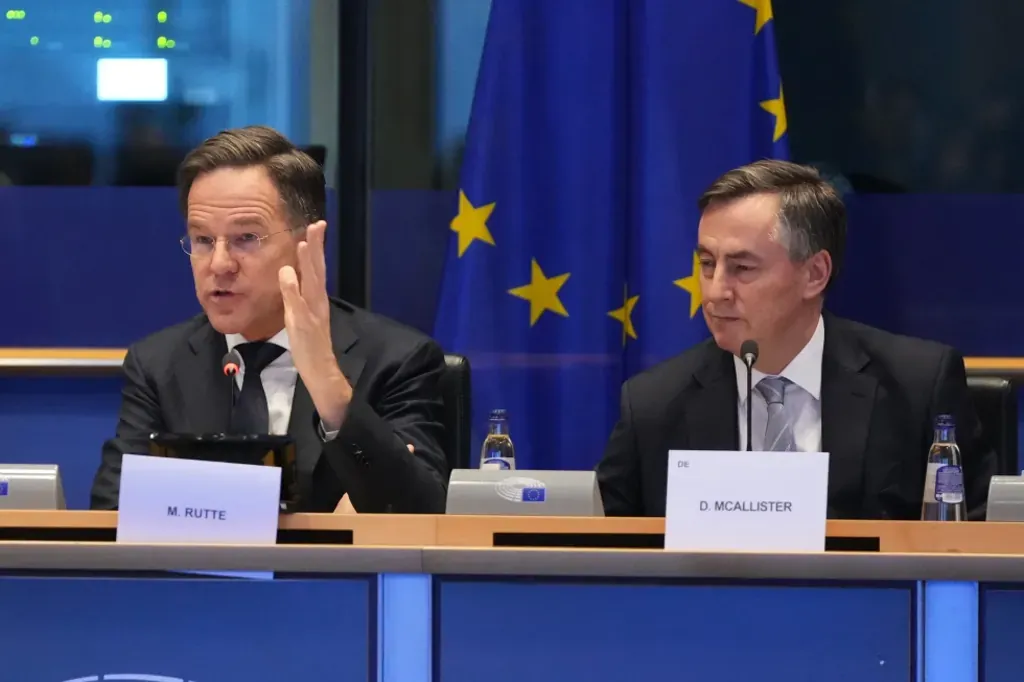
BRUSSELS (AP) – NATO Secretary-General Mark Rutte has issued a blunt warning that Europe would be unable to defend itself without continued U.S. military support, arguing that any attempt to do so would require far higher defense spending and capabilities that most European states do not possess. Speaking in Brussels, Rutte dismissed the idea of European self-sufficiency in security as unrealistic under current conditions.
His comments come amid renewed political strain within the transatlantic alliance, as questions resurface about the United States’ long-term security commitments to Europe and the scale of European defense investment. While European leaders have pledged to increase military spending, Rutte suggested those commitments still fall far short of what would be needed to replace U.S. power.
Addressing members of the European Parliament, the NATO chief stressed that Europe and the United States remain mutually dependent for their security, with Washington continuing to provide the alliance’s most critical military capabilities.
Europe’s reliance on U.S. military power
“If anyone thinks here … that the European Union or Europe as a whole can defend itself without the U.S., keep on dreaming. You can’t,” Rutte told lawmakers on Monday. He said the transatlantic partnership remains indispensable, adding that Europe and the United States “need each other.”
Rutte’s remarks directly challenged calls from some European leaders for greater “strategic autonomy,” the idea that Europe should be able to conduct major military operations and defend itself independently of Washington. While acknowledging that Europe should strengthen its own defenses, he argued that replacing U.S. military support entirely is not feasible in the foreseeable future.
A central issue, Rutte said, is nuclear deterrence. Without the United States, Europe would lose what he described as the “ultimate guarantor” of its security — the U.S. nuclear umbrella that underpins NATO’s collective defense.
Spending targets and the cost of independence
At NATO’s summit in The Hague in July, European allies — with the exception of Spain — along with Canada agreed to a significant increase in defense spending following pressure from U.S. President Donald Trump. The allies pledged to spend 3.5% of gross domestic product on core defense and an additional 1.5% on security-related infrastructure by 2035, bringing total commitments to 5% of GDP.
Rutte said even those targets would be insufficient if Europe attempted to go it alone.
“If you really want to go it alone, forget that you can ever get there with 5%,” he said. “It will be 10%. You have to build up your own nuclear capability. That costs billions and billions of euros.”
His comments underline the scale of the financial and political challenge facing Europe if it were to pursue full military independence, particularly in areas such as nuclear deterrence, strategic airlift, missile defense, and intelligence — domains where the United States plays a dominant role.
Tensions within NATO over U.S. policy
Rutte’s intervention comes as NATO faces internal strains linked to recent statements and actions by President Trump. In recent weeks, Trump renewed threats to annex Greenland, a semi-autonomous territory of NATO member Denmark, raising concerns among European allies about U.S. intentions toward alliance partners.
Trump also announced new tariffs targeting Greenland’s European backers, though he later dropped those threats after what Rutte described as a “framework” agreement was reached regarding the mineral-rich Arctic island. Few details of that arrangement have been made public.
The episode has added to unease in Europe over Washington’s reliability, even as U.S. military power remains central to NATO’s defense posture.
Article 5 and collective defense
NATO’s 32 member states are bound by Article 5 of the alliance’s founding Washington Treaty, which commits each country to come to the defense of an ally whose territory is under attack. The credibility of that guarantee depends heavily on U.S. military strength, particularly its nuclear forces and rapid deployment capabilities.
Rutte emphasized that without the United States, Europe would face a fundamental shift in its security environment. “Without the U.S., Europe would lose the ultimate guarantor of our freedom,” he said, before adding pointedly: “So, hey, good luck.”
While European defense cooperation has expanded in recent years, NATO officials and independent analysts have repeatedly noted that duplicating U.S. capabilities would take decades and vast resources.
Strategic autonomy debate continues
France has been the leading advocate of European strategic autonomy, arguing that the continent must be better prepared to act independently if U.S. priorities shift elsewhere. Support for that position has grown since the Trump administration warned last year that Washington’s security focus was increasingly concentrated outside Europe.
Rutte did not reject the idea of Europe strengthening its defenses, but his remarks suggested clear limits to what autonomy can realistically mean. In his view, greater European responsibility should complement — not replace — the transatlantic alliance.
The debate is likely to continue as European governments balance domestic political pressures, budget constraints, and growing security challenges, while navigating an increasingly uncertain relationship with Washington.
This article was rewritten by JournosNews.com based on verified reporting from trusted sources. The content has been independently reviewed, fact-checked, and edited for accuracy, neutrality, tone, and global readability in accordance with Google News and AdSense standards.
All opinions, quotes, or statements from contributors, experts, or sourced organizations do not necessarily reflect the views of JournosNews.com. JournosNews.com maintains full editorial independence from any external funders, sponsors, or organizations.
Stay informed with JournosNews.com — your trusted source for verified global reporting and in-depth analysis. Follow us on Google News, BlueSky, and X for real-time updates.