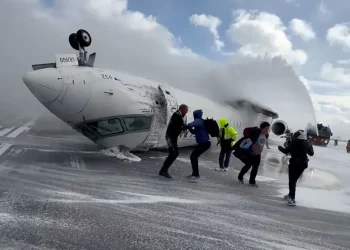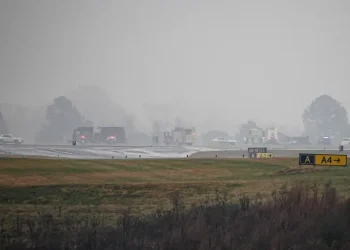
PORTLAND, Maine (JN) – The fatal crash of a business jet during takeoff from Bangor International Airport in Maine is expected to focus investigators’ attention on the aircraft’s deicing process, as questions emerge about weather conditions and a model-specific history of icing-related incidents.
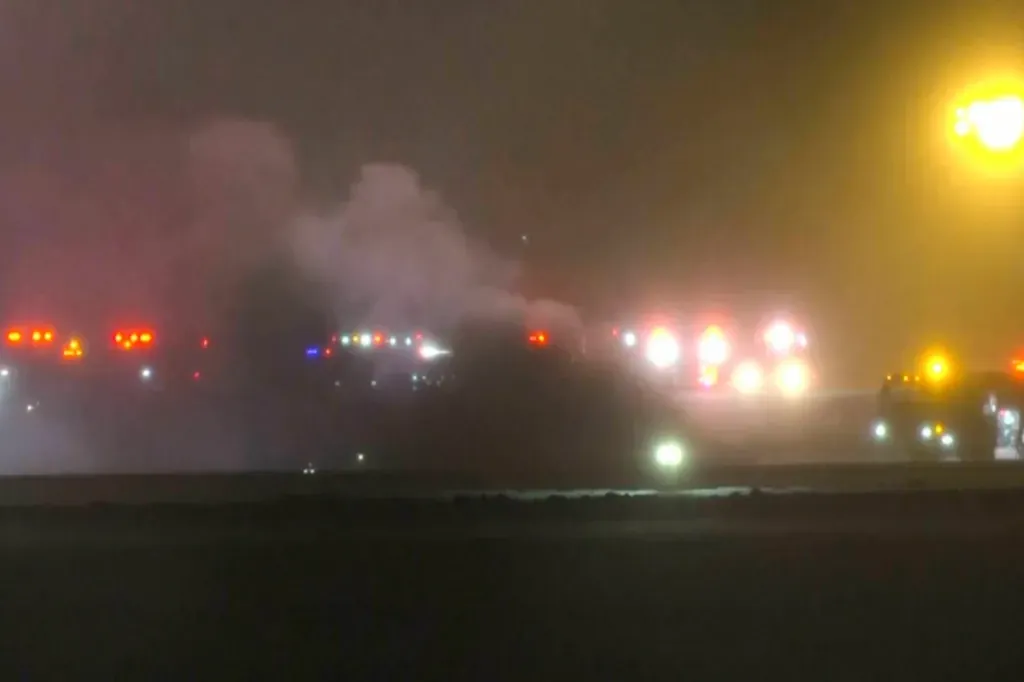
A Bombardier Challenger 600 crashed and caught fire shortly after departing the runway on Sunday evening, killing all six people aboard, airport officials said. The accident occurred as a major winter storm was beginning to reach the region, bringing deteriorating visibility and freezing temperatures, though snowfall accumulation at the airport was still light at the time.
Federal investigators have not determined a cause. The National Transportation Safety Board (NTSB) said the aircraft went down immediately after departure and was consumed by a post-crash fire. A preliminary factual report is expected within about a month, while a final report identifying the cause is likely more than a year away.
Crash during worsening weather conditions
The crash occurred around 7:45 p.m. as New England braced for a large winter storm. While Bangor ultimately received close to 10 inches of snow, National Weather Service data show that accumulation was minimal at the time of the accident, with light but steady snowfall and winds of around 10 miles per hour. Temperatures were falling toward minus 16 degrees Celsius (3 degrees Fahrenheit).
Airport officials said other aircraft were landing and departing safely around the same period. About 30 minutes before the crash, however, a pilot for a Florida-bound Allegiant Air flight aborted a takeoff attempt, citing failed deicing fluid and insufficient visibility. Air traffic control advised that visibility had dropped to roughly three-quarters of a mile.
Audio recordings posted by LiveATC.net indicate that the Challenger 600 had taxied to the deicing pad and requested treatment for its wings and tail. The jet remained there for approximately 20 minutes before proceeding to the runway.
Focus on deicing procedures
Aviation safety consultant Jeff Guzzetti, a former federal crash investigator, said the Challenger 600 has a documented history of takeoff accidents linked to ice contamination on the wings.
“Even a small amount of ice can dramatically affect lift,” Guzzetti said, adding that proper deicing is critical in freezing or near-freezing conditions. He said investigators are likely to examine whether any residual ice remained on the aircraft before departure.
The jet had arrived in Bangor from Houston at about 6:09 p.m., according to FlightRadar24 data, meaning it was on the ground for more than an hour as temperatures dropped. Investigators have previously noted that cold fuel stored in wing tanks can accelerate ice formation when aircraft are exposed to wintry conditions.
Aircraft and ownership details
The Bombardier Challenger 600 is a wide-body business jet typically configured to carry nine to 11 passengers. Introduced in 1980, it was among the first private jets to feature a stand-up cabin and remains in service with charter and corporate operators.
The aircraft involved in the crash was registered to a corporation based in Houston, Texas, sharing an address with the law firm Arnold and Itkin Trial Lawyers. One of the firm’s founding partners is listed as the registered agent for the company that owns the plane. Authorities have not suggested any connection between the firm and the cause of the accident.
The identities of those killed have not yet been released. Officials said names will be made public once formal identification is complete.
Emergency response and airport operations
Air traffic control audio from the moments after the crash includes a controller reporting that an aircraft was “upside down” less than a minute after takeoff clearance was issued. First responders reached the scene within a minute, according to airport director Jose Saavedra.
Bangor International Airport, located about 320 kilometers (200 miles) north of Boston, closed following the accident and is expected to remain shut until at least Wednesday while investigators examine and remove the wreckage. The airport is frequently used by private and military aircraft and is known for operating in challenging weather due to its joint-use arrangement with the Maine Air National Guard.
Airport officials emphasized that winter operations are routine. Controllers noted that the airport rarely closes, even during snowstorms, and staff are accustomed to maintaining runways during adverse weather.
History of icing concerns
Past investigations into Challenger 600 accidents prompted Bombardier and the U.S. Federal Aviation Administration to recommend revised procedures aimed at ensuring wings are free of ice before takeoff. Guzzetti said such incidents have become less common in recent years, but the aircraft’s design history means icing remains a known risk factor.
“Given the conditions and this aircraft’s background, that’s going to be one of the first things investigators look at,” he said.
For now, officials stress that no conclusions should be drawn until investigators complete their on-site work and analyze flight data, wreckage, and weather information. The NTSB is expected to provide further updates once its team arrives in Bangor.
This article was rewritten by JournosNews.com based on verified reporting from trusted sources. The content has been independently reviewed, fact-checked, and edited for accuracy, neutrality, tone, and global readability in accordance with Google News and AdSense standards.
All opinions, quotes, or statements from contributors, experts, or sourced organizations do not necessarily reflect the views of JournosNews.com. JournosNews.com maintains full editorial independence from any external funders, sponsors, or organizations.
Stay informed with JournosNews.com — your trusted source for verified global reporting and in-depth analysis. Follow us on Google News, BlueSky, and X for real-time updates.