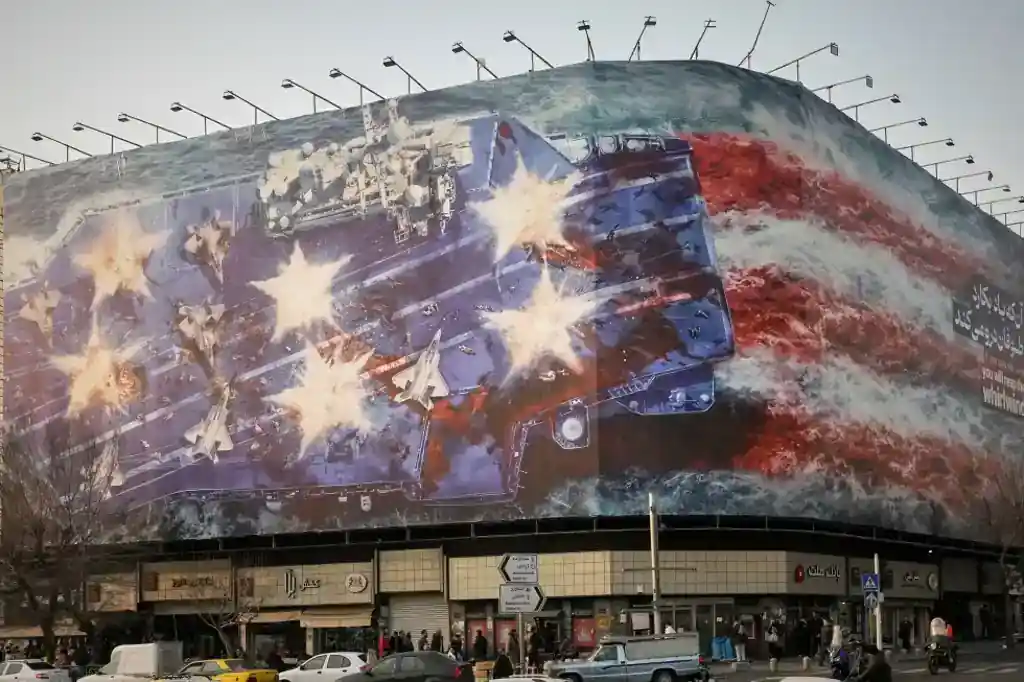
DUBAI, United Arab Emirates (JN) – Iranian authorities have unveiled a stark new mural in central Tehran warning the United States against launching a military strike, as U.S. naval forces move closer to the Middle East and diplomatic tensions deepen following months of unrest inside Iran.
The mural, installed on a giant billboard in Enghelab Square, depicts an aircraft carrier seen from above, its flight deck littered with destroyed fighter jets, bodies, and trails of blood flowing into the surrounding sea. The imagery culminates in a visual echo of the red and white stripes of the U.S. flag. A warning message is printed across the artwork: “If you sow the wind, you will reap the whirlwind.”
The display appears calibrated to coincide with the movement of the USS Abraham Lincoln aircraft carrier strike group toward the region. U.S. President Donald Trump has described the deployment as precautionary, saying the ships are heading to the area “just in case” military action becomes necessary.
Symbolic warning in a politically charged public space
Enghelab Square, located in the heart of Tehran, has long served as a focal point for state-organized rallies and public messaging. Authorities routinely replace the square’s mural to mark national anniversaries or signal political positions, making it a highly visible platform for messaging aimed both at domestic audiences and foreign governments.
The unveiling comes days after Iran’s Islamic Revolutionary Guard Corps (IRGC) commander issued a warning that the force was “more ready than ever, finger on the trigger,” language that underscored Tehran’s confrontational posture as military assets converge in the region.
President Trump, speaking earlier in the week, said the U.S. deployment was intended to provide options rather than signal an imminent strike. “We have a massive fleet heading in that direction and maybe we won’t have to use it,” he said.
Still, the mural’s imagery suggests Iranian officials are intent on broadcasting the potential cost of any confrontation, relying on symbolism rather than direct official statements to convey deterrence.
U.S. and allied military movements intensify
The U.S. Central Command confirmed that F-15E Strike Eagle fighter jets are now operating in the Middle East, saying their presence enhances combat readiness and contributes to regional security and stability. The announcement followed heightened rhetoric from Washington over Iran’s internal crackdown and regional activities.
The United Kingdom has also taken precautionary steps. The British Ministry of Defence said it had deployed Typhoon fighter jets to Qatar in a defensive role, emphasizing that the move was intended to support stability rather than signal escalation.
Taken together, the deployments reflect growing concern among Western governments about the potential for miscalculation, even as officials stress that the measures are defensive.
Protests and crackdown remain central to tensions
The sharp rise in U.S.–Iran tensions follows a sweeping crackdown on nationwide protests that erupted in late December. Demonstrations initially began over economic grievances, including the collapse of Iran’s currency, the rial, before expanding into broader expressions of anger toward the ruling theocracy.
Security forces responded with force, and the protests were eventually quelled after weeks of unrest. Authorities imposed a sweeping internet blackout lasting more than two weeks, severely limiting the flow of information both inside and outside the country.
President Trump has repeatedly cited the government’s response to the protests as a key factor shaping U.S. policy. He warned of possible military action if Iran continued killing peaceful demonstrators or carried out mass executions of detainees.
In recent days, Trump claimed Tehran had halted the planned execution of around 800 protesters. Iran’s top prosecutor rejected that assertion as “completely false,” highlighting the sharp divergence between official Iranian statements and claims from abroad.
Conflicting accounts of death toll and arrests
Independent verification of events during the unrest has remained difficult. The U.S.-based Human Rights Activists News Agency (HRANA) reported on Sunday that at least 5,848 people were killed during the crackdown, with more than 41,280 arrested. The group said its figures were based on a network of activists inside Iran who verify individual cases.
HRANA’s estimates, if accurate, would mark the deadliest period of unrest in Iran in decades, surpassing previous protest movements and recalling the violence surrounding the 1979 Islamic Revolution. The Associated Press has said it has not been able to independently verify the figures.
Iran’s government has acknowledged a far lower death toll of 3,117, stating that 2,427 of those killed were civilians and members of the security forces, and labeling the remainder as “terrorists.” Iranian authorities have previously been accused by international observers of underreporting casualties during periods of unrest.
The disparity between the figures remains a point of contention, feeding international criticism and complicating diplomatic efforts.
Rhetoric hardens despite pause in protests
Although large-scale protests have subsided in recent days, reports from activists suggest deaths continue to be recorded as information slowly emerges following the internet blackout. The absence of demonstrations has not eased rhetorical pressure from Washington.
Trump has said any future military action would dwarf previous U.S. strikes on Iranian nuclear facilities, remarking that last June’s attacks would “look like peanuts” by comparison. The comment reinforced the sense that the administration is deliberately keeping its options open.
For Tehran, the mural in Enghelab Square appears to serve as a calculated response—an assertion of resolve designed to warn against escalation without issuing a formal military threat.
As U.S. and allied forces consolidate their presence and Iran projects defiance through symbolism and rhetoric, the situation remains tense, with both sides signaling preparedness while stopping short of direct confrontation.
This article was rewritten by JournosNews.com based on verified reporting from trusted sources. The content has been independently reviewed, fact-checked, and edited for accuracy, neutrality, tone, and global readability in accordance with Google News and AdSense standards.
All opinions, quotes, or statements from contributors, experts, or sourced organizations do not necessarily reflect the views of JournosNews.com. JournosNews.com maintains full editorial independence from any external funders, sponsors, or organizations.
Stay informed with JournosNews.com — your trusted source for verified global reporting and in-depth analysis. Follow us on Google News, BlueSky, and X for real-time updates.