WASHINGTON (JN) – The U.S. House of Representatives on Thursday approved the final set of annual spending bills, clearing a major hurdle toward funding much of the federal government and averting a partial shutdown later this month. The package, totaling roughly $1.2 trillion, now moves to the Senate, where lawmakers face a Jan. 30 deadline to complete action.
While most of the legislation drew broad bipartisan backing, the measure funding the Department of Homeland Security exposed deep divisions over immigration policy and enforcement. Democrats said the bill failed to meaningfully constrain the Trump administration’s deportation agenda, while Republicans argued it was essential to national security and border control.
The votes reflected lingering political tensions following last year’s record 43-day government shutdown, as both parties sought to project stability while drawing sharp contrasts on immigration and oversight of federal agencies.
Bipartisan support for most spending measures
Three of the four appropriations bills passed with wide margins, funding the Departments of Defense, Education, Transportation, and Health and Human Services, among others. Together, they include a 3.8% pay raise for U.S. military personnel, a provision that drew support across party lines.
The full four-bill package passed the House by a 341–88 vote. The Homeland Security bill, however, was approved on a narrower 220–207 margin after Republicans overcame unified Democratic opposition.
Lawmakers from both parties emphasized the urgency of completing the appropriations process to avoid another funding lapse. The House is several months behind the typical schedule, but leaders said passing individual bills rather than a single omnibus measure marked a return to more regular order.
Democratic objections center on ICE funding
House Democratic leaders announced ahead of the vote that they would oppose the Homeland Security bill, citing concerns that it did not sufficiently limit funding for Immigration and Customs Enforcement (ICE) amid the administration’s stepped-up deportation efforts.
In a joint statement, Democratic Leader Hakeem Jeffries, Whip Katherine Clark, and Caucus Chair Pete Aguilar said President Donald Trump had pledged to prioritize the removal of violent criminals but had instead overseen enforcement actions that, they said, swept up U.S. citizens and lawfully present immigrants.
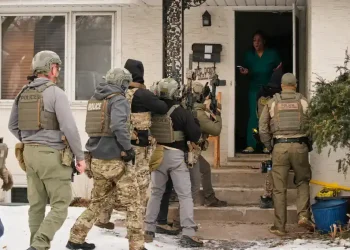
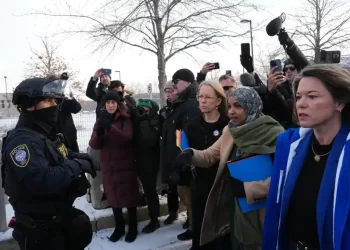
They pointed to recent immigration operations in the Minneapolis area, where, according to Democratic lawmakers, more than 2,000 officers have been deployed. Democrats referenced the fatal shooting of Renee Nicole Good, a mother of three, by an ICE officer, an incident they cited as evidence of what they described as excessive enforcement practices.
“Taxpayer dollars are being misused to brutalize U.S. citizens,” the leaders said in their statement, calling for stronger oversight of the agency.
Limited leverage for Democrats
Democrats acknowledged they had few viable options to block or significantly alter the Homeland Security funding.
Typically, funding disputes are resolved through short-term continuing resolutions that maintain current spending levels. But Rep. Rosa DeLauro of Connecticut, the top Democrat on the House Appropriations Committee, said that approach would have handed greater discretion to the administration over how Homeland Security funds are allocated.
There was also concern that failing to pass a Homeland Security bill could disrupt disaster relief programs and operations at agencies such as the Transportation Security Administration, while ICE and Customs and Border Protection could continue operating using funds provided through earlier legislation.
ICE, which usually receives about $10 billion annually through regular appropriations, was allocated substantially more funding for operations and detention facilities under a separate Republican-backed tax and immigration package approved earlier.
Oversight provisions included in final bill
The Homeland Security bill approved by the House keeps Congress’s direct annual funding for ICE roughly flat compared with the previous year. It also includes provisions limiting the Homeland Security secretary’s ability to unilaterally shift funds between accounts.
Among the oversight measures added to the bill is $20 million for the purchase and operation of body cameras for ICE and Customs and Border Protection officers during public-facing enforcement activities. The legislation also requires the department to provide monthly reports to Congress detailing how it plans to spend funds authorized under earlier immigration legislation.
Rep. Henry Cuellar of Texas, a Democrat on the Appropriations Committee, said the bill fell short of his party’s goals but represented a partial step toward accountability.
“We wanted more oversight,” Cuellar said. “But Democrats don’t control the House, the Senate, or the White House. This was the oversight we were able to secure.”
Republicans defend bill as public safety measure
Republicans rejected Democratic characterizations of ICE and defended the Homeland Security bill as central to the government’s responsibility to protect the public.
“This legislation delivers on that duty and upholds the America First agenda,” said Rep. Tom Cole of Oklahoma, the Republican chair of the House Appropriations Committee.
GOP lawmakers also highlighted that this year’s process avoided a large omnibus spending bill, which they argue tends to increase overall federal spending. Non-defense discretionary spending in the package is slightly below current levels, Republicans said.
Rep. Mark Alford of Missouri said the votes demonstrated that the House was returning to its governing role after months of partisan standoffs.
“It sends a clear message back home that the House is back at work,” Alford said.
Heated debate on the House floor
The Homeland Security vote was preceded by emotional speeches from Democratic lawmakers, many of whom focused on ICE’s expanded hiring of deportation officers and enforcement tactics.
Rep. Betty McCollum of Minnesota said constituents in her state were being racially profiled and detained without cause. Rep. Jerrold Nadler of New York said he could not support funding for what he described as abusive practices, while Rep. Clark accused the administration of using immigration enforcement for political retribution.
Republicans pushed back sharply. Cole warned that rhetoric portraying ICE agents as broadly abusive risked undermining public trust in federal law enforcement.
“It’s reckless to suggest there are masses of bad actors in a single agency,” he said.
Last-minute provision removed
In a late change to the package, the House unanimously agreed to remove a provision that would have repealed senators’ ability to sue the government over the collection of their cellphone data during special counsel Jack Smith’s investigation into the Jan. 6, 2021, attack on the U.S. Capitol.
The provision, included in an earlier funding measure, had allowed damages claims of up to $500,000 and had drawn bipartisan criticism.
With House passage complete, attention now turns to the Senate, where leaders must decide whether to advance the bills as written or seek changes before the shutdown deadline.
This article was rewritten by JournosNews.com based on verified reporting from trusted sources. The content has been independently reviewed, fact-checked, and edited for accuracy, neutrality, tone, and global readability in accordance with Google News and AdSense standards.
All opinions, quotes, or statements from contributors, experts, or sourced organizations do not necessarily reflect the views of JournosNews.com. JournosNews.com maintains full editorial independence from any external funders, sponsors, or organizations.
Stay informed with JournosNews.com — your trusted source for verified global reporting and in-depth analysis. Follow us on Google News, BlueSky, and X for real-time updates.