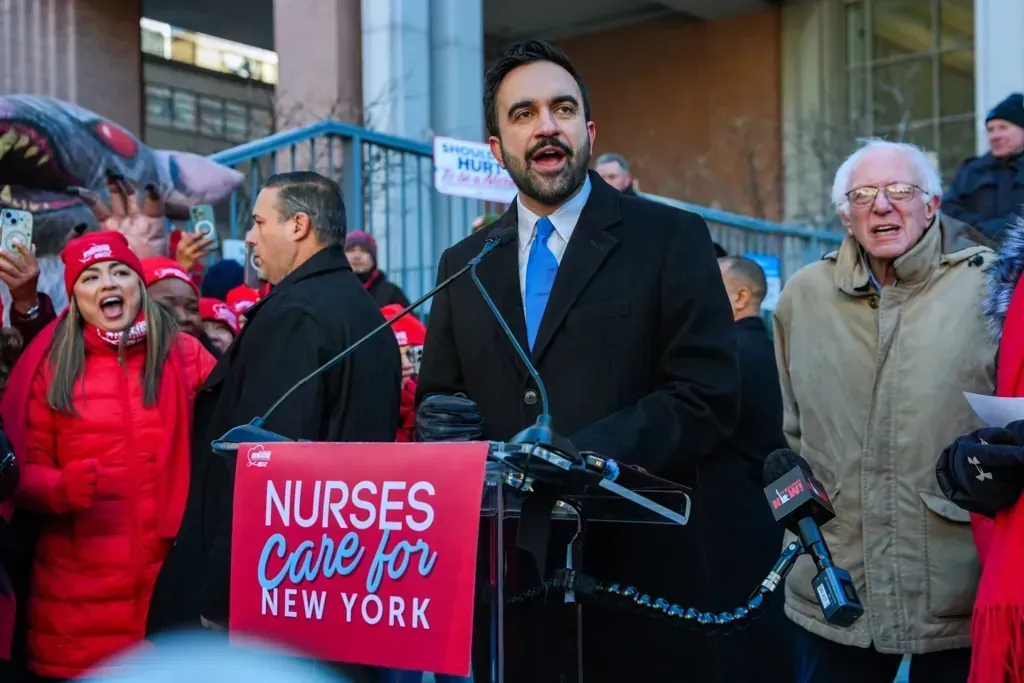
NEW YORK (JN) – New York City Mayor Zohran Mamdani and U.S. Senator Bernie Sanders joined striking nurses in Manhattan on Tuesday, amplifying pressure on hospital executives as the city’s largest nursing walkout in decades entered its ninth day.
The rally outside Mount Sinai West underscored the growing political attention surrounding the labor dispute, which has sidelined roughly 15,000 nurses across three major hospital systems. Union leaders say stalled negotiations over pay and benefits have left frontline staff with few options but to remain on strike, even as hospitals insist their operations remain stable.
The dispute has become a high-profile test of labor relations in New York’s health care sector, touching on broader debates over hospital finances, executive compensation, and the sustainability of working conditions for nurses in one of the world’s most expensive cities.
Political leaders join picket lines
Speaking to a crowd of nurses and supporters on the Upper West Side, Mamdani and Sanders called on hospital management to resume serious negotiations with the New York State Nurses Association (NYSNA), which represents the striking workers.
Sanders, a Vermont independent who has long aligned with progressive labor causes, criticized what he described as excessive executive compensation within the health care industry. He argued that rising pay for hospital executives stands in sharp contrast to the pressures faced by nurses who provide day-to-day patient care.
Mamdani echoed those sentiments, framing the strike as not only a labor dispute but also a cost-of-living issue. He told nurses that the city should be a place where health care workers can afford to live as well as work, drawing applause from the crowd gathered outside the hospital.
Both leaders stopped short of proposing specific contract terms, instead urging hospital systems to return to the bargaining table and reach a negotiated settlement.
Limited progress in negotiations
The strike began on January 12 after contract talks broke down between NYSNA and three hospital systems: Mount Sinai, Montefiore, and NewYork-Presbyterian. Since then, the union says it has held one bargaining session with each system, but reports little substantive progress.
Union representatives describe the meetings as lengthy but unproductive. Jonathan Hunter, a registered nurse at Mount Sinai and a member of the negotiating committee, said the sessions failed to produce meaningful movement on key issues.
The union met with Montefiore officials on Sunday evening, following earlier talks last week with administrators from Mount Sinai and NewYork-Presbyterian. As of Tuesday, no additional bargaining sessions had been scheduled.
Hospital administrators say they are waiting for guidance from contract mediators on when talks should resume. Each hospital system is negotiating separately with the union, adding complexity to the process and limiting the prospect of a coordinated breakthrough.
Pay and benefits at the center of dispute
At the heart of the conflict are disagreements over wages and health care benefits. Hospital officials say the union is seeking salary increases totaling about 25 percent over three years, a demand they argue is unrealistic given current financial pressures.
NewYork-Presbyterian said in a statement that the union’s proposals do not reflect “the economic realities of healthcare in New York City and the country,” pointing to rising costs and reductions in federal Medicaid funding.
Hospital representatives also emphasize that nurses at their facilities are already among the highest paid in the city. They maintain that the compensation packages on offer are competitive and sustainable within existing budgets.
The union, however, disputes that framing. NYSNA argues that rising living costs and demanding working conditions have eroded the real value of nurses’ pay, and that proposed changes to benefits would leave many workers more vulnerable.
Nurses cite personal stakes
On the picket lines Tuesday morning, nurses marched in freezing temperatures, chanting slogans as passing taxi drivers honked in solidarity. For many participants, the dispute goes beyond wages to include concerns about health security and family stability.
Nicole Rodriguez, a nurse at Mount Sinai West, said preserving comprehensive health care benefits is her primary concern. She described living with an autoimmune condition that leaves her frequently ill and worried about transmitting infections to her child.
Rodriguez said reliable health coverage is essential not only for her family’s well-being but also for her ability to provide safe, effective care to patients. She expressed hope that hospital management would recognize the level of public support behind the strike and reconsider its position.
The union says hospitals are seeking to reduce benefits, while hospital systems counter that they have proposed maintaining existing employer-funded health plans. Administrators argue those benefits already exceed what most private-sector employees receive.
Hospitals say care continues
Despite the ongoing strike, hospital officials say patient care has not been compromised. The systems involved report that they have hired thousands of temporary nurses to fill staffing gaps and have committed additional funds to extend those contracts as needed.
In a message to staff on Monday, Mount Sinai CEO Brendan Carr said employees who continued working during the strike, along with temporary staff, were helping to maintain essential services and save lives.
Hospital leaders acknowledge the disruption caused by the walkout but stress that contingency plans were implemented in advance. They also reiterate that long-term financial stability is necessary to sustain patient care across their networks.
A standoff with broader implications
As the strike continues, both sides appear entrenched, with no immediate timetable for renewed negotiations. The presence of prominent political figures has raised the dispute’s profile, but it remains unclear whether that attention will translate into movement at the bargaining table.
For New York’s health care system, the outcome could shape future labor talks and set benchmarks for pay and benefits in an industry already under strain. For the nurses on strike, the focus remains on securing a contract they believe reflects the realities of their work and the cost of living in the city they serve.
This article was rewritten by JournosNews.com based on verified reporting from trusted sources. The content has been independently reviewed, fact-checked, and edited for accuracy, neutrality, tone, and global readability in accordance with Google News and AdSense standards.
All opinions, quotes, or statements from contributors, experts, or sourced organizations do not necessarily reflect the views of JournosNews.com. JournosNews.com maintains full editorial independence from any external funders, sponsors, or organizations.
Stay informed with JournosNews.com — your trusted source for verified global reporting and in-depth analysis. Follow us on Google News, BlueSky, and X for real-time updates.