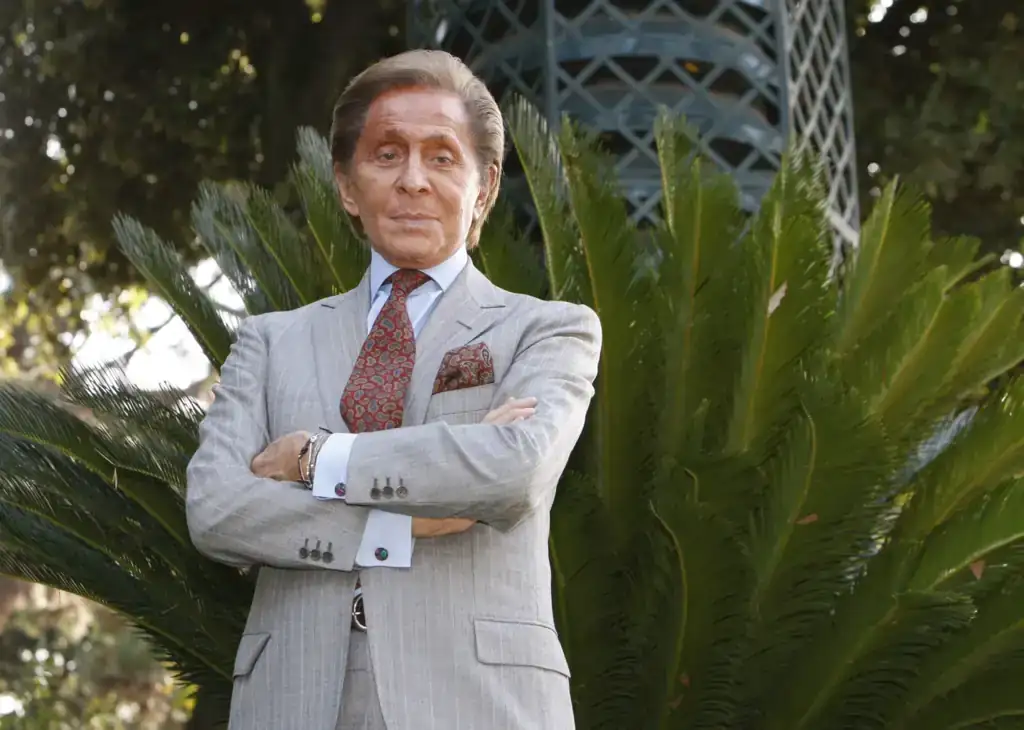
MILAN (JN) – Valentino Garavani, the Italian fashion designer whose name became synonymous with refined glamour and a distinctive shade of crimson known as “Valentino red,” has died at his home in Rome. He was 93, according to a statement from the Valentino Garavani and Giancarlo Giammetti Foundation.
For nearly half a century, Valentino’s couture dressed royalty, first ladies and Hollywood stars, offering a vision of elegance that resisted trends and favored timeless beauty. From Paris runways to the world’s most photographed red carpets, his work helped define modern haute couture while projecting a distinctly Italian sense of grace.
Though he stepped away from active design in 2008, Valentino’s influence continued to shape the global fashion industry, both through the house that bears his name and through a legacy closely tied to the idea that clothing should make women feel confident, beautiful and seen.

A designer known simply as Valentino
Universally recognized by his first name, Valentino cultivated a rare stature in fashion, one that transcended seasons and marketing cycles. His foundation described him as “a constant guide and inspiration” and “a source of light, creativity and vision,” reflecting the reverence he commanded within his own institution.
He was known for a clear philosophy. “I know what women want,” he once said. “They want to be beautiful.” That conviction guided collections that avoided provocation or shock, favoring clean lines, rich fabrics and meticulous craftsmanship.
Although based in Rome, Valentino often presented his haute couture collections in Paris, aligning himself with the traditional center of high fashion. He spoke French fluently and worked closely with his longtime partner Giancarlo Giammetti, who managed the business side of the house from its earliest days.
Red carpets, royalty and global recognition
Valentino’s designs became fixtures at major cultural moments. His gowns were worn by Jacqueline Kennedy Onassis, Julia Roberts, Cate Blanchett and Queen Rania of Jordan, among many others. Roberts famously accepted her Academy Award in 2001 wearing a vintage black-and-white Valentino gown, while Blanchett won an Oscar in 2004 dressed in butter-yellow silk from the designer.
Kennedy Onassis was among his closest friends and most devoted clients. She wore a long-sleeved lace Valentino dress for her 1968 wedding to Aristotle Onassis and later favored the designer almost exclusively. Diana, Princess of Wales, was also frequently seen in his creations.
These relationships were not only commercial but personal, reinforcing Valentino’s reputation as a designer trusted by women under intense public scrutiny.
Signature style and enduring aesthetics
Beyond his iconic red, Valentino was known for romantic details: bows, ruffles, lace and intricate embroidery. His dresses emphasized femininity without excess, achieving a balance that appealed across generations and cultures.
He avoided overtly political or conceptual fashion, instead positioning couture as an art of refinement. That restraint helped him maintain relevance across decades in an industry often driven by disruption.
His approach also made him a favorite for formal occasions, earning him a reputation as the “king of the red carpet” during the height of awards-season fashion.
A jet-set life aligned with his clientele
Valentino shared the lifestyle of his clients. Perpetually tanned and impeccably dressed, he moved between homes in Rome, Paris, New York, London, Capri, Gstaad and elsewhere, often accompanied by a group of pugs.
His assets included a 46-meter yacht, a major art collection with works by Picasso and Miró, and a 17th-century château near Paris reportedly surrounded by more than a million roses. Friends and guests over the years included Madonna, Gwyneth Paltrow and other figures from fashion, film and society.
In interviews, Valentino spoke candidly about his views on appearance and presentation, expressing a belief that elegance was a form of respect — for oneself and for others.
From Voghera to global fashion capitals
Born on May 11, 1932, in Voghera in northern Italy, Valentino credited his childhood love of cinema with inspiring his fascination with beauty and style. After studying fashion in Milan and Paris, he worked in the 1950s for established designers Jean Dessès and Guy Laroche.
He founded the House of Valentino in 1959 on Rome’s Via Condotti. Giammetti joined him from the outset, forming a partnership that would endure for more than six decades.
Despite early financial difficulties, the brand gained momentum as Valentino attracted influential supporters, including Italian film stars Gina Lollobrigida and Sophia Loren, Hollywood icons Elizabeth Taylor and Audrey Hepburn, and Vogue editor Diana Vreeland, who championed his work internationally.
Business expansion and later years
As the label grew, Valentino expanded into ready-to-wear, menswear and accessories, transforming the house into a global luxury brand. In 1998, Valentino and Giammetti sold the company to an Italian holding group for an estimated $300 million, though Valentino remained creatively involved for another decade.
He celebrated his 45th anniversary in fashion in 2007 with a three-day event in Rome, culminating in a grand ball at the Villa Borghese.
After his retirement in 2008, the brand underwent several creative transitions before entering a period of renewed prominence under designers Maria Grazia Chiuri and Pierpaolo Piccioli. Alessandro Michele, formerly of Gucci, is set to present his next Valentino collection in Rome, a symbolic departure from Paris that reflects the house’s roots.
Today, Valentino is majority-owned by Qatar-based Mayhoola, with a minority stake held by Kering, which retains an option to assume full control later in the decade.
Tributes and final arrangements
Tributes poured in from across the fashion world and beyond. Italian Prime Minister Giorgia Meloni called Valentino “an indisputable maestro of eternal style and elegance,” while designers and models shared messages of admiration and loss.
A public viewing will be held Wednesday and Thursday at the Valentino Garavani and Giancarlo Giammetti Foundation in Rome. A funeral service is scheduled for Friday at the Basilica di Santa Maria degli Angeli e dei Martiri.
Valentino Garavani leaves behind a legacy defined not by trends, but by a disciplined belief in beauty — one that shaped how elegance itself is understood.
This article was rewritten by JournosNews.com based on verified reporting from trusted sources. The content has been independently reviewed, fact-checked, and edited for accuracy, neutrality, tone, and global readability in accordance with Google News and AdSense standards.
All opinions, quotes, or statements from contributors, experts, or sourced organizations do not necessarily reflect the views of JournosNews.com. JournosNews.com maintains full editorial independence from any external funders, sponsors, or organizations.
Stay informed with JournosNews.com — your trusted source for verified global reporting and in-depth analysis. Follow us on Google News, BlueSky, and X for real-time updates.