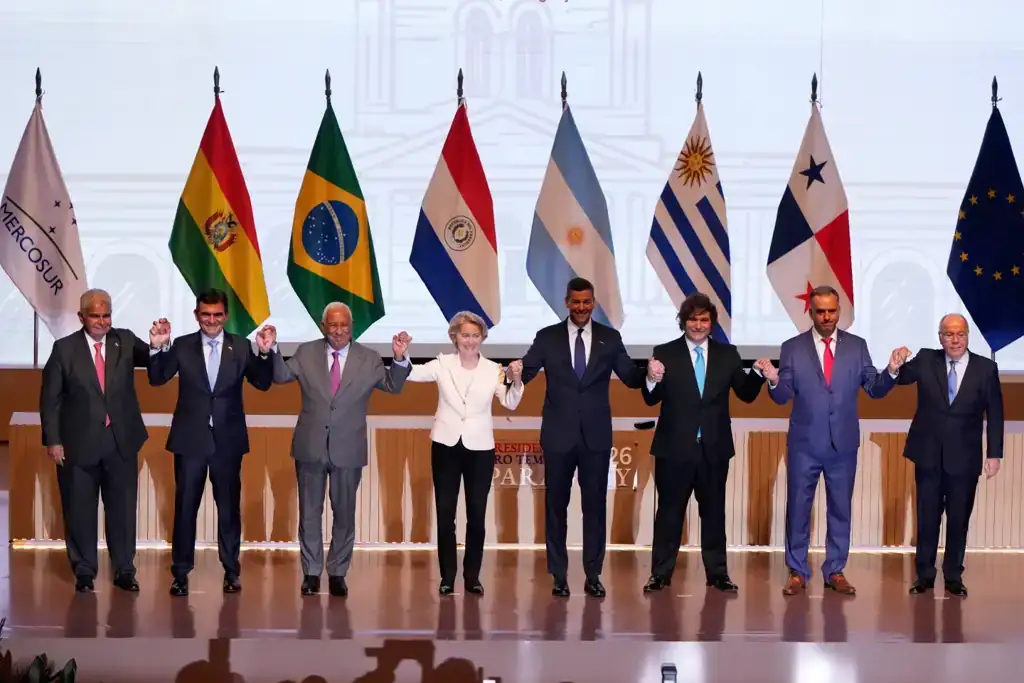
ASUNCION, Paraguay (Journos News) – The European Union and the Mercosur bloc of South American nations on Saturday formally signed a landmark free trade agreement, concluding more than two decades of complex negotiations and reshaping economic ties between the two regions. The accord links markets across Europe and South America at a time of heightened global trade tensions and growing competition among major powers.
Signed in Asuncion, Paraguay, the agreement is designed to gradually lower trade barriers, deepen commercial integration, and reinforce multilateral cooperation between regions representing more than 700 million people. While ratification in Europe remains the final hurdle, the deal is already being framed by its supporters as a strategic statement in favor of open trade.
The agreement arrives as governments worldwide grapple with rising protectionism, supply chain realignments, and geopolitical rivalry, giving the pact significance well beyond tariff schedules and export quotas.

A deal decades in the making
The signing ceremony marked the culmination of negotiations that began more than 25 years ago between the EU and Mercosur, a South American customs bloc that includes Argentina, Brazil, Paraguay and Uruguay. Bolivia, the group’s newest member, is not covered by the current agreement but could join at a later stage. Venezuela remains suspended from Mercosur and is excluded.
Under the terms of the accord, more than 90% of tariffs on goods traded between the two regions will be phased out over time. Products affected range from South American agricultural exports, including beef and sugar, to European manufactured goods such as cars, machinery and pharmaceuticals. Once fully implemented, the agreement would create one of the largest free trade areas in the world.
Supporters say the deal will lower costs for consumers, expand export opportunities for businesses on both sides of the Atlantic, and provide greater predictability for long-term investment. European industrial sectors and South American agricultural producers have been among its strongest backers.
Leaders frame pact as response to protectionism
European Commission President Ursula von der Leyen described the agreement as a clear signal that the EU and Mercosur are choosing cooperation over trade barriers. Speaking at the ceremony, she said the pact reflected a commitment to fair trade and long-term partnership, without directly naming specific countries.
Brazilian President Luiz Inácio Lula da Silva, a longtime proponent of the deal, echoed that message in a statement published on social media, calling the agreement a vote for multilateralism at a moment when unilateral policies risk fragmenting global markets.
The signing took place against a backdrop of renewed trade friction globally, with several governments reassessing tariff policies and industrial protections. For EU officials, the Mercosur agreement is also seen as strengthening Europe’s economic presence in a region where both the United States and China have expanded their influence.
Ratification hurdles remain in Europe
Despite the formal signing, the agreement must still be ratified by the European Parliament before it can enter into force. While approval is considered likely in South America, the process in Europe is expected to be more politically sensitive.
Several EU member states have faced strong domestic opposition from farming groups concerned about competition from South American agricultural imports. France has been among the most vocal critics, with President Emmanuel Macron warning that the deal could intensify political backlash from farmers already under pressure.
EU trade commissioner Maroš Šefčovič said he would begin intensive outreach to European lawmakers to build support for ratification, expressing confidence that the agreement could be approved within the year. He argued that the pact sends a broader signal about the value of predictable, rules-based trade.
Farmers, environment, and political compromise
One of the main reasons negotiations dragged on for years was disagreement over agricultural standards and environmental safeguards. European negotiators pushed for commitments related to deforestation, food safety, and sustainability, arguing that European farmers could not compete without common rules.
The final agreement includes environmental provisions, import quotas for sensitive farm products, and phased tariff reductions. To ease domestic concerns, the EU also committed to additional financial support for its agricultural sector, a move that helped bring some previously hesitant member states on board.
Critics in South America have at times described the EU’s demands as excessive, while European farmers’ groups remain wary that enforcement of safeguards may prove insufficient once trade volumes increase.
Mercosur’s renewed relevance
For Mercosur, the agreement marks a revival after years of internal political divisions, economic crises, and questions about the bloc’s future. The pact is being seen as evidence that the group can still function as a credible platform for international trade negotiations.
Argentine President Javier Milei’s support drew particular attention. Elected in late 2023 after campaigning against Mercosur and threatening withdrawal, Milei embraced the agreement as consistent with his free-market agenda. Speaking at the signing, he argued that protectionism had contributed to economic stagnation in the region.
Brazilian President Lula did not attend the ceremony, reflecting lingering tensions over how the final stages of the negotiations were handled. Still, Brazil remains a central beneficiary of the agreement, given its size and export capacity.
Strategic and economic implications
If ratified, the EU–Mercosur deal would bind two major economic regions at a time when global trade rules are under strain. Analysts say it could encourage further trade agreements and reinforce multilateral institutions, even as geopolitical competition intensifies.
For businesses and investors, the agreement promises expanded market access and clearer long-term rules. For governments, it represents a test of whether large, complex trade deals can still win political backing amid domestic economic anxiety.
The coming months will determine whether Europe’s lawmakers give final approval, turning a long-negotiated framework into one of the most significant trade agreements of the decade.
This article was rewritten by JournosNews.com based on verified reporting from trusted sources. The content has been independently reviewed, fact-checked, and edited for accuracy, neutrality, tone, and global readability in accordance with Google News and AdSense standards.
All opinions, quotes, or statements from contributors, experts, or sourced organizations do not necessarily reflect the views of JournosNews.com. JournosNews.com maintains full editorial independence from any external funders, sponsors, or organizations.
Stay informed with JournosNews.com — your trusted source for verified global reporting and in-depth analysis. Follow us on Google News, BlueSky, and X for real-time updates.