The United States faces a renewed test of its transatlantic relationships after President Donald Trump said eight European countries would be hit with new tariffs for opposing U.S. control of Greenland, an autonomous territory within the Kingdom of Denmark and a NATO ally.
Trump said the proposed import tax would take effect as early as February, escalating sharply if European governments do not engage in talks over what he described as a potential U.S. acquisition of the strategically located Arctic island. The announcement has drawn swift criticism from European leaders and raised questions about the legal and diplomatic viability of the move.
The comments, delivered via social media while Trump was in Florida, revive an issue that has periodically strained relations between Washington and European capitals, blending trade policy with long-standing geopolitical sensitivities over sovereignty, alliance commitments, and Arctic security.

Tariff threat and escalation timeline
In a post on his Truth Social platform, Trump said Denmark, Norway, Sweden, France, Germany, the United Kingdom, the Netherlands and Finland would face a 10% tariff on goods exported to the United States starting in February. He added that the rate would rise to 25% on June 1 if no agreement was reached on what he called the “complete and total purchase of Greenland” by the United States.
The president framed the tariffs as leverage, arguing that European opposition to U.S. control of Greenland undermines American national security interests. He said Washington was “immediately open to negotiation” with Denmark and the other countries he named, despite their stated resistance to any change in Greenland’s status.
The proposal marks one of the most explicit links Trump has drawn between trade penalties and territorial or security disputes involving U.S. allies, echoing earlier efforts during his presidency to use tariffs as a negotiating tool in unrelated policy areas.
European reaction and alliance concerns
European leaders responded cautiously but firmly, warning that the tariff threat risks deepening divisions within the NATO alliance and destabilising transatlantic economic ties.
Denmark’s foreign minister, Lars Løkke Rasmussen, said the announcement came as a surprise, citing what he described as a constructive meeting with senior U.S. officials in Washington earlier in the week. He reiterated that Greenland’s status is not open for negotiation.
In a joint statement, European Commission President Ursula von der Leyen and European Council President António Costa said tariffs of this kind would undermine transatlantic relations and risk a “dangerous downward spiral.” They said the European Union remains committed to defending its sovereignty and unity.
Diplomats also questioned how the tariffs could be implemented in practice, given that the EU functions as a single customs and trade bloc. One European diplomat noted that selectively targeting individual EU member states would be difficult under existing trade rules, while the legal authority for such measures under U.S. law remains uncertain.
Legal and policy questions in Washington
It remains unclear what statutory powers the White House would rely on to impose the proposed tariffs. Trump has previously invoked emergency economic authorities to justify unilateral trade measures, though the scope of those powers is currently under review by the U.S. Supreme Court.
Some members of Congress have expressed concern about the use of tariffs as a foreign policy instrument. Republican Representative Don Bacon of Nebraska said the episode highlighted the need for Congress to reclaim greater authority over tariff policy, warning against decisions being made solely at presidential discretion.
The tariff threat comes ahead of Trump’s planned trip to the World Economic Forum in Davos, Switzerland, where he is expected to encounter several of the European leaders whose countries would be affected.
Greenland’s strategic role
Trump has repeatedly argued that Greenland is critical to U.S. national security, citing its location between North America and Europe and its proximity to Arctic shipping routes. He has also pointed to the island’s largely untapped reserves of critical minerals.
The United States already maintains a military presence in Greenland under a 1951 defence agreement with Denmark. Today, about 200 U.S. personnel are stationed at Pituffik Space Base in the island’s northwest, supporting missile warning, missile defence and space surveillance operations for both the U.S. and NATO.
Danish officials say that American access to Greenland has never been in question. Denmark provides for the island’s defence and has recently increased its military activity there in coordination with allies, citing broader concerns about Arctic security and potential Russian activity in the region.
Military activity and regional tensions
Trump suggested that recent European troop deployments to Greenland, which he described as symbolic, were part of the justification for the tariff threat. Danish military leaders, however, said the deployments were part of routine Arctic defence training among NATO allies.
Maj. Gen. Søren Andersen, who leads Denmark’s Joint Arctic Command, said Copenhagen does not expect any military confrontation with the United States. Speaking in Nuuk, Greenland’s capital, he stressed that NATO allies do not plan for conflict with one another and that recent exercises were aimed at improving coordination in harsh Arctic conditions.
Andersen also said he has not observed Chinese or Russian warships operating near Greenland during his tenure, despite repeated warnings from Trump that Moscow or Beijing could seek to expand their presence in the area.
Protests and political symbolism
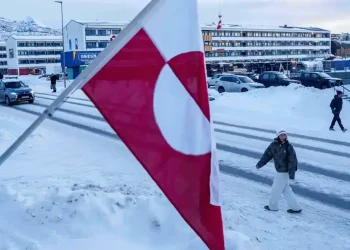
The tariff announcement coincided with public demonstrations in Greenland and Denmark. In Nuuk, hundreds of residents marched through icy streets to show support for Greenlandic self-governance. In Copenhagen, thousands of protesters carried Greenland’s flag and signs opposing U.S. claims.
Danish protester Elise Riechie told the Associated Press that the issue extended beyond Greenland itself. “There are many small countries,” she said. “None of them are for sale.”
The rallies followed a visit by a bipartisan delegation of U.S. lawmakers to Copenhagen, where they sought to reassure Danish and Greenlandic officials of continued congressional support for the alliance.
Broader implications for NATO
The dispute underscores broader strains within NATO as Trump again questions long-standing assumptions about alliance solidarity. While he has argued that tariffs are preferable to military force, critics say linking trade policy to territorial demands risks eroding trust among allies.
Democratic Senator Chris Coons of Delaware, speaking during the congressional visit to Denmark, said the country remains one of Washington’s closest partners. He warned that actions causing allies to doubt U.S. reliability could have consequences well beyond the current dispute.
As European leaders weigh their response, the episode highlights how Greenland — sparsely populated but geopolitically significant — has become a focal point for wider debates over security, sovereignty and the future of transatlantic cooperation.
This article was rewritten by JournosNews.com based on verified reporting from trusted sources. The content has been independently reviewed, fact-checked, and edited for accuracy, neutrality, tone, and global readability in accordance with Google News and AdSense standards.
All opinions, quotes, or statements from contributors, experts, or sourced organizations do not necessarily reflect the views of JournosNews.com. JournosNews.com maintains full editorial independence from any external funders, sponsors, or organizations.
Stay informed with JournosNews.com — your trusted source for verified global reporting and in-depth analysis. Follow us on Google News, BlueSky, and X for real-time updates.