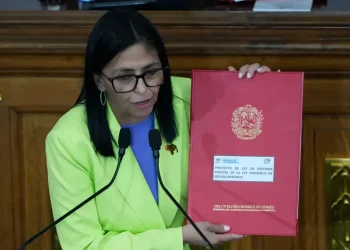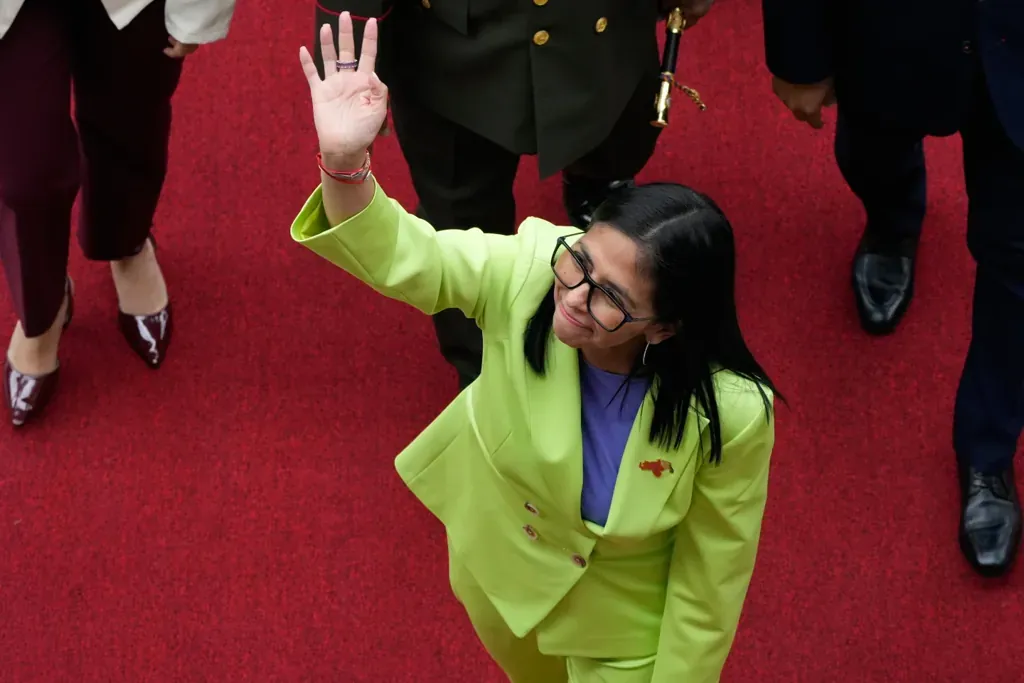
WASHINGTON (Journos News) – Documents reviewed by The Associated Press show that Venezuela’s acting president, Delcy Rodríguez, has been the subject of sustained scrutiny by the U.S. Drug Enforcement Administration for years, including being designated a “priority target” in 2022. The records shed light on a parallel track of intelligence-gathering that contrasts with the recent diplomatic signals from Washington following the removal of Nicolás Maduro.
While the U.S. government has never publicly accused Rodríguez of criminal wrongdoing, the files underscore the complexity facing U.S. policymakers as they navigate a volatile post-Maduro landscape. Rodríguez, a longtime Maduro ally who rose through Venezuela’s political hierarchy, is now being treated publicly as a potential interlocutor even as U.S. law enforcement has quietly monitored her activities across multiple investigations.
The AP’s reporting, based on internal records and interviews with current and former U.S. officials, offers the most detailed picture to date of the DEA’s interest in Rodríguez and the broader context of how power has operated inside Venezuela’s governing elite.

Years of intelligence gathering
According to the records obtained by AP, the DEA has maintained an intelligence file on Rodríguez dating back to at least 2018, when she became vice president. The file catalogs known associates and allegations that range from drug trafficking to gold smuggling, though none of those claims have been tested in court or resulted in public charges.
In 2022, the DEA elevated Rodríguez to the status of a “priority target,” a designation reserved for individuals believed to have a significant impact on the drug trade and one that allows investigators to devote additional resources. Current and former U.S. law enforcement officials told AP that the label does not imply guilt or guarantee prosecution, and that hundreds of people worldwide carry the same designation at any given time.
Rodríguez’s name appears in nearly a dozen DEA investigations involving field offices in Latin America and the United States, including Paraguay, Ecuador, Phoenix and New York. Several of those inquiries remain ongoing, though the specific focus of each investigation could not be determined from the records.
Three current and former DEA agents who reviewed the documents for AP described a sustained interest in Rodríguez during much of her tenure as vice president. They spoke on condition of anonymity because they were not authorized to discuss active or past investigations.
Allegations without public charges
The documents include unverified claims from confidential informants. One report from early 2021 alleges that Rodríguez used hotels on Isla Margarita, a Caribbean resort island, as fronts for money laundering. AP was unable to independently confirm the information, and no public charges have been filed related to the allegation.
Isla Margarita has long been viewed by U.S. authorities as a strategic transit point for drug trafficking routes into the Caribbean and Europe. Over the years, numerous traffickers have been arrested or have sought refuge there, including individuals linked to Mexico’s Sinaloa cartel.
The records also reference scrutiny of Rodríguez’s alleged connections to Alex Saab, a Colombian businessman and close Maduro ally who was arrested in 2020 on U.S. money laundering charges. Saab was later pardoned in 2023 by President Joe Biden as part of a prisoner exchange involving Americans detained in Venezuela.
Despite these references, the U.S. government has never publicly accused Rodríguez of criminal conduct. She is also notably absent from the list of more than a dozen Venezuelan officials who were charged alongside Maduro in U.S. drug trafficking cases.
Political rise and sanctions
Rodríguez, 56, has been one of Maduro’s most loyal aides, building her career through roles as foreign minister and vice president before assuming the acting presidency this month. Her political worldview was shaped early by the death of her father, a socialist activist who died in police custody when she was a child, an event she has publicly blamed on the U.S.-backed authorities of the time.
Despite her anti-U.S. rhetoric, Rodríguez worked during the first Trump administration to court American investment, including hiring U.S. lobbyists with ties to Trump’s political circle. Those efforts collapsed in 2018 when Washington, encouraged by then–Sen. Marco Rubio, intensified pressure on Maduro to hold competitive elections.
That same year, the U.S. Treasury sanctioned Rodríguez, describing her as central to Maduro’s consolidation of power and authoritarian rule. The European Union imposed similar sanctions. Those measures focused on democratic backsliding rather than corruption or drug trafficking.
Diplomatic tension after Maduro’s removal
The DEA’s longstanding interest in Rodríguez has taken on new significance following Maduro’s capture and removal, which President Donald Trump described as a decisive blow against drug trafficking and corruption in Venezuela. Trump has since publicly praised Rodríguez, calling her a “terrific person” and saying he had a “very good talk” with her.
The White House declined to comment on the DEA records and referred questions to Trump’s public remarks. Rodríguez met this week in Caracas with CIA Director John Ratcliffe, underscoring the rapid shift in U.S.-Venezuela engagement.
Some analysts say the contrast between public diplomacy and private law enforcement scrutiny reflects Washington’s limited options. Steve Dudley, co-director of the InSight Crime think tank, described Venezuela’s governing system as one in which criminal activity and political power have long been intertwined.
Opposition leader María Corina Machado, who met Trump at the White House this week, echoed that assessment. She said U.S. authorities already possess extensive information about Rodríguez, calling her profile “quite clear.”
Leverage and uncertainty
Legal experts caution against reading too much into the DEA’s internal designations. Kurt Lunkenheimer, a former federal prosecutor who has handled Venezuela-related cases, said being labeled a priority target reflects investigative interest rather than prosecutorial readiness.
Still, the records highlight the leverage Washington may hold over Rodríguez. David Smilde, a Tulane University professor who has studied Venezuela for decades, said senior figures in highly corrupt systems often understand that their position alone can make them vulnerable to future indictments.
The DEA files also point to inquiries into alleged corrupt dealings involving individuals linked to Rodríguez’s personal circle. In one case, an attorney for Omar Nassif-Sruji, a relative of a reported romantic partner of Rodríguez, denied any wrongdoing and said his client has not been accused of any crime.
Taken together, the documents provide a rare window into how U.S. authorities have viewed Rodríguez behind the scenes, even as she steps into a pivotal public role. They underscore the unresolved tension between accountability and pragmatism as the United States seeks stability in a country long defined by political upheaval and corruption.
This article was rewritten by JournosNews.com based on verified reporting from trusted sources. The content has been independently reviewed, fact-checked, and edited for accuracy, neutrality, tone, and global readability in accordance with Google News and AdSense standards.
All opinions, quotes, or statements from contributors, experts, or sourced organizations do not necessarily reflect the views of JournosNews.com. JournosNews.com maintains full editorial independence from any external funders, sponsors, or organizations.
Stay informed with JournosNews.com — your trusted source for verified global reporting and in-depth analysis. Follow us on Google News, BlueSky, and X for real-time updates.