Warning: This article contains graphic accounts of cartel violence which readers may find upsetting.
Fear and fallout in Culiacán have deepened as rival factions of the Sinaloa cartel battle for control, exposing civilians to daily violence and underscoring the wider stakes of Mexico’s drug war. The turmoil follows major blows against cartel leadership, including the reported death in custody of Nemesio Oseguera Cervantes, known as “El Mencho,” leader of the Jalisco New Generation Cartel.
In the northern state of Sinaloa, however, the focus is on a separate internal rupture. The detention in the United States of Ismael “El Mayo” Zambada, long a central figure in the Sinaloa cartel, has fractured an organization once regarded as tightly controlled. The power struggle has turned Culiacán — a city known for its commerce and modern neighborhoods — into a frontline of internecine conflict.

Paramedics on the Front Line
“The fear is everywhere and the fear is constant,” said Héctor Torres, a 53-year-old paramedic who has worked in Culiacán for decades.
Over recent months, Torres and his colleague Julio César Vega have responded to a succession of shootings, many ending in death before medical help can make a difference. In one recent incident, a garage owner was found shot dead inside his office, relatives arriving in anguish as paramedics confirmed there was nothing to be done.
According to local responders, emergency call-outs have surged sharply over the past year. Few victims survive. Attacks have taken place near schools, hospitals and even funerals — locations that once offered at least symbolic refuge.
Torres described how the Sinaloa cartel once operated as a unified structure. Now, he said, former allies are fighting one another. The dispute has splintered loyalties and produced shifting front lines that leave residents uncertain where danger may erupt next.
A Fractured Cartel
The Sinaloa cartel grew into one of the world’s most powerful drug trafficking organizations, with fentanyl at the center of its business model. Synthetic opioids produced in clandestine laboratories in Mexico have fueled a public health crisis in the United States, where overdose deaths have reached record levels in recent years, according to U.S. health authorities.
■ Related News


U.S. President Donald Trump has previously described Mexican cartels as terrorist organizations and characterized fentanyl as a grave national security threat. Washington has pressed Mexico to intensify enforcement while threatening tougher unilateral measures if trafficking is not curbed.
Mexico’s government says it has increased security deployments in Sinaloa. Thousands of soldiers and marines have been sent to the region, setting up checkpoints and conducting patrols. Yet journalists and residents report that homicides continue at a steady pace.
Ernesto Martínez, a local reporter who has covered the violence for nearly three decades, said the presence of security forces has not consistently translated into fewer killings. “There used to be more police officers, more soldiers, more security,” he said, noting that homicide rates remained stubbornly high.
Brutality and Intimidation
The struggle between factions has been marked by extreme brutality. Bodies bearing signs of torture have been left in public spaces alongside written messages aimed at rival groups. Such displays are intended both as retaliation and as warning.
In one case, the body of a man was abandoned outside a shopping center, accompanied by a sign accusing him of betrayal. Similar incidents followed on roads leading out of the city. For residents, these scenes have become grim reminders that violence can intrude into ordinary routines — commuting, shopping, attending school.
Culiacán remains outwardly prosperous in parts, with malls, parks and car dealerships operating during daylight hours. But as evening falls, streets empty more quickly than they once did. Checkpoints and military convoys have become part of the urban landscape.
“Let Them Fight It Out”
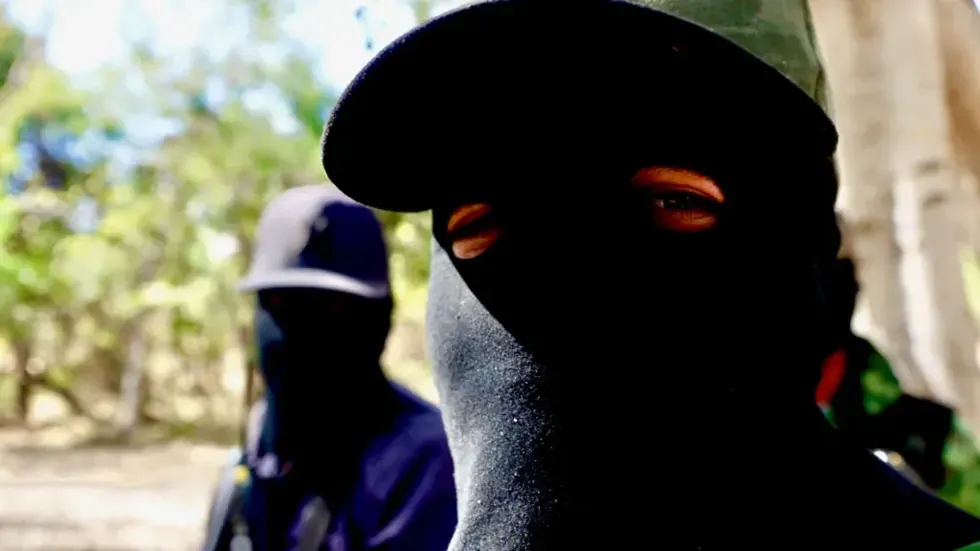
In interviews with members of one cartel faction, masked gunmen argued that the conflict would only end when one side prevails. They expressed little expectation of a negotiated peace and suggested that government intervention merely prolongs the struggle.
One member acknowledged that innocent people, including children, have been killed. Another predicted the violence would continue until a single faction dominates.
Such views highlight the limits of state authority in areas where criminal groups wield significant firepower and resources. They also underscore the human cost borne by civilians caught between rival armed actors.
The Disappeared
Beyond the visible toll of shootings lies another crisis: disappearances.
Reynalda Pulido has been searching for her son, who went missing in 2020. She now leads a collective of mothers who comb fields and vacant lots for clandestine graves. Accompanied by armed escorts for protection, the group uses metal rods and shovels to probe the earth for signs of human remains.
Pulido said she draws strength from solidarity with other families. While recent searches have not yielded new discoveries, the group says it has located hundreds of remains over the years, as well as some missing people found alive.
Disappearances have become a defining feature of Mexico’s security crisis. National registries count tens of thousands of missing persons, many believed linked to organized crime.
The Economics of Fentanyl
The violence in Sinaloa is closely tied to the fentanyl trade. Producers interviewed in cartel-controlled areas described packaging kilogram quantities of powdered fentanyl for shipment north. Prices vary depending on destination, with higher returns reported in major U.S. cities.
Traffickers say enforcement pressure sometimes forces temporary slowdowns, but they insist production resumes once scrutiny eases or operations shift location. The business model is adaptable, they argue, as long as demand persists.
Mexican authorities maintain they are making progress, citing seizures and arrests. Officials have said fentanyl flows to the United States have been reduced, though U.S. agencies continue to report significant quantities entering the country.
Political Pressure
In Mexico City, President Claudia Sheinbaum has attributed the spike in violence in Sinaloa to internal cartel conflict. She has said the government’s priority is to protect civilians while confronting criminal groups.
The challenge is acute. High-profile arrests or killings of cartel leaders can disrupt command structures, but they can also create power vacuums. Security analysts note that fragmentation often leads to short-term surges in violence as rivals compete for territory and revenue streams.
Caught in the Crossfire
On a recent evening in downtown Culiacán, paramedics responded to another shooting. Two men lay wounded on the pavement, both bystanders struck during an exchange of gunfire. Soldiers established a perimeter around the hospital where they were taken, fearing further attack.
Both men survived — a rare outcome in recent months, according to the paramedics who treated them.
Afterward, Torres and Vega removed their bloodstained gloves and paused for a cigarette. For them, the rhythm of emergency calls continues, shaped by a conflict that shows few signs of resolution.
For residents of Culiacán, daily life now unfolds against a backdrop of uncertainty. The fear, as Torres put it, is constant — and in a fractured cartel landscape, peace remains elusive.
Source: BBC – ‘Fear is everywhere’: BBC reports from Mexican city turned into war zone by drug cartel feud