DUBAI, United Arab Emirates (Journos News) – At least 544 people have been killed in a sweeping crackdown on nationwide protests in Iran, according to activist groups, as demonstrations entered their third week amid a near-total information blackout. Iranian officials warned that U.S. and Israeli forces would be considered “legitimate targets” if Washington intervenes to protect demonstrators.
The figures were reported by the U.S.-based Human Rights Activists News Agency (HRANA), which said more than 10,600 people have been detained since protests erupted late last month. Iranian authorities have not released comprehensive casualty figures, and independent verification has been hampered by severe internet and communications restrictions.
Rising toll amid information blackout
HRANA said 496 of those killed were protesters, while 48 were members of Iran’s security forces. The group relies on a network of sources inside the country and has previously provided tallies that broadly aligned with later assessments during past unrest. The Associated Press said it could not independently confirm the numbers, citing limited access and the communications shutdown.

Iranian officials have not acknowledged an overall death toll. State media have instead focused on funerals for slain security personnel and reports of violence attributed to demonstrators.
Rights advocates and Iranian activists abroad say the blackout has made it increasingly difficult to track events on the ground and may be encouraging a harsher response by security forces. Despite the risks, demonstrations were reported again on Sunday in Tehran and other major cities.
Tehran issues warning to Washington and Israel
Iran’s strongest warning came from Parliament Speaker Mohammad Baqer Qalibaf, a hard-line figure who has previously run for president. Speaking in parliament, Qalibaf said U.S. military assets and Israel would be targeted if Iran were attacked.
“In the event of an attack on Iran, both the occupied territory and all American military centers, bases and ships in the region will be our legitimate targets,” he said, using Iran’s standard terminology for Israel. He added that Iran would not wait for an attack but would respond to “any objective signs of a threat.”
Lawmakers chanted anti-American slogans during the session, according to state-linked footage.
Any decision to escalate militarily would ultimately rest with Supreme Leader Ayatollah Ali Khamenei, 86, who has the final say on security and foreign policy matters. Iran’s air defenses were heavily damaged during a brief but intense conflict with Israel earlier this year, complicating assessments of Tehran’s current military posture.
U.S. weighs response as tensions grow
U.S. President Donald Trump said his administration was reviewing a range of options in response to the unrest and Iran’s warnings. Speaking to reporters, Trump said the military was examining “very strong options” and warned Tehran against retaliation.
“If they do that, we will hit them at levels that they’ve never been hit before,” he said, without providing details.
U.S. officials, speaking on condition of anonymity, said potential measures under discussion included cyber operations and possible strikes by U.S. or Israeli forces. The Pentagon has said U.S. forces in the Middle East are positioned to defend American personnel, allies and interests.
Iran previously targeted U.S. forces at Al Udeid Air Base in Qatar in June, while the U.S. Navy’s Fifth Fleet is based in Bahrain, underscoring the regional stakes of any escalation.
International reactions and calls for restraint
Israel is closely monitoring developments, according to an Israeli official not authorized to speak publicly. Prime Minister Benjamin Netanyahu discussed Iran with U.S. Secretary of State Marco Rubio, the official said.
Netanyahu praised what he described as the courage of Iranian citizens, remarks consistent with his long-standing opposition to Iran’s leadership.
International concern has also grown. At the Vatican, Pope Leo XIV referred to Iran as a place “where ongoing tensions continue to claim many lives,” urging dialogue and peace. The United Nations said Secretary-General António Guterres was “shocked” by reports of deadly violence against protesters and called on Iranian authorities to exercise restraint and restore communications.
Solidarity demonstrations were held in several international capitals, reflecting broader alarm over the situation inside Iran.
Protests persist in major cities
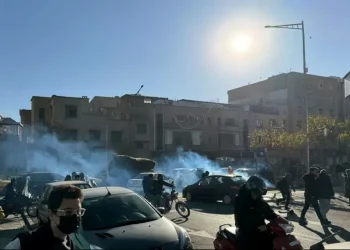
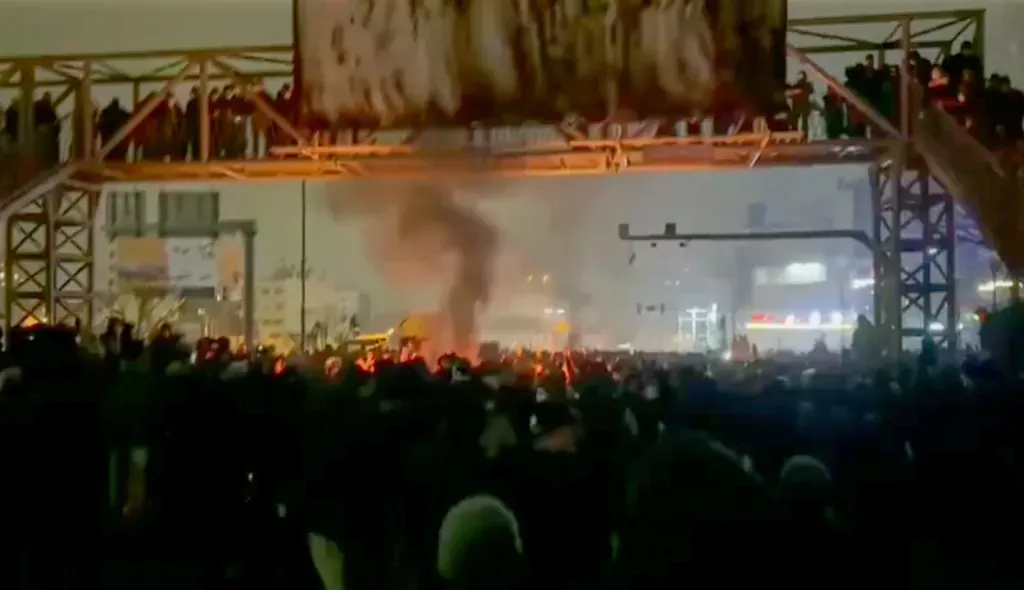
Despite the heavy security presence, videos shared online — some believed to have been transmitted via Starlink satellite connections — appeared to show protesters gathering in northern Tehran’s Punak neighborhood. Demonstrators were seen waving illuminated mobile phones, banging metal objects and setting off fireworks as security forces restricted access to surrounding streets.
HRANA said protests in the capital had become “scattered, short-lived, and fluid,” an apparent tactic to reduce the risk of mass arrests. The group reported the use of surveillance drones and significant security force movements around protest areas.
Footage from Mashhad, Iran’s second-largest city, appeared to show confrontations between protesters and security forces. Smaller demonstrations were also reported in cities including Kerman.
Iranian state television sought to project calm, airing live reports from selected cities showing quiet streets, though Tehran and Mashhad were notably absent from the broadcasts.
Government rhetoric hardens
Senior officials have increasingly framed the unrest as violent and externally driven. Ali Larijani, a senior security official, accused some demonstrators of acts he compared to those of the Islamic State group.
State media reported additional deaths among security forces in provinces including Kermanshah, Fars and North Khorasan, broadcasting images of coffins and morgue scenes. Such coverage has contrasted sharply with the absence of official data on civilian casualties.
President Masoud Pezeshkian, a reformist who had initially signaled openness to dialogue, struck a firmer tone in a televised interview. While acknowledging public grievances, he said authorities could not allow what he described as rioters to “destroy the entire society.”
Economic roots and political challenge
The protests began on Dec. 28 following the collapse of Iran’s rial, which has fallen to more than 1.4 million to the U.S. dollar amid deepening economic pressure. International sanctions linked to Iran’s nuclear program have contributed to inflation, unemployment and declining living standards.
What started as economic demonstrations quickly evolved into broader political protests, with chants and slogans directly challenging Iran’s clerical leadership. Analysts say the scale and persistence of the unrest mark one of the most serious domestic challenges faced by the Islamic Republic in recent years.
This article was rewritten by JournosNews.com based on verified reporting from trusted sources. The content has been independently reviewed, fact-checked, and edited for accuracy, neutrality, tone, and global readability in accordance with Google News and AdSense standards.
All opinions, quotes, or statements from contributors, experts, or sourced organizations do not necessarily reflect the views of JournosNews.com. JournosNews.com maintains full editorial independence from any external funders, sponsors, or organizations.
Stay informed with JournosNews.com — your trusted source for verified global reporting and in-depth analysis. Follow us on Google News, BlueSky, and X for real-time updates.