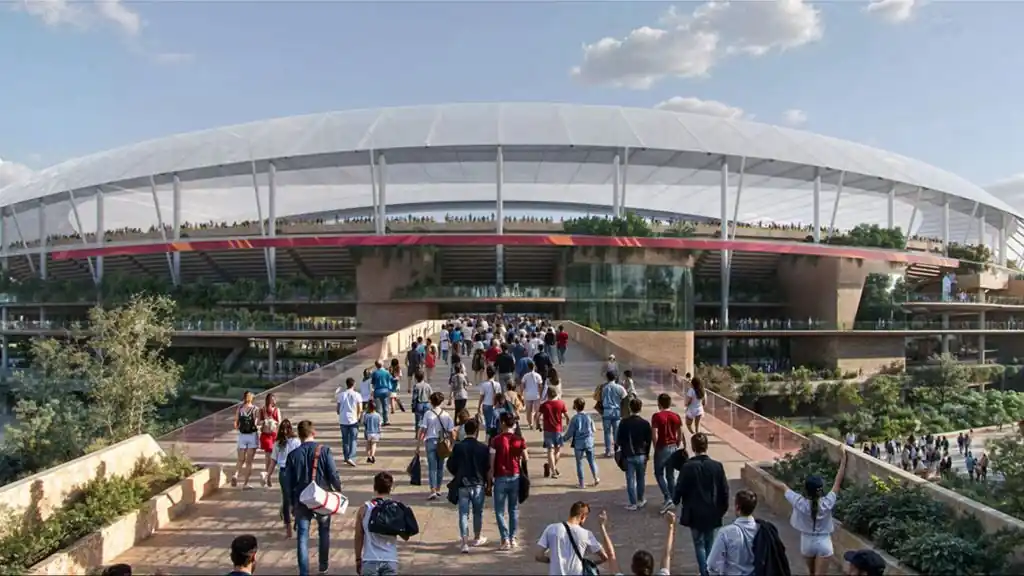
Brisbane, Australia (Journos News) – Brisbane officials have unveiled designs for a new 63,000-seat Olympic stadium intended to host the opening and closing ceremonies of the 2032 Games, along with athletics and Paralympic events. The proposal, announced by the Queensland state government on Monday, would see the stadium built inside Victoria Park, a large heritage-listed green space just north of the city center.
The winning design, selected through an international competition, draws inspiration from traditional “Queenslander” homes, a style familiar to many Australians and popularized internationally through the Brisbane-set children’s television series Bluey. Renderings show a stadium wrapped by a raised, walkable platform evoking the wide verandas typical of the housing style, designed to encourage airflow and outdoor use in Brisbane’s subtropical climate.
State authorities say the venue is central to delivering a coherent Olympic plan after years of uncertainty over where key events should be staged. Yet the decision to pursue a brand-new stadium — after previous assurances that existing venues would be upgraded instead — has drawn criticism from conservation groups, community activists, and Indigenous organizations.

Victoria Park and local opposition
Victoria Park spans about 158 acres and was reopened as a public park in 2021, after operating for decades as a golf course. While government representatives argue the land has already been heavily altered, opponents say its recent return to public use makes preservation even more important.
Campaign group Save Victoria Park condemned the newly released images as “greenwashed computer imagery,” arguing they understate the scale of disruption the project would cause. The group says early government assessments suggest the stadium footprint would cover around 12% to 13% of the park, but independent research commissioned by sustainability researcher Dr. Neil Peach estimates that construction impacts could affect far more land.
According to Peach’s report, as much as two-thirds of the park could be damaged during construction, with more than 1,200 trees potentially removed. The state government has not endorsed those figures.
Andrea Lunt, a spokesperson for Save Victoria Park, said the design visuals misrepresent the project’s real impact. She argued that claims of minimal disruption overlook the ecological and historical value of the existing landscape.
She said the park already offers a rare, open green space close to Brisbane’s central business district, adding that once developed, the land cannot be restored to its current condition.
Government response and political tensions
At a press conference following the announcement, Stephen Conry, chair of the Games Independent Infrastructure and Coordination Authority (GIICA), rejected claims that the stadium would undermine access to green space. He said the project would “maximize the use of the parkland,” allowing hundreds of thousands of people to move through and enjoy the area year-round.
Queensland Deputy Premier Jarrod Bleijie took a more confrontational tone, dismissing critics as “nimbys” opposed to any form of development. He pointed to the site’s history as a golf course and, before that, a landfill, arguing it has not functioned as an untouched natural space for much of the past century.
The remarks underscored how politically sensitive the issue has become. Brisbane was awarded the 2032 Olympics in 2021, receiving an unusually long lead time of more than a decade to prepare. Initial plans focused on redeveloping the Gabba, the city’s main cricket stadium, but ballooning costs and public criticism prompted a review.
That review, released in 2023, recommended abandoning the Gabba upgrade in favor of constructing a new stadium at Victoria Park, with an estimated cost of 3.4 billion Australian dollars, or about $2.3 billion. The proposal was initially rejected by then-Premier Steven Miles and criticized by current Premier David Crisafulli while he was in opposition.
Since taking office, Crisafulli has backed the Victoria Park plan after a further government review endorsed it, marking a significant reversal that has fueled claims of broken election promises.
Indigenous heritage concerns
Beyond environmental issues, the stadium proposal has raised alarms among Indigenous groups, who say Victoria Park — known traditionally as Barrambin — holds deep cultural and historical significance.
In August, the Yagara Magandjin Aboriginal Corporation applied for permanent legal protection of the site through the federal government. The group says the area was used by Aboriginal communities for thousands of years before colonization, and may contain ancient trees, cultural artifacts, and ancestral remains.
Gaja Kerry Charlton, a Yagarabul elder and spokesperson for the group, said there were serious concerns about irreversible harm to sacred land and ecosystems. He said the community felt a responsibility to protect the site for future generations.
The architects behind the winning design, Australian firms Cox Architecture and Hassell, say they have engaged an Indigenous-owned consultancy, Blaklash, to guide consultation with Traditional Owners. Cox Architecture director Richard Coulson said meaningful engagement would now begin in earnest following the firm’s appointment.
Brisbane Olympic stadium design and legacy planning
The design team brings extensive experience in major sporting venues. Cox Architecture and Hassell previously collaborated on Perth’s Optus Stadium and the redevelopment of Adelaide Oval. They are working alongside Japanese firm Azusa Sekkei, which has delivered more than 100 sports facilities worldwide, including the Japan National Stadium used for the Tokyo 2020 Olympics.
Hassell managing principal Lucy O’Driscoll said the design aims to reflect Queensland’s climate and lifestyle, particularly through open, shaded spaces that blur the line between indoors and outdoors. She described the stadium as intentionally “breathing,” relying less on enclosed structures and more on passive cooling.
Legacy use has been a key focus, as Olympic host cities increasingly seek to avoid underused “white elephant” venues after the Games conclude. The Brisbane stadium is planned to become the home ground for the Brisbane Lions Australian rules football team, as well as two local cricket teams. Both sports use oval-shaped fields similar in scale to an athletics track, making conversion simpler than in cities where stadiums must be heavily reconfigured.
Coulson said this compatibility would allow the venue to transition quickly from Olympic mode to everyday use, reducing the risk of long-term underutilization.
Construction is expected to begin later this year, with completion targeted for 2031, one year before the Games. Save Victoria Park says it will continue campaigning against the project while federal authorities review applications for permanent protection of the site. The group has announced plans for a public protest later this month.
This article was rewritten by JournosNews.com based on verified reporting from trusted sources. The content has been independently reviewed, fact-checked, and edited for accuracy, neutrality, tone, and global readability in accordance with Google News and AdSense standards.
All opinions, quotes, or statements from contributors, experts, or sourced organizations do not necessarily reflect the views of JournosNews.com. JournosNews.com maintains full editorial independence from any external funders, sponsors, or organizations.
Stay informed with JournosNews.com — your trusted source for verified global reporting and in-depth analysis. Follow us on Google News, BlueSky, and X for real-time updates.