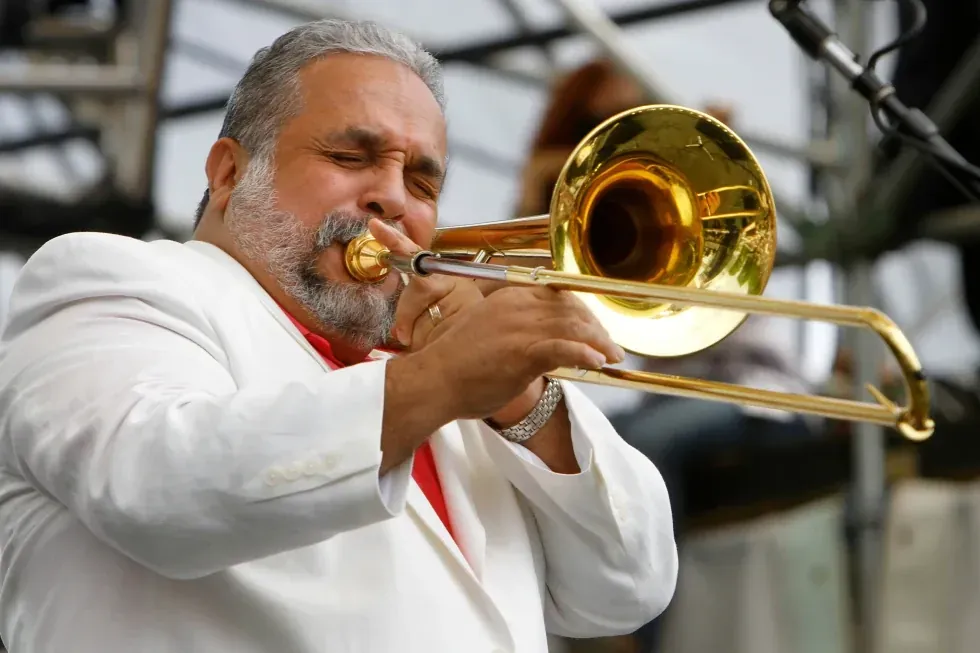
Willie Colón, the Grammy-nominated trombonist and composer widely credited with shaping the sound and social voice of urban salsa, has died at the age of 75. His family and manager confirmed his death on Saturday through social media statements.
Across a career spanning more than five decades, Colón helped redefine Latin music in New York and beyond, blending Caribbean traditions with the rhythms and politics of city life. His recordings sold more than 30 million copies worldwide, and his influence extended well beyond the dance floor into civil rights advocacy and public service.
Colón’s manager, Pietro Carlos, described him as an artist who “expanded” and “politicized” salsa, bringing it to new audiences and stages. Tributes quickly followed from musicians and cultural figures across the Americas, including longtime collaborator Rubén Blades, who wrote on X that he had confirmed “what I was reluctant to believe” and offered condolences to Colón’s family.

A defining voice in salsa’s evolution
Born in the Bronx borough of New York City, Colón was raised by his grandmother and aunt, who immersed him in Puerto Rican musical traditions. From an early age he absorbed the sounds of Cuban son, tango and other Latin American forms that would later shape his compositions.
He began playing music at 11, moving from flute and brass instruments to the trombone. The instrument became his signature after he heard Barry Rogers perform on “Dolores,” a recording associated with Mon Rivera and Joe Cotto. In a 2011 interview with the Colombian newspaper El Tiempo, Colón recalled being struck by the trombone’s raw power and deciding immediately that he wanted to master it.
At 17, he joined the roster of Fania Records, the New York label founded by Jerry Masucci and Johnny Pacheco that played a central role in popularizing salsa globally. Through Fania and its touring ensemble, the Fania All Stars, Colón helped define a brassy, hard-edged sound that mirrored the experience of Latino communities in the city during the 1960s and 1970s.
His work stood out for its fusion of styles. He wove jazz, rock, funk, soul and R&B into traditional forms such as son, mambo, cha-cha-cha and guaracha, while incorporating Puerto Rican genres including bomba and plena. The result was music that resonated both culturally and politically, reflecting the realities of migration, poverty and identity in urban America.
‘Siembra’ and socially conscious salsa
Colón’s partnership with Rubén Blades proved especially influential. Their 1978 album “Siembra” is widely regarded as one of the best-selling salsa recordings of all time and marked a high point for socially conscious Latin music. Songs from that collaboration addressed issues ranging from inequality to displacement, expanding salsa’s lyrical scope.
■ Related News




Among the songs associated with Colón are “El gran varón,” “Sin poderte hablar,” “Casanova,” “Amor verdad” and “Oh, qué será.” Over his career, he received 10 Grammy nominations and one Latin Grammy nomination. In 2004, the Latin Recording Academy honored him with a lifetime achievement award recognizing his contributions to music.
Colón also collaborated across genres, working with artists such as Celia Cruz and David Byrne, reflecting his openness to experimentation and cross-cultural exchange. That willingness to bridge scenes and sounds helped position salsa as part of a broader global music conversation.
Activism and public life
Beyond music, Colón was active in civic and political causes. He supported civil rights initiatives in the United States and worked with organizations including the Hispanic Arts Association, the Latino Commission on AIDS and the Congressional Hispanic Caucus Institute.
In 1991, he received the Chubb Fellowship from Yale University, an honor recognizing public service. Previous recipients have included figures from across the political spectrum.
Colón served as a special assistant to David Dinkins, New York City’s first Black mayor, and later advised Mayor Michael Bloomberg. His own electoral ambitions were less successful: he lost a 1994 Democratic primary challenge to then-Representative Eliot Engel and finished third in the 2001 Democratic primary for New York City public advocate.
His political positions sometimes drew controversy. He supported Hillary Clinton during the 2008 presidential race but later said he voted for Donald Trump in 2016. He also publicly criticized Venezuela’s late president Hugo Chávez on social media, prompting debate among fans.
Colón’s long friendship with Blades fractured after a legal dispute related to a 2003 anniversary concert in Puerto Rico marking 25 years since “Siembra.” The disagreement underscored the personal and professional tensions that can accompany even the most celebrated artistic partnerships.
Screen appearances and later years
In addition to recording and touring, Colón appeared in films including “Vigilante,” “The Last Fight” and “It Could Happen to You,” and on television series such as “Miami Vice” and “Demasiado Corazón.” In recent years, he made a cameo in the music video for “NuevaYol” by Bad Bunny, a nod to his enduring influence on younger generations of Latin artists.
Colón is survived by his wife and four sons.
His death closes a chapter in the history of salsa that began in the barrios of New York and grew into a global cultural force. For many listeners, his trombone came to symbolize both the roots and the restless evolution of Latin music in the modern era.
Source: AP News – Willie Colón, architect of urban salsa music, dies at 75