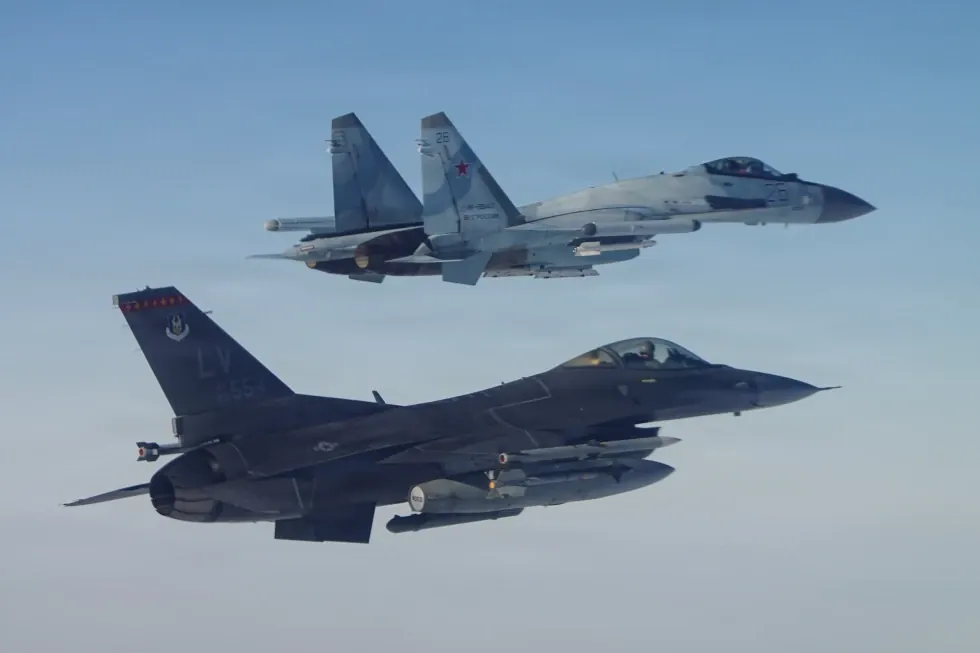
ANCHORAGE, Alaska (Journos News) – The North American Aerospace Defense Command (NORAD) said it intercepted five Russian military aircraft operating in international airspace near Alaska this week, underscoring the routine yet sensitive nature of air activity in the Arctic region.
The Russian aircraft did not enter United States or Canadian sovereign airspace and were not considered a threat, according to a statement released Friday. Still, the episode reflects the steady tempo of aerial operations around the Alaskan Air Defense Identification Zone, an area of strategic importance linking the Pacific and Arctic.
The Arctic has become an increasingly active theater for military aviation, as global powers maintain long-range patrols and test readiness without breaching territorial boundaries. Officials emphasized that Thursday’s intercept followed established protocols and was not viewed as provocative.

Russian aircraft tracked near Bering Strait
According to NORAD, the formation consisted of two Tu-95 strategic bombers, two Su-35 fighter jets and one A-50 airborne early warning aircraft. The planes were detected and tracked on Thursday as they operated near the Bering Strait, the narrow waterway separating Alaska from Russia’s Far East.
The Bering Strait, approximately 50 miles (80 kilometers) wide at its narrowest point, connects the Pacific Ocean to the Arctic and marks one of the shortest distances between the United States and Russia. Aircraft flying in the region often pass through the Alaskan Air Defense Identification Zone (ADIZ), where identification is required for national security purposes.
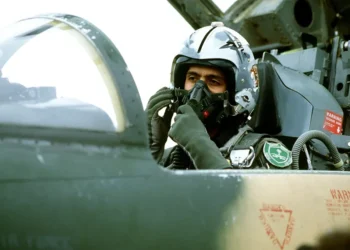
NORAD said it launched two F-16s, two F-35s, one E-3 airborne warning and control aircraft, and four KC-135 refueling tankers in response. The U.S. aircraft identified and escorted the Russian planes until they left the area.
In its statement, NORAD said the Russian military aircraft “remained in international airspace and did not enter American or Canadian sovereign airspace,” adding that such activity “occurs regularly and is not seen as a threat.”
What is NORAD?
North American Aerospace Defense Command is a joint U.S.-Canadian military command responsible for aerospace warning, aerospace control and maritime warning for North America. It uses a layered network of satellites, ground-based radars, airborne early warning aircraft and fighter jets to monitor activity approaching the continent.
■ Related News



Headquartered at Peterson Space Force Base in Colorado, NORAD maintains forward operations in Alaska at Joint Base Elmendorf-Richardson. The Alaska-based units are often the first to respond to aircraft entering the ADIZ from the Pacific or Arctic approaches.
Air Defense Identification Zones are not sovereign airspace. Instead, they extend beyond national boundaries to provide early warning time against potential threats. Aircraft entering the zone are expected to identify themselves and file flight plans consistent with international aviation practices.
Routine but closely watched activity
Russian long-range aviation patrols near North America are not new. Moscow has for decades conducted bomber and reconnaissance flights in international airspace, particularly in the Arctic and North Pacific regions. Western militaries typically shadow such flights to maintain situational awareness and demonstrate readiness.
Defense analysts note that while these intercepts are routine, they carry symbolic weight, especially during periods of geopolitical tension. The aircraft involved — notably the Tu-95, a long-range strategic bomber first introduced during the Cold War — remain central to Russia’s visible power-projection missions.
NORAD emphasized that Thursday’s operation followed standard procedures. Detection relied on a combination of satellite surveillance, ground-based radar and airborne tracking assets. Fighter aircraft were dispatched to visually identify the approaching planes, a common step in intercept missions.
Officials did not provide additional operational details, but the command reiterated that the Russian aircraft’s presence did not constitute a violation of international law.
Strategic significance of the Arctic corridor
The airspace near Alaska has taken on renewed strategic relevance as Arctic sea routes gradually become more navigable due to climate change. The region’s geography places Alaska at the front line of North American air defense, particularly for aircraft traveling between Eurasia and North America.
Military planners from multiple nations view the Arctic as an arena where surveillance, deterrence and signaling intersect. While such intercepts are frequent, public confirmation serves to reinforce transparency and demonstrate vigilance.
For residents of Alaska, these episodes rarely disrupt daily life. However, they offer a reminder of the state’s unique position at the crossroads of global powers.
NORAD said it “remains ready to employ a number of response options” to defend North America, while reiterating that Thursday’s encounter was consistent with longstanding patterns of Russian aerial activity near the ADIZ.
Source: AP News – NORAD intercepts 5 Russian aircraft near Alaska, though military says there was no threat