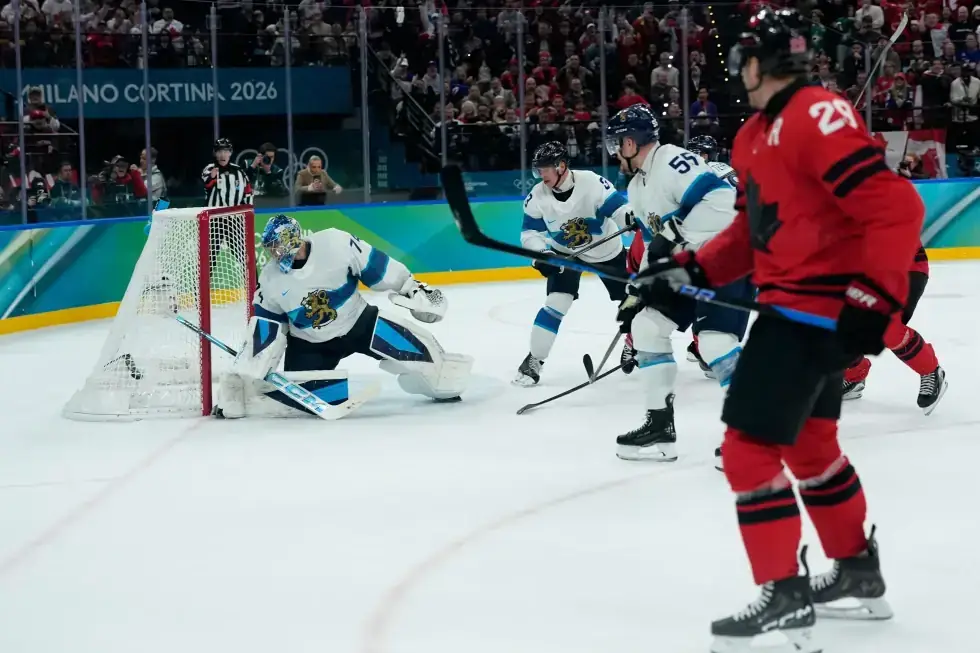
MILAN (Journos News) – Canada will play for Olympic gold after a late power-play strike from Nathan MacKinnon sealed a 3-2 semifinal victory over Finland in Milan on Friday night, capping a composed comeback by a roster stacked with NHL talent.
The Canadians, who had not trailed during group play, found themselves down by two goals early in the second period. Yet there was little sign of anxiety on the bench. Instead, Canada methodically increased pressure, outshooting Finland 31-8 over the final two periods and overturning the deficit in the closing stages.
The result moves Canada into Sunday’s gold-medal game and preserves the possibility of a North American final should the United States advance from the other semifinal.

MacKinnon delivers in final minute
With 35.2 seconds remaining in regulation, MacKinnon redirected a cross-ice pass from Connor McDavid on the power play, finding a narrow opening short side past Finnish goaltender Juuse Saros. The play survived a video review after Finland challenged for offside, confirming Canada’s late breakthrough.
“It was a five-man effort,” MacKinnon said, crediting McDavid’s pass and the traffic created in front of the net.
McDavid, wearing the captain’s “C” in the absence of the injured Sidney Crosby, assisted on two goals. His performance set a record for the most points by an NHL player at a single Olympic tournament, with 13.
Canada coach Jon Cooper said the team showed composure despite the early setback. “You could definitely feel the sense of calm,” McDavid added. “We understood we were in a tough spot, and we had to find a way to get out of it.”
Momentum turns after Finland’s early control
Finland opened the scoring and extended its lead when Erik Haula netted a shorthanded goal early in the second period. The Finnish side, known for its structured defensive system, slowed Canada’s transition game and limited space in the neutral zone during the opening stages.
But the momentum began to shift late in the second period when Sam Reinhart deflected a shot from Cale Makar past Saros with 4:40 remaining. The goal cut the deficit to 2-1 and injected urgency into Canada’s attack.
Shea Theodore tied the game midway through the third period with a long-range effort through traffic, following a net-front scramble involving Brad Marchand and Haula. From there, the pressure rarely relented.
Canada’s ability to sustain offensive zone time was evident in the shot totals. Finland managed only nine shots combined across the second and third periods, compared to Canada’s sustained barrage. While Saros kept Finland within reach, the weight of chances eventually proved decisive.
Leadership and depth on display
Canada’s comeback came without Crosby, who left Wednesday’s quarterfinal with an apparent right knee injury. Cooper said a decision on Crosby’s availability for the final would be made closer to game time.
Even without their long-time captain, Canada leaned on experience and depth. McDavid assumed leadership responsibilities, while younger players also played prominent roles.
Nineteen-year-old Macklin Celebrini, the youngest player on Canada’s roster, registered eight shots on goal, nearly matching Finland’s total over the final two periods combined. His willingness to shoot disrupted Finland’s defensive structure and created second-chance opportunities.
“We’re a deep team with leaders all up and down the lineup,” McDavid said. “It doesn’t matter who’s wearing the ‘C.’ Everybody can play a big role.”
The semifinal marked the second consecutive game in which Canada rallied from behind, having also faced adversity in the quarterfinals against Czechia. Players said those earlier tests may have contributed to the composed response against Finland.
Gold-medal matchup awaits
The victory sets up Canada’s appearance in Sunday’s gold-medal game, where it could face the United States if the Americans overcome Slovakia in the second semifinal.
An all-North American final would echo last year’s 4 Nations Face-Off championship meeting between Canada and the United States, renewing one of international hockey’s most closely watched rivalries. However, Canada’s focus remains on recovery and preparation after a physically demanding semifinal.
For Finland, the defeat ends a disciplined tournament run highlighted by structured team defense and strong goaltending. Saros, in particular, delivered a resilient performance despite the late outcome.
For Canada, the message after Friday’s rally was clear: patience and depth remain its defining strengths. Against an opponent built on structure and precision, Canada relied on composure and high-end execution at critical moments — enough to extend its pursuit of Olympic gold.
Source: AP News – Nathan MacKinnon scores late as Canada beats Finland to reach the Olympic gold-medal game