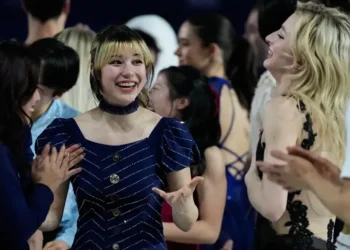
MILAN (Journos News) – Alysa Liu’s Olympic moment unfolded with both precision and personality. After completing a near-flawless free skate inside the Milano Ice Skating Arena, the 20-year-old American delivered a spontaneous, jubilant exclamation into a television camera — a burst of emotion that captured the significance of the night.
With a total of 226.79 points, Liu secured the Olympic women’s singles title at the Milan-Cortina Winter Games, becoming the first American woman in 24 years to win figure skating gold. The victory ended a drought stretching back to the 2002 Salt Lake City Olympics, when Sarah Hughes claimed the top podium spot.
For Liu, the achievement marked not only a personal triumph but also a milestone for U.S. figure skating.

Her path to Olympic gold has been anything but linear. Once hailed as a prodigy and the youngest U.S. champion at age 13, Liu stepped away from the sport after finishing sixth at the Beijing Olympics. Burned out and searching for balance, she retired, spending time traveling and enrolling at the University of California, Los Angeles, where she studied psychology.
That pause reshaped her relationship with skating. When she eventually returned to competition, it was on her own terms — with renewed perspective and a calmer approach to expectations. “Everything in general has led me to this point,” Liu said after her win.
A performance under pressure
Liu skated last among the contenders and appeared at ease even during warmups, smiling and waving toward friends and family in the stands. Her free skate, set to Donna Summer’s rendition of “MacArthur Park,” opened with a confident triple flip and built momentum throughout. She completed her elements cleanly, finishing with composure as the music faded and the crowd rose in applause.
Her score held firm as competitors attempted to surpass it.
Japan’s Kaori Sakamoto, a three-time world champion and bronze medalist at the Beijing Olympics, delivered a strong performance but finished second with 224.90 points. Seventeen-year-old Ami Nakai took bronze, underscoring Japan’s continued strength in women’s skating.
■ Related News




Sakamoto, who has indicated this will be her final competitive season, expressed disappointment afterward, saying she had hoped to end her Olympic career with gold.
The United States also saw a strong showing from Amber Glenn, who rebounded from a difficult short program to deliver a season-best free skate. Her total of 214.91 points briefly placed her in the leader’s chair and ultimately secured a fifth-place finish. Glenn later reflected on Liu’s comeback story, noting the broader message it could send about mental health and stepping back when needed.
“It’s OK to take time,” Glenn said.
A broader context for U.S. figure skating
Liu’s victory is significant in historical terms. Since Hughes’ win in 2002, American women had struggled to reclaim Olympic dominance in a discipline long marked by intense international competition. The sport has evolved technically and artistically over the past two decades, with rising standards for jump difficulty and program components.
Liu herself contributed to that evolution. Before her temporary retirement, she became known for attempting technically ambitious elements at a young age. Her return, however, has emphasized balance as much as difficulty.
Earlier in the Milan-Cortina Games, Liu and Glenn helped the United States secure gold in the team event, giving Liu two gold medals at a single Olympics. The dual success reinforces a resurgence for American figure skating on the global stage.
Russian skater Adeliia Petrosian, competing as a neutral athlete, attempted the only quadruple jump of the women’s competition but fell on her quad toe loop. Though she skated cleanly otherwise, the lost points left her narrowly behind Glenn. Japan’s Mone Chiba briefly overtook Glenn before Liu’s decisive skate closed the competition.
Growth beyond medals
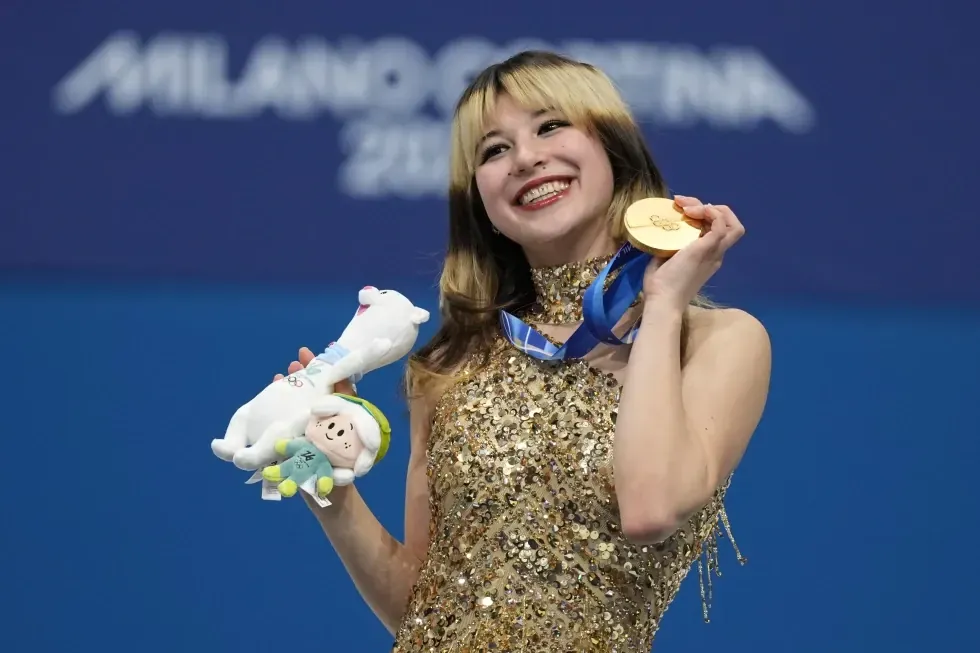
Liu’s gold medal, draped over a glittering dress accented with gold sequins, symbolized the culmination of years marked by early acclaim, pressure and self-discovery. Her hairstyle — streaked with gold meant to resemble tree rings — reflected a theme of growth she has spoken about openly.
After retiring, Liu climbed to the base camp of Mount Everest and explored interests outside skating. She has described that period as formative, helping her reconnect with the sport from a healthier perspective.
“I don’t need this,” Liu said of the medal. “What I needed was the stage.”
Her words suggested that the performance itself — and the ability to skate freely — carried as much weight as the podium finish. Even had the jumps gone differently, she said, she would have considered the moment meaningful.
For U.S. figure skating, however, the result is clear. The Olympic gold ends a 24-year wait and signals the arrival of a champion who has already experienced both the heights of early success and the complexities of stepping away.
In Milan, Alysa Liu returned not just to competition, but to the top of it.
Source: AP News – Alysa Liu dazzles to win figure skating gold, ending a 24-year Olympic drought for US women