Ash Wednesday marks the beginning of Lent for Catholics and many other Christians, initiating a 40-day period of fasting, reflection and penitence. This year, its observance falls within days of Ramadan, Islam’s month of fasting and prayer — a calendar overlap that invites comparison between two of the world’s most prominent religious seasons.
While the rituals differ in theology and structure, both periods foreground restraint, introspection and communal identity. The convergence is not uncommon. Because both Easter and Ramadan are calculated using lunar elements, their observances periodically align. The overlap underscores how major religious traditions structure time around cycles of spiritual discipline, even as their doctrinal foundations diverge.
The comparison raises broader questions about how modern religious communities adapt ancient practices — and how fasting seasons function not only as theological observances but as social institutions shaping behavior, commerce and public life.

The Meaning of Ash Wednesday
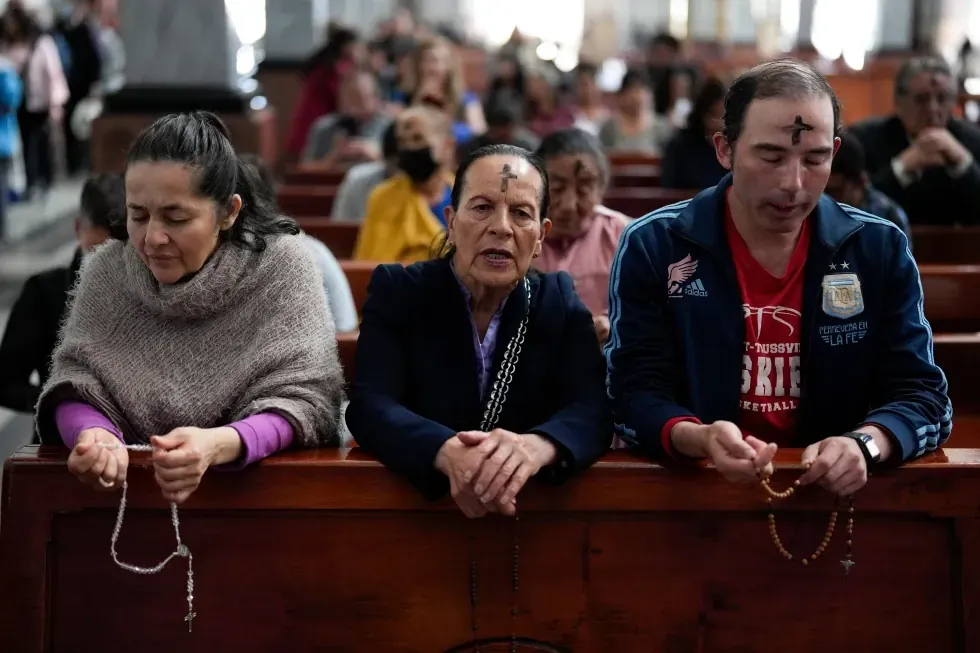
Ash Wednesday signals the formal beginning of Lent in Western Christianity. In churches across traditions — particularly within the Roman Catholic Church and mainline Protestant denominations such as the Episcopal and Lutheran churches — worshippers receive ashes, often traced in the shape of a cross on the forehead. Clergy typically recite phrases drawn from scripture: “Remember that you are dust, and to dust you shall return,” or “Repent and believe in the Gospel.”
The ritual emphasizes mortality, repentance and humility. According to reporting by the BBC and the Associated Press, Ash Wednesday is observed by hundreds of millions of Christians worldwide, though the degree of liturgical emphasis varies by denomination.
For Roman Catholics aged 18 to 59, Ash Wednesday is designated as an obligatory fast day, meaning one full meal and two smaller meals that do not equal a second full portion. The discipline extends through the Lenten season, with abstinence from meat on Fridays. Fish is traditionally permitted, giving rise in the United States to parish fish fries that combine religious observance with communal gathering.
Lent as Structured Discipline
Lent lasts 40 days, excluding Sundays, culminating in Easter — the commemoration of Jesus’ crucifixion and resurrection. The number 40 carries biblical symbolism, echoing the 40 days Jesus fasted in the wilderness, as well as earlier scriptural narratives of testing and purification.
Yet the practice is not uniform. Western churches count backward from Easter to determine the start of Lent, while Eastern Orthodox Christians follow a different calculation. The Eastern Orthodox Church begins Great Lent on Clean Monday, a distinct liturgical starting point that does not include the imposition of ashes.
■ Related News




Orthodox Easter (Pascha) is typically observed later than Western Easter due to differences in calendar calculations rooted in early church history. These variations highlight how even within Christianity, fasting traditions reflect institutional evolution and theological nuance.
The modern Lenten experience also illustrates adaptation. In recent years, some Episcopal churches have offered “Ashes to Go” at commuter stations or public spaces — a practice noted by the Reuters as part of broader efforts to meet congregants outside traditional worship settings. The shift suggests that while the symbolism remains ancient, the delivery mechanisms evolve with social rhythms.
Ramadan: A Parallel Season of Fasting
Ramadan, observed by Muslims worldwide, involves fasting from dawn to sunset each day for roughly a lunar month. The fast includes abstention from food and drink during daylight hours and emphasizes prayer, charitable giving and recitation of the Qur’an.
Unlike Lent’s selective fasting days, Ramadan requires daily abstinence for the entire month from sunrise to sunset. The obligation applies to adult Muslims, with exemptions for illness, travel, pregnancy and other circumstances. According to the Pew Research Center, Ramadan observance remains one of the most widely practiced pillars of Islam globally.
The structural difference is notable. Lent blends fasting with symbolic self-denial — many Christians choose to “give up” particular habits such as sweets or social media — while Ramadan prescribes a uniform daily fast. Both, however, emphasize spiritual purification and renewed focus.
Calendar mechanics also create periodic overlaps. Easter is determined by the first Sunday after the first full moon following the spring equinox, a formula dating to early church councils. Ramadan follows the Islamic lunar calendar, which shifts roughly 10–11 days earlier each year relative to the Gregorian calendar. As a result, their proximity varies over decades.
Communal Identity and Public Expression
Beyond theology, fasting seasons shape public life. In the United States, parish fish fries during Lent have become both cultural and fundraising events, blending religious identity with civic community. In Muslim-majority countries, Ramadan often alters working hours, business rhythms and media programming.
Such practices illustrate how fasting extends beyond private devotion. It organizes social time and reinforces collective belonging. Reporting from the Financial Times has noted that Ramadan can influence consumer spending patterns and economic activity, particularly in retail and food sectors, while Lenten observances in Western contexts may have subtler commercial effects.
The comparison also reveals different relationships to secularization. In largely secular Western societies, Ash Wednesday observance is visible but not structurally embedded in civic scheduling. Ramadan, in contrast, shapes public policy and institutional timetables in several Muslim-majority states.
Adaptation in a Digital Era
Religious leaders across traditions have increasingly acknowledged how modern lifestyles intersect with ancient disciplines. During Lent, many Christians now cite reducing screen time or limiting social media as contemporary forms of ascetic practice. Similarly, digital platforms broadcast nightly Ramadan prayers, extending communal participation beyond physical mosques.
These developments point to a broader trend: fasting seasons serve as adaptable frameworks rather than rigid relics. Their endurance may lie in their flexibility — the ability to preserve symbolic meaning while accommodating social change.
Convergence Without Equivalence
Despite calendar overlap, Lent and Ramadan are not interchangeable experiences. Their theological premises differ: Lent centers on preparation for Easter and the commemoration of Christ’s passion and resurrection; Ramadan commemorates the revelation of the Qur’an to the Prophet Muhammad.
The duration, daily structure and legal obligations also diverge. Yet both seasons emphasize discipline, charity and introspection. They function as annual recalibrations, inviting adherents to reassess priorities and deepen spiritual focus.
The coexistence of these observances within the same week underscores the pluralistic religious landscape of the modern world. Rather than signaling convergence of doctrine, the overlap highlights parallel structures within distinct traditions — each shaped by centuries of interpretation, adaptation and communal practice.
As religious calendars continue to intersect in an increasingly interconnected global society, the comparison between Ash Wednesday and Ramadan offers insight into how faith communities navigate continuity and change. The rituals differ, but the underlying impulse — structured reflection within a shared calendar — remains a durable feature of religious life.
Source: AP News – Ash Wednesday marks the start of Lent, a period of fasting, reflection — and fish fries